
Cryphalus fulvus
Cryphalus fulvus
Description
How to identify
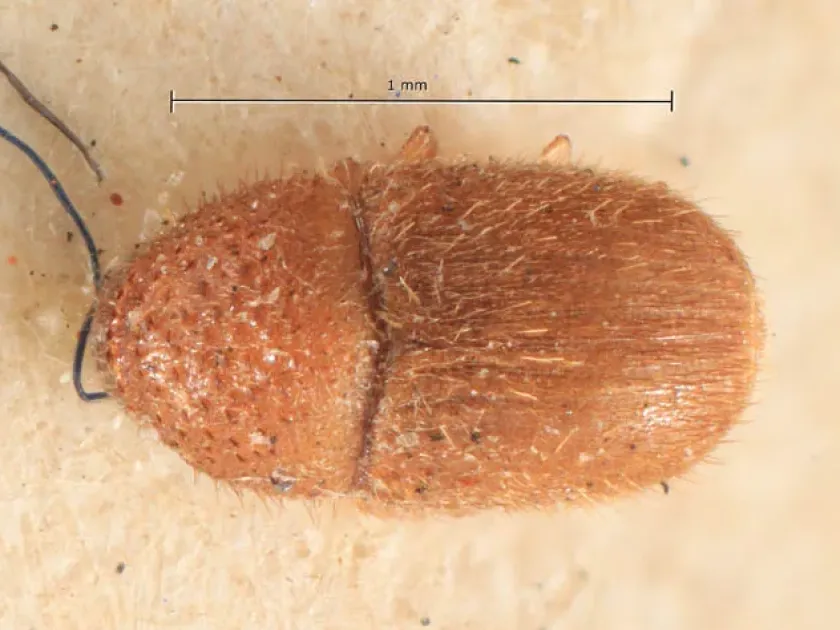
Cryphalus fulvus is a small beetle belonging to the Curculionidae family and the Scolytinae subfamily. These insects are known as bark beetles and typically measure between 1.5 and 2 millimeters in length.
The beetle has a cylindrical body shape and displays a reddish-brown or yellowish-brown coloration. Its elytra are covered with fine scales and hairs, which help in distinguishing it from other species.
The head of the insect is retracted into the pronotum, a common morphological trait for many bark beetles. The antennae have a club-shaped end, which is essential for their sensory activities.
Larvae are white, legless, and have a darkened head capsule. They spend their entire life cycle protected under the bark of host trees, making them difficult to spot during the early stages of infestation.
Entomologists identify this species by examining the specific patterns of its galleries and its preference for certain conifer species during its reproductive phase.
What it damages
Cryphalus fulvus is a specialized pest that primarily targets coniferous trees. It is particularly known for infesting young spruce trees, as well as some pine and fir species.
The beetle typically chooses weakened or stressed trees, often those suffering from drought, poor soil conditions, or recent transplantation shock, as hosts for their offspring.
The damage is caused by both adults and larvae feeding on the phloem layer beneath the bark. This feeding activity disrupts the flow of nutrients, causing portions of the tree to wither and die.
Heavy infestations can lead to the mortality of young trees, which is a major concern in nurseries and young forest plantations where the loss of seedlings can be significant.
Furthermore, the physical damage to the bark facilitates the entry of pathogenic fungi, which further weakens the tree's health and accelerates its decline.
When it appears
The activity of Cryphalus fulvus begins in the spring when ambient temperatures consistently rise above 15 degrees Celsius, signaling the start of the growing season.
Adult beetles emerge to find new host trees during the peak of the sap flow season, which makes the trees more vulnerable and provides the necessary resources for egg-laying.
Mating and gallery formation occur primarily during the months of May and June. Females create tunnels under the bark to deposit eggs into specialized niches.
Larval development takes place throughout the summer months. Under favorable warm and humid conditions, the species typically completes one generation per year.
As autumn temperatures drop, the young adult beetles seek refuge for overwintering, often remaining inside the host tree bark or migrating to the forest litter until spring.
Signs of infestation
The presence of the pest is first signaled by the appearance of minute entrance holes on the bark, accompanied by fine wood powder known as frass.
Over time, the needles on infested branches lose their vitality, changing color from vibrant green to yellow and eventually reddish-brown before falling off completely.
Peeling away the bark reveals a network of galleries beneath the surface. These larval tunnels radiate from the main mating chamber and are diagnostic of a bark beetle infestation.
Trees may attempt to defend themselves by producing resin, resulting in visible resin drops on the trunk. However, in cases of severe infestation, this defense is usually ineffective.
- Minute holes in the bark surface.
- Presence of frass near the base or on branch crevices.
- Progressive needle discoloration and needle drop.
Control measures
The most effective management approach involves strict forest hygiene, including the prompt removal and destruction of infested trees before the next generation of beetles emerges.
Pheromone traps serve as an excellent monitoring tool for foresters and nursery managers, allowing them to track population levels and time potential insecticide applications accurately.
In ornamental garden settings, systemic or contact insecticides can be applied to the bark during the adult flight period to prevent new colonizations on high-value trees.
Cultural practices such as proper irrigation, fertilization, and site maintenance are crucial to keeping trees healthy and resistant to beetle attacks.
Biological control, which includes protecting natural predators like woodpeckers and parasitic wasps, plays a vital role in maintaining the beetle population at manageable levels.
Taxonomy
- Latin name
- Cryphalus fulvus
- Order
- Coleoptera (beetles)
- Family
- Curculionidae
- EPPO code
- CRYHFU
Discussion
No discussions yet — be the first.