
Loquat bark beetle
Cryphalus eriobotryae
Description
How to identify
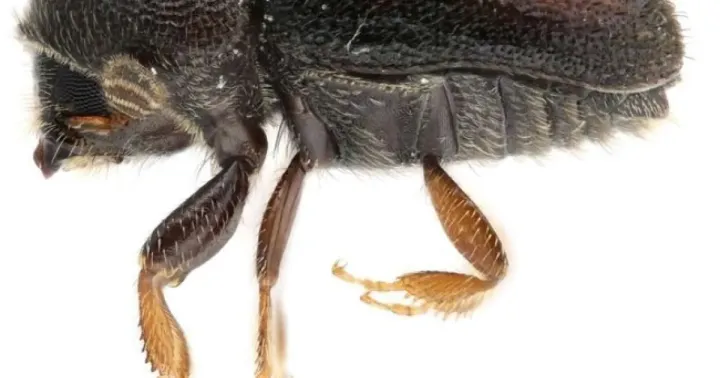
The loquat bark beetle, scientifically known as Cryphalus eriobotryae, is a member of the Curculionidae family and the Scolytinae subfamily. These insects are extremely small, typically measuring between 1.5 and 2 millimeters in length.
The adult beetle has a cylindrical body shape and is characterized by a dark brown or black coloration. Their elytra are covered with dense, short setae, which assist them in navigating and anchoring within their excavated tunnels.
Larvae are legless, white in color, and possess a distinct yellowish head capsule. They spend their entire developmental period hidden beneath the bark, feeding on the tree's inner tissues.
Adult beetles are capable of flight, which facilitates their spread between trees, particularly targeting those already weakened by environmental stress or poor health.
They establish complex gallery systems within the cambium and xylem layers, which serve both as living space and a food source for the developing larvae.
What it damages
While primarily associated with loquat trees (Eriobotrya japonica), these beetles can also infest other Rosaceae species if the trees are under physiological stress.
The primary damage occurs when beetles and larvae disrupt the vascular tissues, effectively cutting off the flow of nutrients and water to specific branches or twigs.
This disruption causes the affected branches to wither and die back. In severe infestations, the entire structural integrity of the tree may be compromised.
The tunnels created by the beetles act as entry points for various fungal and bacterial pathogens, which further exacerbate the health decline of the host tree.
Repeated or chronic infestations significantly reduce the tree's vigor, leading to poor fruit set and potential long-term mortality of the specimen.
When it appears
Adult beetle activity typically begins in the early spring as temperatures rise, signaling the emergence from overwintering sites in bark or wood debris.
The life cycle can involve multiple generations per year, with activity peaking during the warm growing season when trees are in active stages of growth.
Hot and dry periods are particularly favorable for bark beetle expansion, as such weather often stresses trees, making them more attractive to the insects.
During the autumn, the beetles prepare for the winter months, retreating into deeper, more protected areas within the tree structure to survive the cold.
Mass flight events are often observed during periods of high humidity and moderate temperatures, which trigger the search for new host trees.
Signs of infestation
The most visible indicator of an infestation is the presence of tiny, circular entry holes on the surface of the bark, often resembling pinpricks.
Accumulated fine wood dust, commonly known as "frass" or "boring dust," can often be found near these entry points or in the forks of branches below the holes.
Premature yellowing, wilting, and subsequent browning of leaves on specific branches are classic symptoms of the vascular disruption caused by the beetle galleries.
In some cases, the tree may exhibit localized sap exudation at the entry sites, which is an unsuccessful defensive mechanism against the burrowing beetles.
- Entry holes on branches and stems.
- Accumulation of fine wood dust.
- Flagging (wilting of branch tips).
- Bark cracking or premature peeling around infected areas.
Control measures
Sanitation is the most effective management tool; all heavily infested branches must be pruned and burned immediately to prevent the spread to healthy parts of the tree.
Good orchard management practices, such as consistent irrigation and balanced fertilization, are crucial to maintain tree health and resilience against potential beetle attacks.
Contact insecticides applied during the peak flight period can protect trees by preventing adults from successfully boring into the bark surface.
Using pheromone traps helps monitor population levels and timing, allowing orchardists to apply control measures exactly when they are most needed.
For persistent or severe infestations, systemic insecticides may be employed to reach and eliminate the larvae developing within the tree tissues.
Taxonomy
- Latin name
- Cryphalus eriobotryae
- Order
- Coleoptera (beetles)
- Family
- Curculionidae
- EPPO code
- CRYHER
Discussion
No discussions yet — be the first.