
Spruce bark beetle
Cryphalus dilutus
Description
How to identify
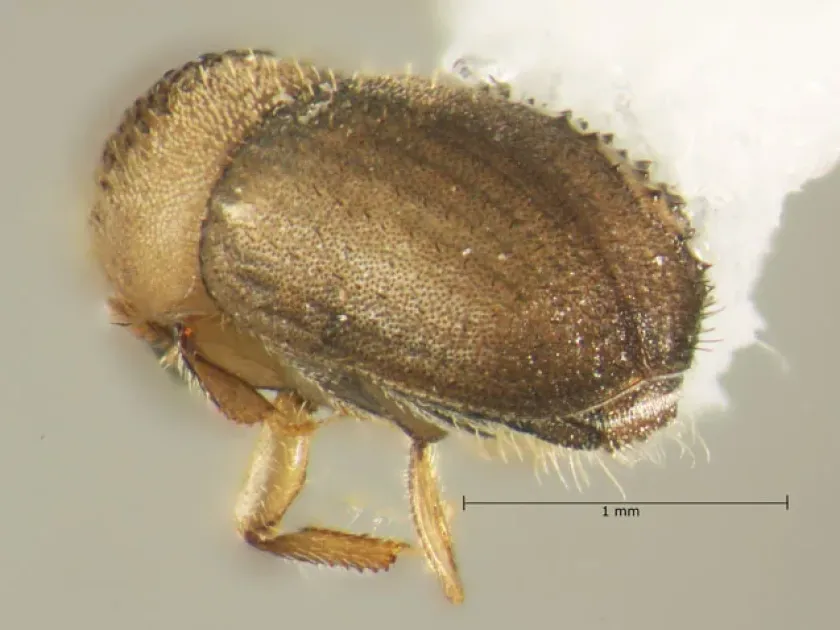
The spruce bark beetle (Cryphalus dilutus) is a tiny insect belonging to the Curculionidae family, subfamily Scolytinae. Adult beetles are typically 1.5 to 2 mm long.
Their bodies are cylindrical and dark brown or black, covered with fine hairs that give them a slightly dull appearance compared to other bark beetle species.
Larvae are legless, white grubs with a distinct brown head. They live exclusively under the bark, where they develop and complete their life cycle.
Distinguishing this species from other related beetles is difficult for the untrained eye and often requires microscopic examination of the beetle's morphology.
Being cryptic insects, they spend most of their lives hidden inside the host tree, making visual identification of the pest itself rare during routine inspections.
What it damages
This pest primary targets Norway spruce (Picea abies). It favors stressed, dying, or wind-thrown trees, as well as the thinner branches of healthy specimens.
The damage is caused by both adults and larvae feeding on the phloem (inner bark), which disrupts the flow of nutrients and water, eventually killing the branch or tree.
In cases of high infestation, the spruce bark beetle can cause significant decline in young plantations and ornamental hedges if left untreated.
Urban trees are particularly susceptible because environmental stressors, such as pollution and soil compaction, weaken their natural defense mechanisms against borers.
The beetle's galleries also create entry points for pathogenic fungi, which further degrade the wood and accelerate the decline of the host conifer.
When it appears
Adult beetles emerge in early spring once temperatures consistently reach approximately 15 degrees Celsius, signaling the start of the breeding season.
Depending on local climate conditions, the species may complete one or two generations per year, with peak activity occurring during the mid-summer months.
As autumn approaches and temperatures drop, adults seek overwintering sites, often within the bark of infested trees or in the leaf litter at the base.
The speed of development is highly temperature-dependent, meaning warmer summers can lead to faster life cycles and increased populations of the pest.
The beetle remains inactive during the cold winter months, surviving in a state of diapause until the return of warmer spring weather triggers emergence.
Signs of infestation
The most visible sign of infestation is the presence of "frass" (bore dust), which looks like fine reddish sawdust collecting near the base or on branch crotches.
Needle yellowing and browning on individual branches are clear indicators that the vascular system of the branch is compromised by larval feeding.
Resin flow (pitching) may appear on the bark surface as the tree attempts to push out invading beetles or seal off the entrance holes.
Peeling back a small section of bark reveals intricate galleries etched into the wood, confirming the presence of the beetle and its progeny.
- Reddish bore dust at the base of the tree.
- Premature yellowing or browning of needles.
- Resin spots on the bark surface.
- Evidence of gallery patterns under the bark.
Control measures
Sanitation is the most effective management tool: removing and destroying infested branches or entire trees prevents the beetle from spreading to healthy neighbors.
Maintaining tree vigor through proper watering, mulching, and fertilization helps the tree generate enough resin to defend itself against beetle attacks.
Chemical control using systemic insecticides can be applied during the flight period to protect high-value ornamental trees from colonization.
Monitoring the population using pheromone-baited traps provides early warning signs and can help reduce adult numbers in controlled environments.
Regular visual inspections of spruce trees during the spring and summer are essential to detect early symptoms before a full-scale infestation occurs.
Taxonomy
- Latin name
- Cryphalus dilutus
- Order
- Coleoptera (beetles)
- Family
- Curculionidae
- EPPO code
- CRYHDI
Discussion
No discussions yet — be the first.