
Fir bark beetle
Cryphalus abietis
Description
How to identify
The Fir bark beetle (Cryphalus abietis) belongs to the order Coleoptera and the family Curculionidae, subfamily Scolytinae.
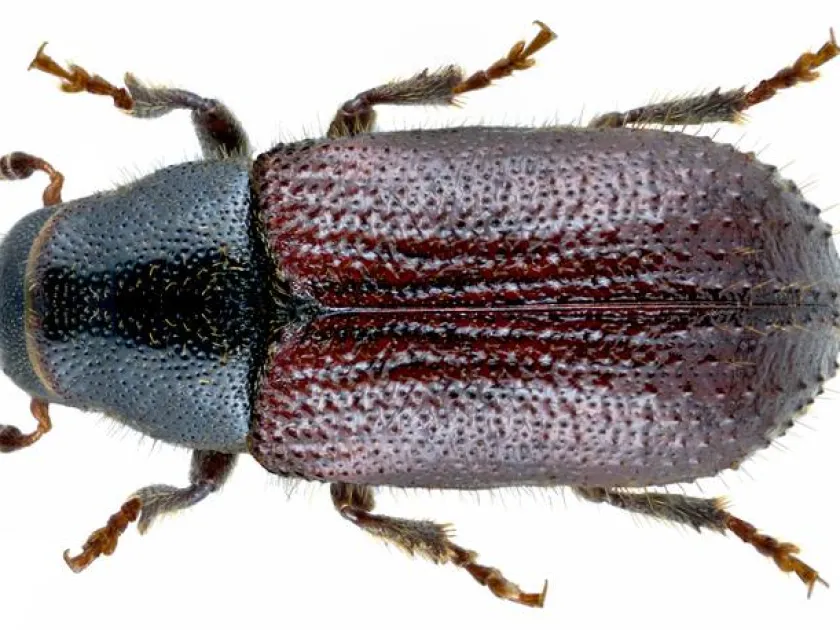
It is a tiny insect, with adult beetles measuring approximately 1.2 to 1.6 mm in length, making them difficult to spot without close inspection.
The body is cylindrical and dark brown to black, covered with fine, dense hairs which provide a matte appearance to the insect's surface.
Larvae are legless, white-colored grubs with a yellowish head capsule, specifically adapted to live and feed within the inner bark tissues.
These beetles are primarily found in temperate forests where they target specific coniferous hosts, playing a complex role in the ecosystem.
What it damages
The primary host for this species is the European silver fir, although it frequently attacks Norway spruce and other conifer varieties.
The beetles target younger trees or the thinner bark areas of mature trees, causing structural damage to the cambium layer.
By excavating galleries beneath the bark, the larvae interrupt the flow of nutrients and water, eventually leading to branch dieback.
Under favorable conditions, such as drought or physical tree injury, beetle populations can explode, causing severe degradation to the tree crown.
In nursery settings, the Fir bark beetle acts as a significant economic pest, potentially leading to the loss of entire batches of young conifers.
When it appears
The activity of the Fir bark beetle is highly dependent on ambient temperatures, typically beginning in the mid-to-late spring.
Adult beetles emerge from their overwintering sites to seek out suitable host material for mating and egg-laying during the warmer months.
The larval stage develops throughout the summer, with the larvae actively feeding on the phloem and cambium during this period.
Pupation occurs in late summer or early autumn, resulting in a new generation of adults that prepare for the winter period.
Overwintering takes place primarily in the bark of the host tree, where adults remain protected from harsh winter elements until spring arrives.
Signs of infestation
One of the earliest signs of an infestation is the accumulation of frass, or fine wood dust, which gathers near entry holes in the bark.
Affected foliage typically begins to yellow and eventually turns brown, as the branch distal to the damage loses its functional transport system.
Exposing the inner bark reveals intricate gallery patterns created by the female beetles and their larvae, which are diagnostic for this species.
Small, inconspicuous entry holes are visible upon careful examination of the bark, often found in clusters or along weaker branches.
Deterioration of the tree's overall vigor, manifested by wilting needles and branch mortality, indicates a progressed stage of colonization.
Control measures
Sanitation is the most critical management tactic; removal and destruction of infested branches or trees are necessary to prevent population spread.
Maintaining high tree vigor through proper irrigation and soil management is essential to increase natural resistance against colonization.
- Utilizing pheromone-baited traps for monitoring and reducing local beetle populations.
- Applying systemic or contact insecticides during the peak flight period to protect high-value specimen trees.
- Clearing the area of slash and woody debris to minimize available breeding sites for the beetles.
- Encouraging natural predators such as woodpeckers and parasitic wasps that help keep beetle populations in check.
Proactive management and regular inspection of coniferous plantings remain the best defenses against the Fir bark beetle's damaging impact.
Taxonomy
- Latin name
- Cryphalus abietis
- Order
- Coleoptera (beetles)
- Family
- Curculionidae
- EPPO code
- CRYHAB
Discussion
No discussions yet — be the first.