
Japanese pinhole borer
Crossotarsus niponicus
Description
How to identify
The Japanese pinhole borer (Crossotarsus niponicus) belongs to the Curculionidae family, subfamily Scolytinae. This insect is classified as an ambrosia beetle, specialized in penetrating deep into the wood tissue to cultivate fungal gardens.
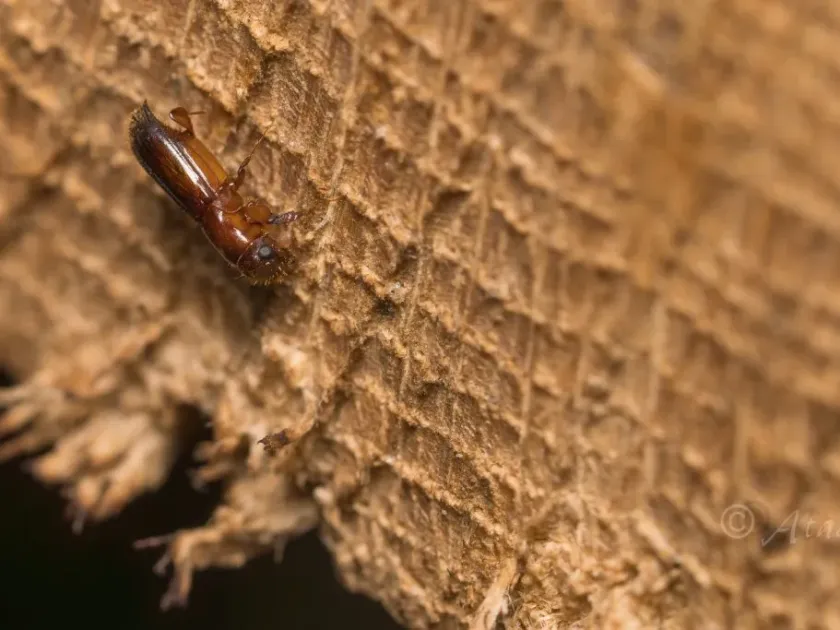
Adults have a cylindrical, elongated body characteristic of the Platypodinae group. The coloration ranges from dark brown to black, allowing them to remain effectively concealed within the wood galleries they excavate.
The larvae are white, legless, and possess well-developed head capsules adapted for chewing through dense wood fibers. Their development occurs entirely within the trunk, making them difficult to detect through visual inspection.
Sexual maturity is reached after the pupal stage. Males and females exhibit morphological differences, often related to the structure of the elytra, which are specialized for pushing wood dust out of the entry holes.
The life cycle is closely linked to symbiotic fungi, which serve as the primary food source for both larvae and adults. The beetle does not digest the wood itself but uses it as a substrate for fungal growth.
##damage##The primary targets for colonization are weakened, dying, or freshly cut coniferous and deciduous trees. The beetle prefers wood with high moisture content, which is typical for recently felled logs.
This insect is a significant concern in the timber industry, where it infests stacks of roundwood. Adequate moisture is a critical factor for the successful establishment of the colony within the log.
Substantial damage is inflicted on the technical quality of the lumber. The galleries bored by the beetles penetrate deep into the sapwood and heartwood, significantly reducing the commercial grade of the timber.
Wood infested by the pinhole borer rapidly loses its structural integrity due to the degradation caused by symbiotic fungi. This results in severe pinholing and characteristic dark staining of the wood fibers.
While in natural forest ecosystems the beetle contributes to the decomposition of deadwood, in commercial forestry and timber storage, its activity is considered a major economic threat.
Signs of infestation
The most visible sign of infestation is the presence of fine wood dust (frass) accumulating at the base of the trunk or in bark crevices. The color of this dust varies depending on the tree species and the stage of wood degradation.
Circular entry holes are visible on the bark or exposed wood, with diameters strictly corresponding to the body size of the beetle. These serve as the main entrance for the colony.
When the trunk is sawn, a network of radial galleries is revealed, often stained dark due to the growth of fungal mycelium. This is commonly referred to as "ambrosia staining" in the wood industry.
Upon removing the bark on infested sections, a complex network of branching tunnels becomes apparent. Unlike many bark beetles, the Japanese pinhole borer penetrates deep into the wood perpendicular to the tree axis.
A faint rustling or clicking sound may occasionally be audible during mass colonization in quiet conditions, although this sign is rarely used for field identification purposes.
Control measures
The primary control method is the prompt processing of freshly harvested timber. Rapid debarking of logs significantly reduces their attractiveness to females searching for sites to lay their eggs.
Storing roundwood under water-spraying systems to maintain high moisture levels can sometimes prevent the wood from drying out, which may reduce the colonization rate, although this is not always effective against all wood borers.
Chemical protection involves spraying timber stacks with contact insecticides. It is critical to perform these treatments immediately after harvest to establish a barrier against beetle penetration.
Sanitary logging and the timely removal of logging residues help to decrease the overall pest population in forest stands. Neglected wood piles often serve as major breeding grounds for the population.
- Deployment of pheromone traps for population monitoring.
- Strict adherence to timber storage duration limits.
- Application of specialized wood preservatives for deep penetration.
Taxonomy
- Latin name
- Crossotarsus niponicus
- Order
- Coleoptera (beetles)
- Family
- Curculionidae
- EPPO code
- CROSNI
Discussion
No discussions yet — be the first.