
Cossonus linearis
Cossonus linearis
Description
How to identify
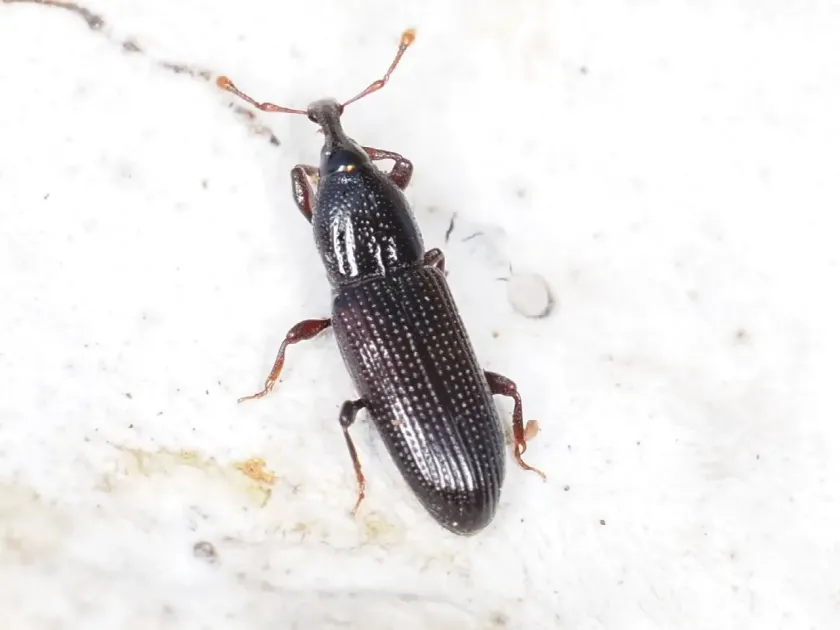
Cossonus linearis is a species of weevil belonging to the Curculionidae family. It is recognized by its elongated, flattened, and narrow body, which is typically dark brown or black in color, adapted for its wood-boring lifestyle.
The adult beetle possesses a relatively short and broad rostrum compared to other weevils. Its geniculate antennae are equipped with a distinct club, which helps the insect navigate the narrow environments it inhabits.
The larvae are apodal (legless), white to yellowish in color, with a sclerotized brownish head capsule. They typically maintain a curved, C-shaped posture while feeding inside the galleries they construct.
This morphological specialization allows both adults and larvae to survive effectively within the wood substrate, providing them with a secure environment against most external environmental threats.
Due to their size and shape, these insects can penetrate deep into the sapwood and heartwood of trees, leaving minimal external signs until significant structural damage occurs.
What it damages
This weevil primarily targets deciduous tree species such as oak, beech, hornbeam, alder, and willow. It generally infests trees that are stressed, dying, or freshly felled.
The larvae are xylophagous, creating numerous winding tunnels within the sapwood. As they mature, these tunnels may penetrate deeper into the denser portions of the stem, compromising the wood's structural integrity.
The economic impact of Cossonus linearis is significant in the timber industry, as infested wood becomes riddled with holes and filled with wood flour, rendering it unsuitable for high-quality carpentry or furniture production.
In natural forest ecosystems, the weevil acts as a decomposer, accelerating the breakdown of fallen logs and dead wood, which contributes to nutrient cycling in the forest floor.
However, in managed stands, heavy infestations often facilitate the introduction of secondary wood-decay fungi, which accelerate the total degradation of the wood and the death of the tree.
When it appears
The flight period for adults usually takes place during the warmer months, typically from May through July, when the beetles actively disperse to find suitable hosts for oviposition.
The life cycle can be quite prolonged, sometimes lasting several years, depending on the temperature and the moisture content of the wood, which is crucial for larval development.
Cossonus linearis strongly prefers humid conditions. Consequently, high infestation rates are often observed in riparian forests, swampy areas, or stored timber that has been kept in damp conditions.
Both adult beetles and late-instar larvae are capable of overwintering, residing safely inside the wood galleries or within the bark layers of the host tree until the return of favorable spring temperatures.
Environmental factors, particularly humidity levels and temperature, are the primary drivers of population outbreaks and the speed of the pest's reproductive cycle.
Signs of infestation
The most reliable sign of an infestation is the presence of small, round emergence holes on the surface of the bark or the exposed wood of the tree trunk.
Accumulations of fine wood dust, often called frass or boring flour, near the base of the tree or within the crevices of the bark are clear indicators of internal larval activity.
A decline in the tree's vigor, characterized by thinning foliage or branch dieback, is frequently associated with internal colonization by this wood-boring pest.
Peeling back the bark often reveals a complex, intricate network of galleries packed with packed frass, which is diagnostic of an active infestation by this species.
The presence of these beetles in stored lumber or log piles is a serious phytosanitary alert, requiring immediate inspection and appropriate treatment to prevent further degradation.
Control measures
The primary control measure involves sanitary logging, where infested or severely weakened trees are removed from the stand before the new generation of adults emerges.
Proper timber storage management is essential; logs should be kept in well-ventilated, dry conditions to reduce the wood moisture content, which discourages colonization by Cossonus linearis.
Chemical control using authorized insecticides may be necessary for protecting high-value timber stocks during storage if biological and cultural controls prove insufficient.
Debarking logs immediately after harvesting is a highly effective cultural practice, as it exposes the vulnerable larvae and disrupts the initial stages of the pest's lifecycle.
- Strict adherence to forest hygiene protocols.
- Encouraging natural predators such as woodpeckers and parasitic wasps.
- Minimizing physical damage to standing trees during logging operations.
Taxonomy
- Latin name
- Cossonus linearis
- Order
- Coleoptera (beetles)
- Family
- Curculionidae
- EPPO code
- COSOLI
Discussion
No discussions yet — be the first.