
Whitefish
Coregonus fera
Description
How to identify
Whitefish (Latin: Coregonus fera) is a freshwater fish species belonging to the family Salmonidae and the order Salmoniformes. It is important to emphasize that this organism is not an agricultural pest but a significant component of aquatic ecosystems.
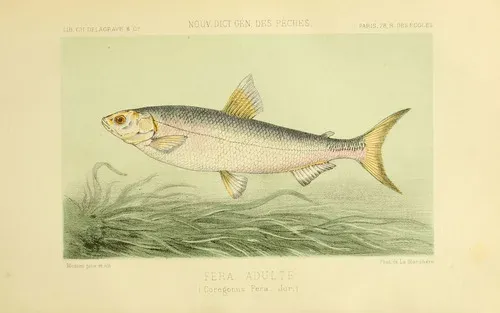
The fish is characterized by a streamlined, silver body and a small adipose fin, which is a distinctive trait of salmonids. In its natural environment, it typically inhabits deep, oxygen-rich lakes.
Taxonomically, the genus Coregonus is known for its high phenotypic plasticity, which makes species classification complex. The whitefish is a pelagic species that thrives in temperate, cold waters.
From an agronomic perspective, this species is completely harmless to any agricultural crops. Its life cycle is strictly aquatic, and it plays a role in the natural trophic chains of freshwater bodies.
Scientific research regarding Coregonus fera is focused on ichthyology and ecology rather than pest control, as the species does not interact with terrestrial plant life.
What it damages
The whitefish does not damage any agricultural crops, as it is strictly a water-dwelling vertebrate. Its diet consists of zooplankton, benthic invertebrates, and larvae that live within the water column.
Because the species does not feed on vegetation, it causes no injury to stems, leaves, roots, or fruits. There is no biological mechanism for this fish to behave as a pest to field or greenhouse crops.
There is no interaction between the whitefish and terrestrial agrocenoses. Therefore, it is categorized as non-threatening to any plant species cultivated for human or animal consumption.
Any perceived impact on agriculture would be purely indirect, such as the potential sensitivity of the fish to water pollution caused by agricultural runoff, making it an ecological indicator species.
In aquaculture or irrigation reservoirs where whitefish might exist, it acts as a beneficial part of the ecosystem, helping to regulate the populations of aquatic organisms without threatening the surrounding crops.
When it appears
The activity level of the whitefish is determined by water temperature and the seasonal changes in the lake's thermal layers. During warmer months, the fish remains in deeper, cooler zones.
Spawning generally occurs in the autumn or winter, depending on environmental conditions. This biological cycle is completely independent of the agricultural seasons or the growth cycles of crops.
The fish does not exhibit any migratory behavior that would bring it into contact with land-based agricultural zones. It remains in its aquatic habitat throughout the entire year.
Whitefish are sensitive to water temperature fluctuations and do not show any "seasonal appearance" that would suggest a pest invasion or agricultural infestation.
Since the life cycle is strictly regulated by aquatic temperature regimes, there is no overlap with the phenological phases of plant development or the planting and harvesting schedules.
Signs of infestation
Signs of whitefish presence are only detectable through ichthyological survey methods, such as sonar monitoring or water quality assessments. They leave no visible marks on land or on crops.
Agricultural fields will never exhibit symptoms of damage associated with this species. There is a complete absence of bite marks, wilting, or tissue destruction that could be attributed to Coregonus fera.
Since the fish is not a phytophagous organism, there are no biological traces such as frass, webs, or feeding patterns on plant materials that a farmer would need to identify.
Presence of the species is purely a matter for freshwater ecology. Monitoring for its presence has no value for crop protection or disease control programs within the agricultural sector.
Lack of any physical symptoms on plants confirms that whitefish is not an object of interest for plant pathology, entomology, or weed science.
Control measures
There are no measures required for plant protection against whitefish, as it is not a pest. Growers should focus on managing actual pests that have a real economic impact on their specific crops.
Applying any pesticides or chemicals to control this fish is strongly discouraged, as it would cause unnecessary environmental destruction and harm a native species without benefiting the crop.
The best practice for managing water resources near agricultural land is to implement sustainable agricultural runoff management to prevent pollution and maintain the natural health of the aquatic ecosystem.
Integrated Pest Management (IPM) protocols do not include this species, as it has zero relevance to crop losses, yield reduction, or the quality of harvestable goods.
- Maintaining water purity in reservoirs.
- Managing agricultural drainage to protect local fauna.
- Focusing control efforts only on proven phytophagous pests.
Taxonomy
- Latin name
- Coregonus fera
- Family
- Salmonidae
- EPPO code
- COEGFE
Discussion
No discussions yet — be the first.