
Castor bean borer
Coptoborus ricini
Description
How to identify
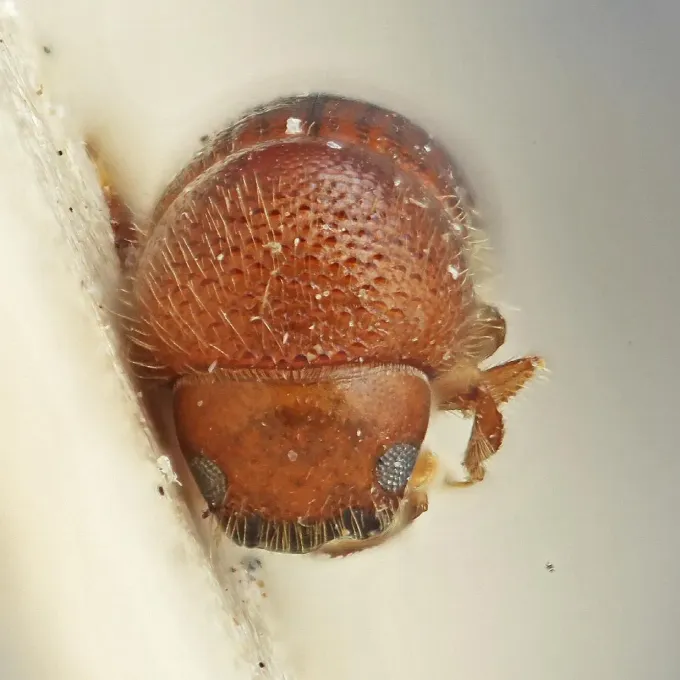
The castor bean borer (Coptoborus ricini) is a small beetle belonging to the Scolytinae subfamily (bark beetles). The adult beetle is cylindrical, typically measuring between 2 to 3 mm in length, and has a dark brown or black coloration.
As a member of the Coleoptera order, this pest has a specialized life cycle. Unlike many bark beetles, it maintains a symbiotic relationship with specific fungi, which it introduces into host plants to serve as food for its larvae.
The larvae are legless, white in color, and have a distinct dark head capsule. They spend their entire development phase inside the stem tissues of the host plant, hidden from external exposure.
Identification is challenging because the pest lives primarily inside the plant structure. Its presence is often confirmed only after structural damage to the host plant becomes visible.
The species is taxonomically distinct due to its specialized feeding habits and its ability to thrive within the tissues of the castor oil plant (Ricinus communis).
What it damages
The castor oil plant is the primary host for this borer. The beetle bores into the plant stem, creating intricate tunnel systems that disrupt the plant's vascular system.
By damaging the xylem and phloem, the borer significantly impairs the transport of water and nutrients. This interference is particularly devastating during the plant's flowering and seed-filling stages.
The tunnels serve as entry points for various pathogenic fungi and bacteria, leading to secondary infections that exacerbate the damage and can cause the plant to decay from the inside.
Mechanical weakening of the stem is a major issue; heavily infested plants are prone to lodging (falling over) due to wind or the weight of the crop, resulting in significant yield losses.
Seed quality is also compromised, as the plant lacks the necessary resources to develop full, oil-rich seeds, leading to a direct economic impact on the harvest.
When it appears
The activity of the castor bean borer is closely tied to climatic conditions. Warm and humid environments are optimal for its development, leading to potentially rapid population growth.
Adult beetles typically emerge and migrate to new host plants during the active vegetative growth phase of the castor oil crop. This period is critical for infestation.
Overwintering occurs primarily within the stalks of host plants left in the field after harvest. This makes the crop residues a crucial factor in the pest's annual cycle.
Depending on the latitude and climate, multiple generations can occur within a single growing season, allowing the pest to build up significant numbers quickly.
Monitoring for the presence of adult beetles during the early stages of crop development is essential for understanding the seasonal pressure of the pest in a specific area.
Signs of infestation
The first indicator of an infestation is the appearance of tiny entry holes on the stem surface, often accompanied by small piles of "frass" or boring dust expelled by the beetles.
Affected plants often display signs of general stress, such as yellowing of the leaves or wilting, which results from the blockage of water and nutrient transport channels.
A cross-section of an infested stem reveals extensive tunnel networks. These tunnels may contain larvae, pupae, or adults, along with fungal mycelium introduced by the beetle.
Increased brittleness and susceptibility to breaking are clear signs of severe infestation. Plants may collapse suddenly, even in the absence of strong winds.
Local necrosis or discoloration around the entry points is common, indicating that the plant is attempting to wall off the damaged tissue, albeit often unsuccessfully.
Control measures
The most effective management strategy is rigorous sanitation. Removing and destroying castor oil crop residues immediately after harvest is vital to eliminate the overwintering sites.
Crop rotation is essential for breaking the pest's life cycle. Planting non-host crops for several years in previously infested fields helps to drastically reduce the local population.
Chemical control can be difficult due to the internal nature of the damage. Systemic insecticides may be effective only when applied at the precise moment of adult emergence, before they bore into the stems.
Healthy crop management, including adequate fertilization and irrigation, helps plants withstand minor damage and maintain productivity despite the presence of the borer.
- Deep plowing to bury infested plant debris.
- Use of pheromone traps to monitor adult beetle flight activity.
- Isolation of new plantings from old, infested fields.
- Application of entomopathogenic fungi as a biological control method.
Taxonomy
- Latin name
- Coptoborus ricini
- Order
- Coleoptera (beetles)
- Family
- Curculionidae
- EPPO code
- COPBRI
Discussion
No discussions yet — be the first.