
Fruit weevil
Conotrachelus setosus
Description
How to identify
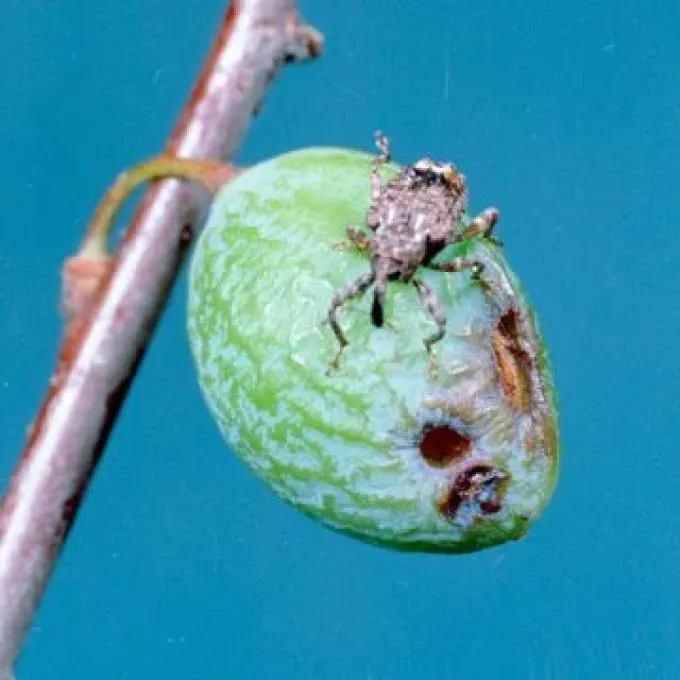
The fruit weevil Conotrachelus setosus belongs to the family Curculionidae within the order Coleoptera. The adult insect is a small beetle characterized by its elongated snout, known as a rostrum.
The beetle's body color is typically brown or greyish with a mottled pattern, providing effective camouflage against tree bark. Its elytra are covered with fine setae, giving it a dull, textured appearance.
Larvae are typically C-shaped, legless, and creamy-white, with a well-developed, dark head capsule. They lead a concealed life, developing within plant tissues to protect themselves from predators.
Adult beetles exhibit a defense mechanism called thanatosis, where they drop to the ground and curl their legs when threatened, making them look like small bits of debris.
Identification often requires careful inspection of morphological features, such as the structure of the antennae and specific patterns on the pronotum, which are best identified by specialists.
What it damages
This pest targets a variety of fruit crops, primarily members of the Rosaceae family. It causes significant economic damage to both stone fruit and pome fruit production.
Adults feed on buds, young leaves, and flowers, weakening the tree early in the season. However, the most severe damage is caused by the larvae, which burrow into developing fruit and ovaries.
Infested ovaries frequently drop prematurely, leading to a substantial decrease in yield. If the fruit remains on the tree, it often becomes deformed and loses all commercial value.
The punctures made by females during egg-laying provide entry points for secondary infections, such as fungal pathogens, which further degrade the fruit quality through decay.
High infestation levels in an orchard can render the entire crop unmarketable, necessitating proactive monitoring and timely intervention strategies for fruit growers.
When it appears
Adult activity begins in early spring, triggered by rising air and soil temperatures. The beetles emerge from overwintering sites to feed on emerging vegetation.
Peak activity coincides with the bud swell, bud burst, and flowering stages of fruit trees. This timeframe is critical as it marks the period of mating and initial egg-laying.
The larval stage occurs throughout the summer, corresponding with the growth and development phases of the fruit. Development duration is heavily influenced by ambient temperature and humidity.
Pupation generally occurs in the soil beneath the canopy. After completing their life cycle, new adults may either emerge or overwinter in the soil until the next season.
Overwintering takes place in protected environments, such as leaf litter, organic debris, or within the upper soil layers, which provide thermal insulation during colder months.
Signs of infestation
The most prominent sign of infestation is the presence of small puncture marks on developing fruit. These sites are often accompanied by sap oozing or dark necrotic spots.
Premature fruit drop is a strong indicator of larval presence. If fallen fruit is sliced open, one can often find larvae or tunnels indicating their recent activity.
During the spring, characteristic shot-hole damage on leaves and buds can be observed, caused by adult beetles feeding prior to egg-laying.
General tree stress, such as stunted shoot growth or wilting of early blossoms, may be a secondary indicator of a heavy infestation within the orchard canopy.
Visual inspection using the beat-sheet method, where branches are shaken over a white fabric, is an effective way to confirm the presence of adult weevils in the tree.
Control measures
Cultural control practices include the regular collection and disposal of fallen fruit, which prevents larvae from entering the soil and completing their life cycle.
Cultivating the soil around the base of trees in autumn and spring helps disrupt the pupal stage and exposes overwintering adults to adverse conditions.
The installation of trunk bands can act as a physical barrier, trapping beetles as they move from their overwintering sites toward the canopy in the spring.
Chemical applications should be timed precisely to match the insect's vulnerability, focusing on the pre-bloom and bloom periods to minimize damage.
- Use selective insecticides according to regional agricultural safety guidelines.
- Encourage natural predators, such as birds and beneficial insects, in the orchard.
- Prune and destroy infested branches during regular orchard maintenance.
Taxonomy
- Latin name
- Conotrachelus setosus
- Order
- Coleoptera (beetles)
- Family
- Curculionidae
- EPPO code
- CONHST
Discussion
No discussions yet — be the first.