
Conotrachelus posticatus
Conotrachelus posticatus
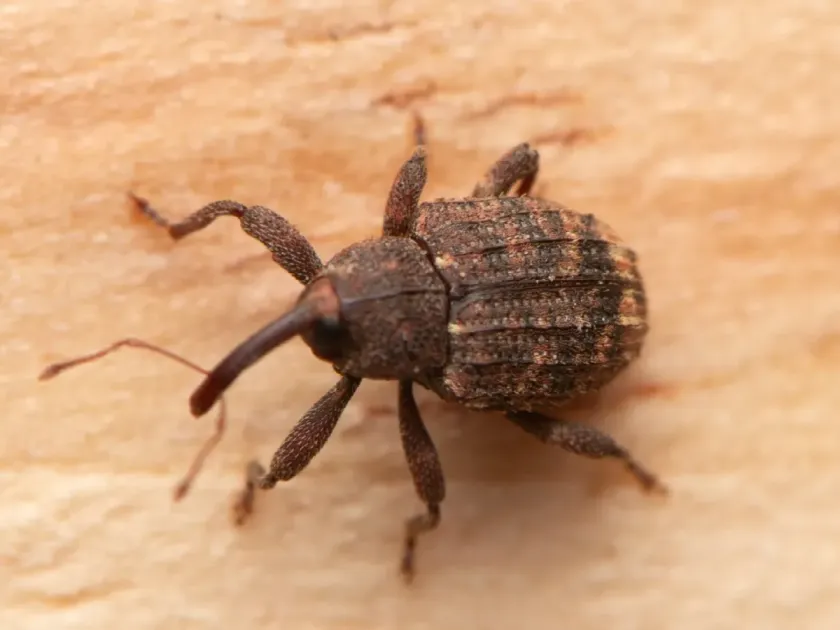
Description
How to identify
Conotrachelus posticatus is a species of weevil belonging to the Curculionidae family. These insects are known for their characteristic long snout or rostrum, which they use to bore into plant tissue for feeding and oviposition.
The adult beetles are typically dark brown or black, often with mottled patterns on their elytra that serve as camouflage against tree bark. Their small size makes them difficult to spot during routine garden inspections.
The larvae are legless, creamy-white grubs with a distinct, hardened brown head capsule. They spend their entire developmental period inside the host fruit, shielded from external environment and predators.
The life cycle is closely linked to the phenology of fruit-bearing trees. Adults are mobile and capable of flight, allowing them to disperse throughout an orchard during the growing season.
Overwintering occurs primarily in the adult stage within soil, leaf litter, or debris at the base of host trees, providing them with protection against cold temperatures.
What it damages
This pest targets a range of fruit-bearing species, with a particular affinity for members of the Rosaceae family. Both stone fruits and pome fruits are susceptible to their activity.
Adults cause damage by feeding on young fruitlets, creating small pits that lead to fruit malformation and early abscission. This thinning effect can significantly impact the overall harvest yield.
Larval feeding inside the fruit destroys the interior pulp, leaving tunnels filled with frass. This degradation ruins the fruit quality and makes the produce unmarketable due to internal decay.
Secondary infections, such as fungal rots, frequently enter through the puncture sites made by the adults or the exit holes of the larvae, leading to rapid fruit spoilage.
Significant infestations can result in total loss of the crop in severely affected areas, making it a serious concern for both commercial orchards and home gardens.
When it appears
Emergence of overwintered adults typically begins in early spring as temperatures rise, usually coinciding with the onset of bud break or flowering of the host trees.
The peak period of activity occurs during fruit set and initial development, as females search for suitable fruits to lay their eggs, which will serve as food for the next generation.
Larval development proceeds within the fruits throughout the summer months. This phase is largely hidden, and signs of damage may not be immediately obvious until the fruit begins to drop.
By late summer and early autumn, the new generation of adults emerges. After a short period of maturation feeding, they seek suitable overwintering sites in the soil or ground cover.
The total duration of the life cycle and the number of generations per year are highly dependent on regional climate conditions, with warmer seasons facilitating more robust populations.
Signs of infestation
The most reliable sign of an infestation is the presence of small, crescent-shaped scars on the surface of young fruits, which are the egg-laying punctures made by the females.
Premature fruit drop is a strong indicator of larval activity. If young fruits are falling in large numbers, it is advisable to cut them open to check for the presence of larvae.
Internally, the fruit will exhibit winding tunnels and decay, often associated with a brownish, powdery substance consisting of larval waste products.
Observing adult beetles on the bark or foliage during evening hours, when they are most active, provides direct evidence of the population's presence in the garden.
Visual identification of deformed, stunted, or prematurely ripening fruits can help growers pinpoint the specific trees or branches that require immediate intervention.
Control measures
The primary cultural control method is the rigorous sanitation of the orchard floor. Collecting and disposing of all fallen fruit prevents the larvae from entering the soil to pupate.
Tilling or cultivating the soil beneath host trees in the autumn or early spring can disrupt the overwintering sites of the adults, exposing them to environmental stress and predators.
Sticky bands applied around the trunks of trees can be an effective mechanical barrier, trapping adults as they climb the trees to feed and lay eggs.
Chemical control involving insecticides should be timed to coincide with the post-bloom period, targeting adults before they can successfully lay eggs within the developing fruits.
Integrated pest management should include the use of biological controls, such as entomopathogenic nematodes applied to the soil, which target the larvae during their pupation phase.
Taxonomy
- Latin name
- Conotrachelus posticatus
- Order
- Coleoptera (beetles)
- Family
- Curculionidae
- EPPO code
- CONHPO
Discussion
No discussions yet — be the first.