
Plum curculio
Conotrachelus nenuphar
Description
How to identify
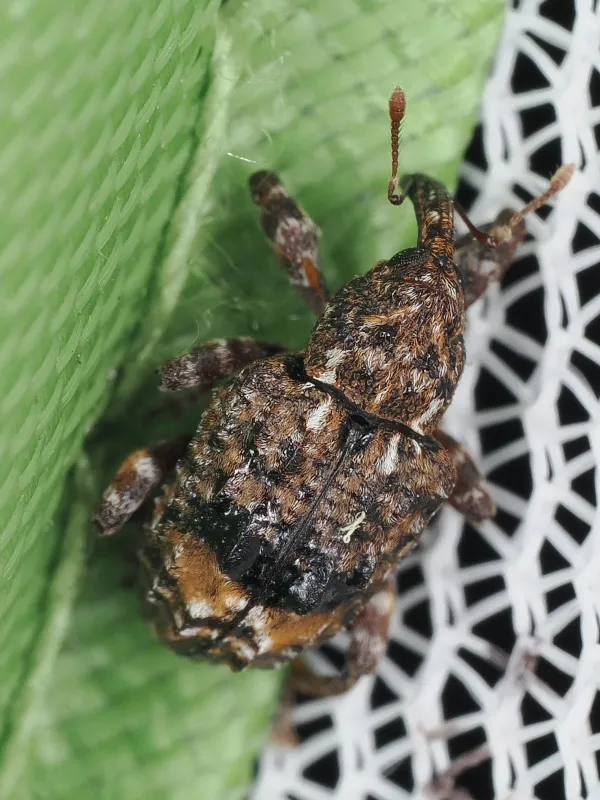
The Plum curculio (Conotrachelus nenuphar) is a destructive snout beetle belonging to the Curculionidae family. Adult beetles are roughly 4–6 mm long, with a dark brown mottled appearance and four distinct humps on their wing covers.
The most defining characteristic is the long, curved snout (rostrum), which the insect uses to feed on foliage and excavate small cavities in fruit for egg-laying. Their coloration provides excellent camouflage against tree bark, making them hard to spot.
When disturbed, these beetles demonstrate a behavior known as "thanatosis," or playing dead. They tuck their legs against their bodies and drop to the ground, blending in with soil debris, which is a key survival mechanism.
The larvae are legless, white, C-shaped grubs with a brown head capsule. They spend their entire developmental phase inside the fruit, reaching up to 10 mm in length before exiting to pupate in the soil.
Adults overwinter in protected areas such as under brush, leaf litter, or in the upper soil layers, emerging in the spring when temperatures begin to rise consistently.
What it damages
This pest affects a wide range of stone fruits, including plums, peaches, nectarines, cherries, and apricots. Pome fruits like apples, pears, and quinces are also susceptible to infestation.
Damage begins early in the season when adults feed on flower buds and young foliage. However, the most severe damage occurs when females cut crescent-shaped slits into developing fruits to deposit their eggs.
The crescent-shaped incision is designed to kill the fruit tissue around the egg, preventing the developing fruit from crushing the egg as it grows. This often leads to fruit deformity and premature drop.
Larvae tunnel through the fruit flesh, feeding specifically on the area surrounding the pit. This activity makes the fruit entirely unmarketable and inedible for consumers.
Furthermore, the physical damage and holes caused by the curculio provide entry points for secondary pathogens, such as brown rot (Monilinia), leading to significant post-harvest losses.
When it appears
Adult emergence typically begins when temperatures exceed 12–15°C. In many regions, this correlates with the green tip or pink bud stage of stone fruit development.
The period of active egg-laying is most intense during the weeks following petal fall. The small, pea-sized fruitlets are highly attractive to female curculios during this vulnerable stage.
Larval development inside the fruit takes about 2 to 3 weeks. Once fully grown, the larvae exit the fruit and burrow into the soil to reach the pupal stage.
Depending on the latitude and climate, the Plum curculio may complete one or two generations per year. Cooler climates generally support a single generation, while warmer regions may experience a second cycle.
Monitoring the orchard during the spring bloom and post-bloom period is critical for accurate timing of control measures to prevent heavy infestations.
Signs of infestation
The most recognizable sign of infestation is the characteristic crescent-shaped scar left on the skin of young fruits. These scars are distinctive and easy to identify upon inspection.
Premature fruit drop, often referred to as "June drop," is a common indication that larvae have finished feeding and have exited the fruit to burrow into the soil.
Detection can be performed by "jarring" or shaking tree limbs over a white sheet during the early morning hours. Adults will fall from the canopy, allowing growers to assess the population density.
Cutting into fallen fruit often reveals internal tunneling and the presence of the cream-colored larvae, confirming that the fruit has been successfully colonized by the pest.
- Crescent-shaped oviposition scars on fruit.
- Premature fruit drop in early summer.
- Presence of C-shaped larvae in fallen fruit.
- Springtime feeding damage on buds and blossoms.
Control measures
Sanitation is a cornerstone of management: collecting and destroying fallen fruit daily helps prevent larvae from reaching the soil and starting the next generation.
Tilling the soil under the tree canopy in late summer or fall can expose pupae to desiccation and natural predators, effectively reducing the overwintering population.
Chemical control usually involves applying contact or systemic insecticides at the petal fall stage, which is the most critical window for protecting the developing fruit crop.
Trapping with pheromone-based lure traps or trunk-mounted sticky bands can help monitor activity levels and provide a level of suppression in smaller orchard blocks.
Biological control agents, including parasitic wasps and entomopathogenic nematodes that target larvae in the soil, can be integrated into an IPM strategy to minimize pesticide reliance.
Taxonomy
- Latin name
- Conotrachelus nenuphar
- Order
- Coleoptera (beetles)
- Family
- Curculionidae
- EPPO code
- CONHNE
Discussion
No discussions yet — be the first.