
Oak nut weevil
Conotrachelus naso
Description
How to identify
The oak nut weevil (Conotrachelus naso) is a species of snout beetle in the family Curculionidae, known for its specific host preference for oak trees.
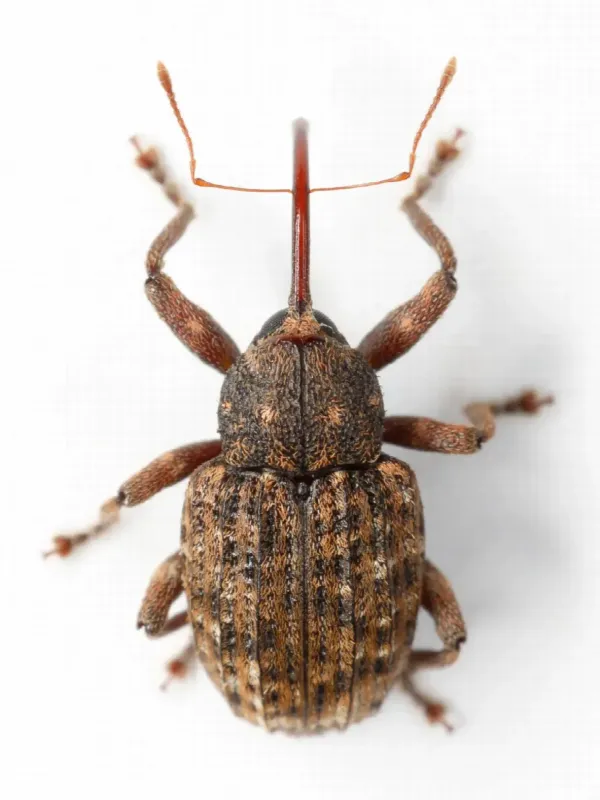
Adult beetles are characterized by their elongated rostrum, which is essential for feeding and creating egg-laying sites in plant tissues.
The adult insect is typically small, ranging from 5 to 8 mm in length, with a brownish, mottled coloration that blends perfectly with tree bark.
The larvae are legless, C-shaped, and creamy-white, developing internally within the acorns, which protects them from many external predators.
Their morphological structure is highly adapted to drilling through hard seed coats, reflecting a long evolutionary history with their host plants.
What it damages
The primary economic damage caused by this insect involves the destruction of acorns, which are vital for natural oak regeneration.
Adults also feed on buds and tender leaves, though this damage is usually minor compared to the loss of reproductive material.
Larval feeding inside the acorn destroys the cotyledons, effectively killing the embryo and making the acorn inviable for germination.
In high-density populations, the weevil can destroy a significant percentage of an annual acorn crop, impacting local wildlife food sources.
Forest managers and nursery owners frequently face challenges with seedling establishment when seeds are infested by these weevils.
When it appears
Adults emerge in late spring or early summer, synchronized with the development of young acorns on the host trees.
Egg-laying activity occurs during the summer months when the developing acorns are soft enough for the female to pierce.
Larval development happens rapidly throughout the summer, with larvae feeding continuously on the nutritious core of the acorn.
Upon maturity, larvae exit the acorns, typically in the late summer or autumn, to burrow into the soil for overwintering.
They remain in the soil as pupae or dormant larvae until the conditions of the following spring trigger their emergence as adult beetles.
Signs of infestation
A classic sign of infestation is the presence of tiny, pin-prick holes on the outer surface of the acorn where the female has deposited her eggs.
Premature nut drop is a strong indicator of an active infestation, as infested acorns are often shed by the tree before full maturity.
Evidence of larval activity can also be seen through the exit holes bored by mature larvae leaving the acorn to enter the soil.
When an infested acorn is opened, one can see internal tunnels filled with larval waste (frass), which discolors the seed tissue.
- Pin-prick holes on the shell
- Premature acorn drop
- Internal tunnel damage
- Exit holes on fallen nuts
- Adult beetles found on foliage
Control measures
Sanitation is the most effective cultural practice; collecting and destroying fallen acorns immediately prevents larvae from entering the soil.
Cultivating the soil around the base of oak trees can help disturb or destroy overwintering larvae and pupae within the ground.
Chemical control can be difficult due to the cryptic nature of the larvae, but targeted insecticide applications may be used against adults before egg-laying occurs.
Monitoring using pheromone traps can help foresters determine the timing of insecticide applications or the necessity of intervention.
Encouraging natural predators, such as birds or parasitic wasps, can help keep weevil populations in check within diverse forest ecosystems.
Taxonomy
- Latin name
- Conotrachelus naso
- Order
- Coleoptera (beetles)
- Family
- Curculionidae
- EPPO code
- CONHNA
Discussion
No discussions yet — be the first.