
Elegent weevil
Conotrachelus elegans
Description
How to identify
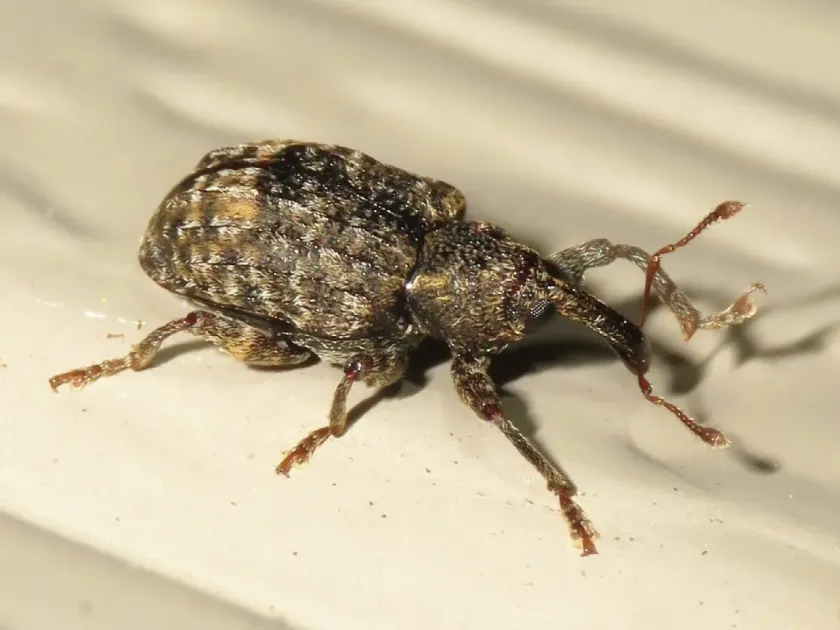
The elegant weevil (Conotrachelus elegans) is a member of the Curculionidae family within the Coleoptera order. Adult beetles are characterized by a prominent snout and a hardened, often mottled, exoskeleton.
Their coloration typically mimics the bark of the host trees, providing excellent camouflage against predators and making manual detection during the day quite challenging.
The larval stage features a creamy-white body, a curved posture, and a distinct brown head capsule, which are classic diagnostic traits for weevil larvae found in fruits.
The species undergoes complete metamorphosis: egg, larva, pupa, and adult. Adults are generally nocturnal or crepuscular, hiding in bark crevices or foliage during bright daylight hours.
As a highly specialized pest, its biological success is intrinsically tied to the phenology of its primary host plants, specifically those within the Juglandaceae family.
What it damages
The elegant weevil primarily targets species of nut trees, most notably hickory and pecan, which are susceptible to infestation during the critical nut-filling stages.
While adult feeding on buds and young shoots may cause minor aesthetic or structural damage, the primary economic impact is caused by larvae consuming the developing nut kernels.
Females bore into the young, tender fruit to deposit eggs. Once hatched, the larvae tunnel into the center, completely destroying the edible part of the nut from within.
Infested nuts frequently drop prematurely from the tree, significantly reducing the total yield and making the remaining harvest unmarketable due to internal damage.
The internal galleries created by larvae serve as entry points for secondary fungal and bacterial pathogens, leading to further rotting and potential contamination of the entire cluster.
When it appears
Adult emergence from overwintering sites in the soil generally coincides with the warming of soil temperatures in spring, as trees begin their active vegetative growth.
Mating and oviposition occur throughout the spring and early summer, targeting the newly formed fruit sets, which are at their most vulnerable stage during this period.
The duration of the larval stage within the nut is determined by ambient temperatures; in warmer climates, the development cycle can be accelerated, potentially leading to multiple events.
By late summer or early autumn, the larvae exit the fallen nuts and burrow into the soil, where they prepare to overwinter in a quiescent state until the following spring.
Overwintering as larvae in the soil protects the population from extreme cold and desiccation, ensuring a high survival rate for the next generation of weevils.
Signs of infestation
The most reliable indicator of an infestation is the presence of small, puncture-like holes on the surface of young nuts, often accompanied by sap bleeding.
Excessive premature nut drop during mid-summer is a major red flag that indicates larval activity within the developing crop, warranting immediate field inspection.
Dissecting fallen nuts will reveal tunneling damage and the presence of larvae or their accumulated frass, which appears as brownish, gritty material within the hollowed-out kernel.
Feeding marks on the leaves, appearing as tiny holes or irregular edges, may also suggest the presence of adult weevils in the canopy during the early growing season.
Beating the foliage over a white cloth during evening hours can confirm the presence of adult beetles, as they will drop from the branches when disturbed.
Control measures
Sanitation is the cornerstone of control; collecting and destroying fallen nuts on a regular basis prevents larvae from escaping into the soil to pupate.
Cultivating or tilling the soil under the tree canopy in late autumn or early spring can disrupt larval overwintering sites and expose them to bird predators and weather extremes.
Targeted insecticide applications are most effective when timed with the adult emergence period, ensuring the population is reduced before significant egg-laying occurs.
Monitoring with pheromone or light traps provides essential data on population density, allowing growers to make data-driven decisions regarding the need for chemical intervention.
- Prompt removal of dropped orchard fruits.
- Soil cultivation beneath the tree canopy.
- Use of certified systemic insecticides.
- Encouraging natural predator populations.
- Regular canopy inspections during the growing season.
Taxonomy
- Latin name
- Conotrachelus elegans
- Order
- Coleoptera (beetles)
- Family
- Curculionidae
- EPPO code
- CONHEL
Discussion
No discussions yet — be the first.