
Crested Curculio
Conotrachelus cristatus
Description
How to identify
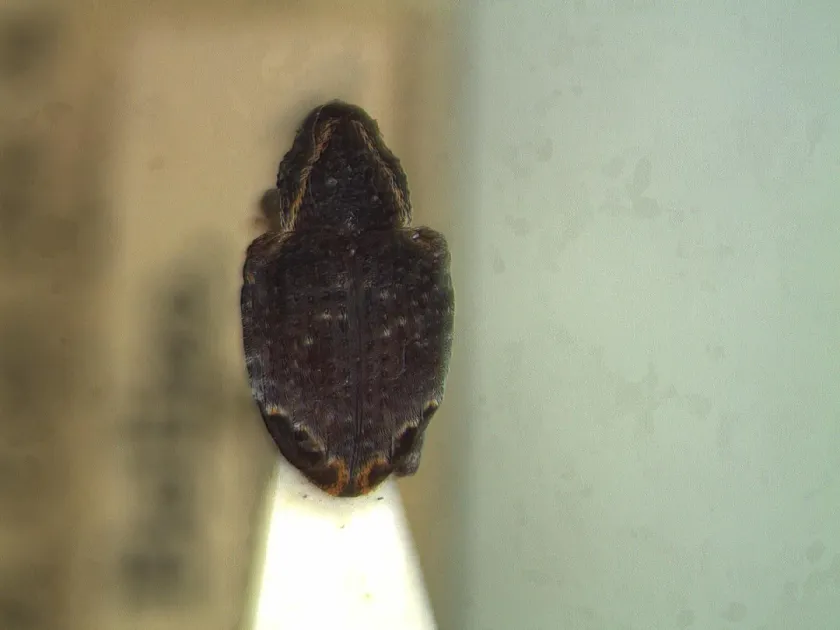
The crested curculio (Conotrachelus cristatus) is a beetle belonging to the Curculionidae family, easily recognized by the distinct crest-like ridges on its elytra.
Adult beetles are typically small with an oval shape, and their coloration ranges from dull brown to grey, which blends perfectly with the bark and soil environments.
They possess a pronounced rostrum (snout) which is used to bore holes into plant tissues for both feeding and the deposition of eggs by the females.
The life cycle encompasses four distinct stages: egg, larva, pupa, and adult, with the larval stage being the most destructive to agricultural yields.
These insects are highly resilient and have evolved to mimic their surroundings, often remaining motionless as a primary defense mechanism when threatened.
What it damages
The larvae are primary pests, burrowing into developing fruits, which causes significant internal damage and disruption of nutrient transport within the fruit.
Adults contribute to plant stress by feeding on buds, tender leaves, and shoots, causing physical injury that weakens the overall vigor of the host plant.
Infested fruit typically stops developing, shrivels, and eventually drops prematurely, resulting in substantial economic losses for orchard owners.
The punctures made by the adults during feeding or egg-laying act as entry points for secondary pathogens, such as fungi or bacterial rots.
In severe infestations, the cumulative damage to both reproductive and vegetative parts of the plant can lead to significant reductions in annual yield.
When it appears
Adult activity typically begins in early spring, triggered by rising temperatures and the phenological development of the host trees, such as bud break.
The peak period of damage often coincides with the fruit set stage, during which females actively deposit eggs inside the developing young fruits.
Throughout the summer, the population continues to feed and complete its development, often with multiple overlapping stages present in the orchard.
As autumn approaches and temperatures decline, the adult beetles seek overwintering sites, often moving into the soil or under leaf litter.
The timing of the life cycle can vary depending on the local microclimate and the specific fruit species being targeted by the curculio population.
Signs of infestation
Visible signs of infestation often include tiny, dark punctures on buds or young fruits, which may sometimes ooze sap or gum depending on the plant variety.
The premature drop of small fruits is a major indicator of larval activity, as the internal damage makes it impossible for the fruit to stay on the branch.
Observation of the adult beetles can be conducted using the limb-jarring technique, where beetles fall onto a white cloth and remain still for identification.
Leaves showing irregular holes or notched edges are common symptoms of adult feeding, which can be easily spotted during routine orchard scouting.
- Puncture marks on buds and young fruit.
- Premature fruit abscission.
- Internal galleries inside dropped fruit.
- Presence of adult beetles on the foliage.
- Deformed fruit development.
Control measures
Cultural control measures, such as frequent cultivation of soil under trees, are essential to disrupt the pupation process and kill the larvae in the soil.
Sanitation practices involving the rapid removal and destruction of all fallen fruit help break the life cycle by preventing larvae from reaching the soil.
Chemical control involving timely applications of registered insecticides is recommended during the pre-bloom and post-bloom periods to target adults.
Implementing trunk bands can act as a physical barrier, significantly reducing the number of adult beetles that crawl up from the soil to the canopy.
Integrated Pest Management (IPM) strategies, including monitoring and threshold-based spraying, are highly recommended to optimize control efficacy.
Taxonomy
- Latin name
- Conotrachelus cristatus
- Order
- Coleoptera (beetles)
- Family
- Curculionidae
- EPPO code
- CONHCS
Discussion
No discussions yet — be the first.