
Hickory curculio
Conotrachelus aratus
Description
How to identify
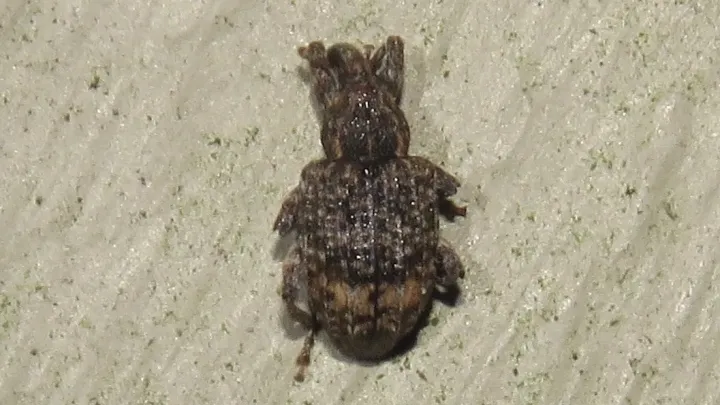
The hickory curculio (Conotrachelus aratus) is a member of the Curculionidae family, commonly known as weevils. These beetles are easily identified by their elongated snouts and compact, oval-shaped bodies.
The adult beetle usually displays a mottled brown or reddish-brown coloration, which helps it blend in with the bark of host trees. This natural camouflage makes them quite difficult to spot during daylight hours.
Larvae are legless, C-shaped grubs with creamy white bodies and distinct brownish head capsules. They spend their entire developmental phase feeding inside plant tissues, shielded from external environment.
The life cycle is closely synchronized with the phenology of their host trees, specifically species within the Carya genus. Successful reproduction depends on the availability of tender new growth.
Being primarily nocturnal or crepuscular, adult curculios are most active during low-light conditions, which is a crucial fact for those attempting to monitor populations in an orchard.
What it damages
The primary hosts for the hickory curculio are hickory trees and pecan trees. Both adults and larvae cause significant damage, although the impact manifests in different ways.
Adult beetles feed on buds, leaf stems, and succulent new shoots. This feeding behavior causes necrotic spots and can lead to the wilting of affected foliage.
Larval damage is far more severe, as they bore into young twigs and shoots. This tunneling activity disrupts the flow of nutrients, leading to structural weakness and branch dieback.
Heavily infested trees often exhibit stunted growth and reduced nut production, which has significant economic implications for commercial orchards or nut growers.
The physical wounds left by the larvae can also serve as entry points for fungal pathogens, potentially causing secondary infections that exacerbate the overall damage to the tree.
When it appears
Adult activity begins in the spring as temperatures rise, signaling the emergence of overwintering beetles from the soil surface to begin feeding and mating.
The egg-laying period corresponds with the flush of new growth on the trees. Females use their snouts to create niches in twigs or young fruit for oviposition.
Throughout the summer, larvae remain active inside the plant tissues, feeding and growing. This is the most destructive phase for the tree's development.
By late summer or early autumn, the mature larvae exit the plant tissues and drop to the ground. They then burrow into the soil to pupate and remain there until the following season.
The severity of an infestation is often linked to the weather patterns during the spring; warmer and wetter conditions can lead to higher survival rates and faster life cycle completion.
Signs of infestation
The most visible sign of infestation is the presence of drooping or withered twigs on the tree canopy, which often break off during light wind events.
Careful inspection of the foliage will reveal small feeding punctures or scarring on the leaf petioles and young stems, caused by the adult weevils' feeding habits.
If a damaged twig is pruned and split open, one will frequently find tunnels filled with larval frass and perhaps the white, C-shaped larva itself.
Premature nut drop or small, scarred nuts may indicate that the larvae have targeted the developing fruit, which is particularly common in highly susceptible cultivars.
During the early morning hours, placing a white sheet under the branches and shaking them can dislodge the adult beetles, revealing their presence in the orchard.
Control measures
Sanitation is a cornerstone of control: pruning and immediately disposing of (burning or burying) infested twigs significantly reduces the larval population before they reach the soil.
Chemical control using systemic insecticides is most effective when timed with the spring emergence of adults, aiming to kill them before they can lay eggs.
Cultivating the soil beneath the canopy in the late autumn can help expose pupating larvae to predators or adverse weather, disrupting their successful overwintering.
Biological control agents, such as beneficial nematodes, can be applied to the soil to target larvae that are in the process of pupation.
- Monitor tree health regularly to ensure vigor, as stressed trees are more attractive to pests.
- Use pheromone-baited traps if available to track population spikes.
- Maintain orchard hygiene by removing fallen debris that might harbor the insects.
Taxonomy
- Latin name
- Conotrachelus aratus
- Order
- Coleoptera (beetles)
- Family
- Curculionidae
- EPPO code
- CONHAR
Discussion
No discussions yet — be the first.