
Hickory nut weevil
Conotrachelus affinis
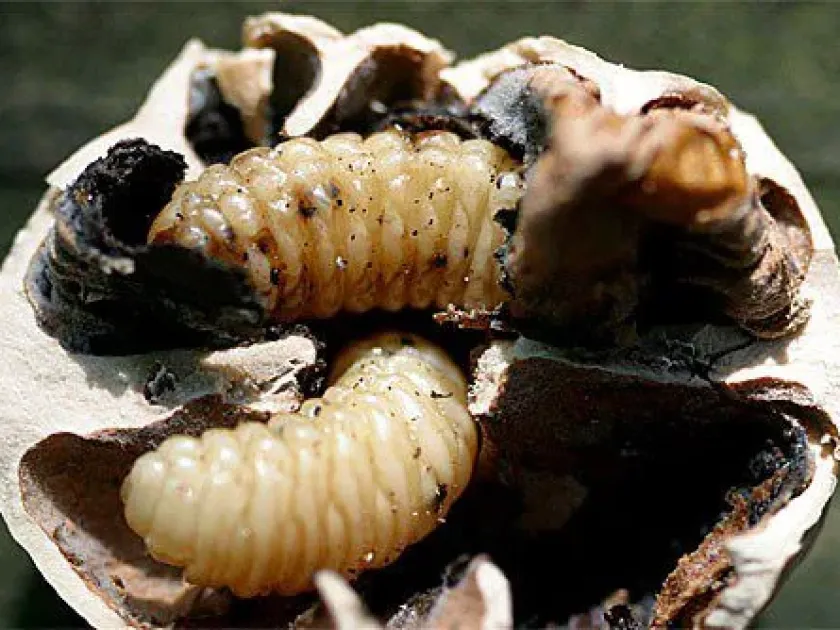
Description
How to identify
The hickory nut weevil (Conotrachelus affinis) is a beetle belonging to the family Curculionidae within the order Coleoptera. Adults are easily recognized by their elongated snout, which is typical for the members of this genus.
The body color of the beetle typically ranges from dark brown to black. It is often covered with small scales that provide excellent camouflage against the bark of the host trees. Adults usually reach a length of 5 to 8 millimeters.
The larvae are legless, C-shaped grubs with a creamy-white body and a distinct brown head capsule. They develop entirely inside the fruit, remaining hidden until the adult larva emerges.
The life cycle of this pest is synchronized with the phenology of host trees. Adults overwinter in the soil or under leaf litter, emerging in the spring when temperatures become favorable for activity.
Following mating, females chew small holes into developing nuts to deposit their eggs. This stage is crucial for the pest, as the larva requires an immediate food source within the nutmeat to survive.
What it damages
The primary food source for the hickory nut weevil is the fruit of hickory and pecan trees (genus Carya). While they prefer specific hosts, they can occasionally impact other related nut-producing trees.
Economic damage is most severe during heavy crop years when the beetle population peaks. Infested nuts frequently drop prematurely, leading to significant yield losses before the harvest season.
Larvae feeding inside the nut consume the kernel completely, replacing it with frass and decayed plant matter. This destruction renders the nut entirely unmarketable and inedible for consumers.
Secondary damage occurs when the entry and exit holes serve as access points for fungal pathogens and bacteria. This often triggers nut rot, which can spread to healthy neighboring nuts on the same branch.
In commercial orchards, infestation levels can result in the loss of 30% to 50% of the total crop if monitoring protocols and integrated pest management (IPM) strategies are not implemented.
Signs of infestation
The initial sign of an infestation is the appearance of small dark spots or pits on the surface of green nuts, representing the punctures made by females during the egg-laying process.
Later in the season, small circular holes become visible on the nut shell. These are exit holes where the mature larva has emerged to reach the soil for pupation.
A mass premature drop of immature nuts during mid-summer is a major indicator of weevil activity. Often these nuts appear normal externally but contain a hollow center upon inspection.
Adult beetles are nocturnal, making them difficult to spot during daylight hours. They usually hide in foliage or bark crevices, coming out to feed and mate during the evening or at night.
Using pheromone or light traps in the orchard is the most reliable way to confirm the presence of adults. Regular scouting of the ground under trees is also essential for assessing damage levels.
Control measures
The most critical control measure is the immediate and thorough collection and destruction of all fallen nuts. This kills the larvae inside and prevents them from entering the soil to pupate for the next season.
Cultivating the soil beneath the trees in the autumn or early spring helps disturb overwintering larvae and pupae, exposing them to predators or harsh environmental conditions.
Chemical control involves applying registered insecticides during the period when adults emerge from the soil but before they have the chance to lay eggs inside the growing nuts.
Biological control methods, such as the application of entomopathogenic nematodes to the soil, can help reduce the population of pupating weevils in organic or integrated orchard management programs.
- Regular monitoring using specialized traps.
- Sanitation by removing infested fallen nuts.
- Strategic insecticide applications during peak emergence.
- Orchard floor management to reduce overwintering success.
Taxonomy
- Latin name
- Conotrachelus affinis
- Order
- Coleoptera (beetles)
- Family
- Curculionidae
- EPPO code
- CONHAF
Discussion
No discussions yet — be the first.