
Ponderosa pine cone beetle
Conophthorus ponderosae
Description
How to identify
The Ponderosa pine cone beetle is a small insect belonging to the Curculionidae family, specifically the Scolytinae subfamily of bark beetles.
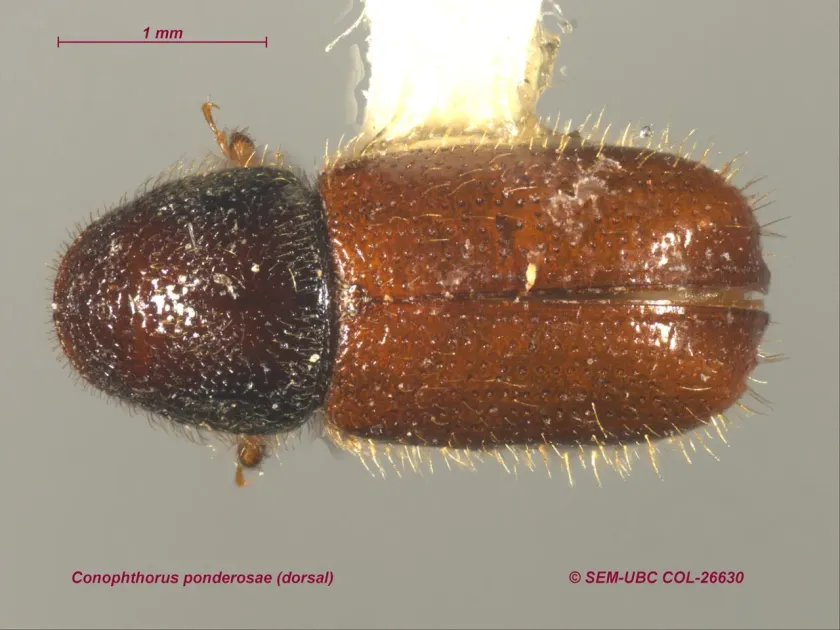
Adult beetles are approximately 3 to 4 mm long with a cylindrical, dark brown or blackish body, adapted for boring into woody tissues.
The life cycle is intimately linked to the development of pine cones, where the beetles lay their eggs and where the larvae complete their growth.
They overwinter as adults, primarily within infested cones that have fallen to the forest floor, protected by the forest litter layer.
Emergence occurs in the spring when rising temperatures trigger mating flights as the beetles seek fresh, developing cones to attack.
What it damages
The primary host trees include various pine species, with a notable preference for Ponderosa pine, from which the beetle derives its scientific name.
The damage is caused primarily by the beetles boring into the stalks of second-year cones, which disrupts nutrient flow to the developing fruit.
Infestation results in the death of the cone, leading to total seed loss, which is a major concern for silviculture and reforestation programs.
When infestation levels are high, the beetle can destroy nearly an entire year's cone crop in a specific area, causing long-term impact on local ecosystems.
Young plantations and seed orchards are particularly vulnerable, as the economic value of high-quality seeds is significant.
Signs of infestation
The most diagnostic sign of infestation is the premature browning and drying of cones while they are still attached to the tree branches.
Entry holes are often visible at the base of the cone, sometimes surrounded by small amounts of pitch or resinous exudate.
Internal examination of an infested cone reveals complex larval galleries that completely consume the seed-bearing tissues.
Significant premature cone drop throughout the summer months is a strong indicator of an active beetle population within the tree canopy.
- Premature cone browning.
- Resin accumulation at the cone base.
- Internal larval gallery damage.
- Extensive premature cone drop.
Control measures
Sanitation practices, such as the collection and disposal of fallen cones, are critical for disrupting the beetle's overwintering cycle.
In high-value seed orchards, chemical interventions during the critical flight window can effectively protect the developing crop.
Natural biological controls, including predatory beetles and parasitic wasps, play a significant role in regulating population dynamics in natural forests.
Maintaining diverse forest structures helps reduce the concentration of host trees, potentially lowering the intensity of beetle outbreaks.
Monitoring programs utilizing pheromone traps are recommended to detect adult activity early, allowing for precise and timely management decisions.
Taxonomy
- Latin name
- Conophthorus ponderosae
- Order
- Coleoptera (beetles)
- Family
- Curculionidae
- EPPO code
- CONPPO
Discussion
No discussions yet — be the first.