
Lambert pine cone beetle
Conophthorus lambertianae
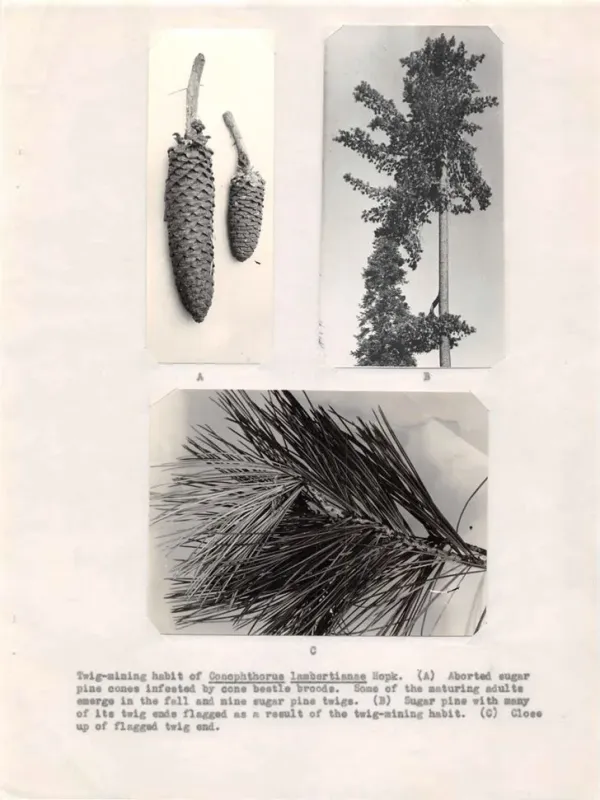
Description
How to identify
The Lambert pine cone beetle (Conophthorus lambertianae) is a small bark beetle belonging to the family Curculionidae. It is a specialized pest that targets the reproductive structures of specific pine species.
Adult beetles are tiny, typically only a few millimeters long, with a dark brown to black cylindrical body that blends in with pine bark.
The larvae are white, legless, and have a distinct head capsule, spending their entire developmental phase inside the pine cones they infest.
The species has evolved a specialized life cycle that is synchronized with the phenology of the host tree's cone production.
Because they are capable of flight, adult beetles can effectively locate host trees and infest large areas of forest within a single season.
What it damages
The primary damage is caused by adults and larvae feeding within developing cones, which causes the cones to stop growing and prematurely die.
By boring into the base of the cone and severing the nutrient-conducting vessels, the beetle effectively cuts off the supply of water and nutrients to the developing seeds.
This results in the shriveling and browning of the cones, leading to their premature abscission from the branch.
Economic damage is significant in seed orchards and forest regeneration projects, as the beetle can destroy a large percentage of the annual seed crop.
The damage is highly specialized, and the trees themselves rarely suffer long-term structural harm, although the loss of reproductive output is substantial.
When it appears
Adult activity begins in the spring, triggered by rising temperatures, as beetles emerge from their overwintering sites.
Females search for young, succulent cones to bore into, creating entrance holes and laying eggs within the protective environment of the cone.
Larval development occurs throughout the summer months, with the insects feeding on seeds and cone scales as they mature into pupae.
The new generation of adults usually emerges in late summer or autumn, though some may remain in the fallen cones to overwinter.
Overwintering sites primarily consist of fallen cones on the forest floor or protected crevices in the tree bark.
Signs of infestation
The first external signs of an infestation include resin beads or streaks at the base of the cone where the beetle has bored in.
Premature browning and wilting of green cones are clear indicators that the vascular supply has been severed by feeding beetles.
A high volume of fallen, undersized cones under the tree canopy during the summer months suggests a heavy infestation.
Internally, infested cones show intricate galleries filled with frass, as well as the presence of larval stages or pupae.
Close observation of the cone base reveals the characteristic small, circular entrance hole used by the female beetle.
Control measures
Sanitation is the most effective management tool, involving the collection and destruction of fallen cones to break the life cycle of the beetle.
Regular monitoring of tree health and cone development helps to identify potential outbreaks before they spread across the stand.
Pheromone-baited traps can be utilized in seed orchards to monitor population levels and determine the precise timing for chemical intervention if necessary.
Chemical control measures are generally reserved for high-value seed production areas where loss of seeds would have a major financial impact.
- Monitor cone development during the spring.
- Remove and burn infested or fallen cones.
- Maintain forest stand vigor to ensure tree resistance.
Taxonomy
- Latin name
- Conophthorus lambertianae
- Order
- Coleoptera (beetles)
- Family
- Curculionidae
- EPPO code
- CONPLA
Discussion
No discussions yet — be the first.