
Green-striped weevil
Compsus viridivittatus
Description
How to identify
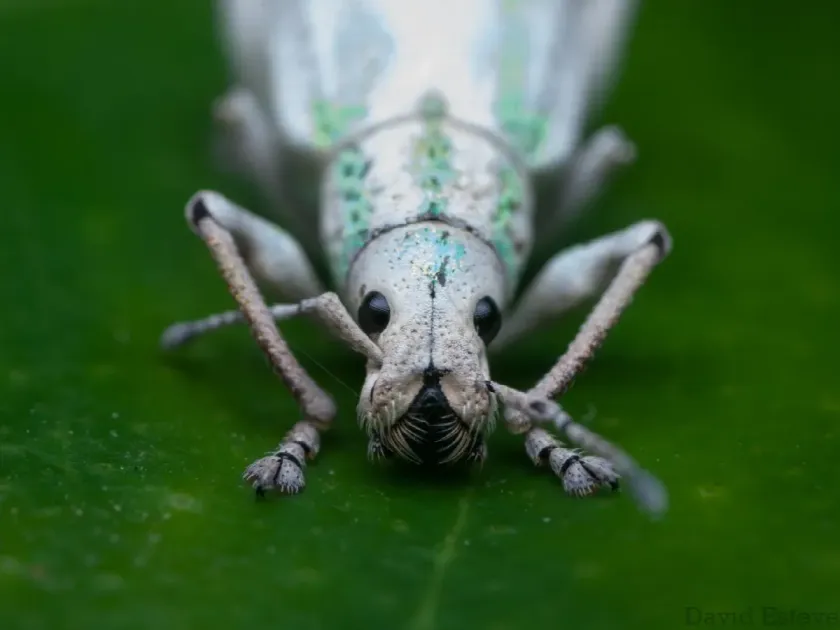
The Green-striped weevil (Compsus viridivittatus) is a member of the Curculionidae family, belonging to the order Coleoptera. The insect is characterized by a distinctive appearance, with its body covered in fine scales that provide a metallic green hue with longitudinal pale stripes.
Adults possess the typical weevil morphology, featuring a well-defined rostrum and hardened elytra. The body length of the adults typically ranges from 10 to 15 millimeters, making them clearly visible on the leaves of infested plants.
The larvae of this species develop in the soil or within the root zone; they are legless, white-colored, and have a darkened head capsule. Unlike the adults, the larval stage leads a cryptic, subterranean lifestyle.
The biology of this species is closely tied to tropical and subtropical climates, where population levels can reach critical thresholds for plantations. It is widely distributed across regions of Central and South America.
Reproduction is sexual, with females laying eggs primarily on the leaf surface or within bark crevices, after which the larvae quickly migrate into the soil to feed on plant roots.
What it damages
Citrus trees, including oranges, limes, and lemons, are the primary hosts for this pest. The insect is capable of causing significant damage to both young saplings and mature, fruit-bearing trees.
In addition to citrus, the weevil has been documented damaging a variety of ornamental plants and other agricultural crops cultivated in humid tropical environments.
Adult weevils damage the vegetative parts of the plants by feeding on the edges of leaf blades, which leads to a significant loss of photosynthetic surface area.
Larvae living in the root zone sever fine root hairs, which disrupts the plant's nutrient and water uptake, thereby stunting growth and development.
Mass infestations can result in reduced plantation yields, weakened tree immunity, and subsequent susceptibility to secondary pathogens through the feeding wounds.
Signs of infestation
The first clear sign of the pest's presence on the canopy is the characteristic scalloping of the leaf edges, which is a classic symptom of weevil feeding activity.
During soil inspections around the root zone of saplings, one may find larvae feeding on fine roots, which may cause wilting of the aerial parts during dry periods.
Trees severely infested by these weevils often exhibit signs of chlorosis, caused by the impairment of nutrient conductivity due to root system damage.
Reduced shoot growth rates and premature leaf drop serve as indirect indicators of a high population density of Compsus viridivittatus within the orchard.
During the early morning or evening hours, adult weevils can be spotted on the undersides of leaves, where they hide to avoid direct sunlight.
Control measures
The primary control method involves the use of systemic insecticides, which effectively target both adults feeding on foliage and larvae when applied to the soil.
Agronomic practices include maintaining orchard hygiene, regular weed control, and cultivation of the soil around the base of the trees to disrupt larval pupation.
Biological control strategies may incorporate the use of entomopathogenic fungi and nematodes, which effectively suppress larval populations within the soil layer.
Manual collection of adults during the early morning hours is effective only on small garden plots or in scenarios with low pest pressure.
Monitoring populations using sticky traps allows for the timely detection of adult emergence, enabling protective treatments before mass egg-laying occurs.
Taxonomy
- Latin name
- Compsus viridivittatus
- Order
- Coleoptera (beetles)
- Family
- Curculionidae
- EPPO code
- CMSSVI
Discussion
No discussions yet — be the first.