

Grape erineum mite
Colomerus vitis
Description
How to identify
The grape erineum mite (Colomerus vitis) is a microscopic pest belonging to the Eriophyidae family. Measuring only about 0.15 to 0.2 mm, it is impossible to detect with the naked eye under normal conditions.
These mites have a worm-like, elongated body, typically pale yellow or white. They are obligate parasites that live and feed almost exclusively on the leaves and green tissues of grapevine plants.
The life cycle involves several generations per season, with the rate of reproduction being highly dependent on ambient temperature and humidity levels in the vineyard environment.
Adult females overwinter in protected areas, specifically under bud scales, in leaf scars, or within the deep cracks of the bark of one-year-old vine canes.
Dispersal across the vineyard primarily occurs through passive movement, aided by wind, water, crawling insects, or via human-mediated transport of infested vine cuttings used for propagation.
What it damages
This mite is a specialist pest that feeds exclusively on the genus Vitis. By feeding on the epidermal cells, it causes the formation of galls or characteristic felt-like patches on the leaves.
Severe infestations interfere with the photosynthetic capacity of the grapevine. The loss of functional leaf area leads to reduced carbon assimilation, which directly affects the vine's vigor and health.
In cases of high population density, mites can attack developing flowers and young green shoots. This damage often causes flower cluster deformation and poor fruit set, leading to lower yields.
Infested vines are generally weakened and may show reduced tolerance to environmental stressors, including drought and extreme cold during the winter dormancy period.
Furthermore, weakened vines become more susceptible to secondary infections from various fungal pathogens, as the plant's overall immune system is compromised by the constant stress of mite feeding.
When it appears
The mites break their winter diapause in early spring as temperatures rise, signaling the beginning of the growing season and the swelling of grape buds.
During late spring and summer, the mites migrate from their wintering sites to the newly emerging leaves, where they establish colonies and begin their feeding cycle.
Multiple overlapping generations are produced throughout the summer months, with population growth accelerating during periods of sustained warm and dry weather conditions.
As autumn approaches and temperatures begin to drop, the mites gradually move away from the foliage to search for suitable overwintering sites on the vine wood.
The winter months represent a period of reduced activity where the mites remain dormant, waiting for the return of favorable temperatures to restart the life cycle in the following spring.
Signs of infestation
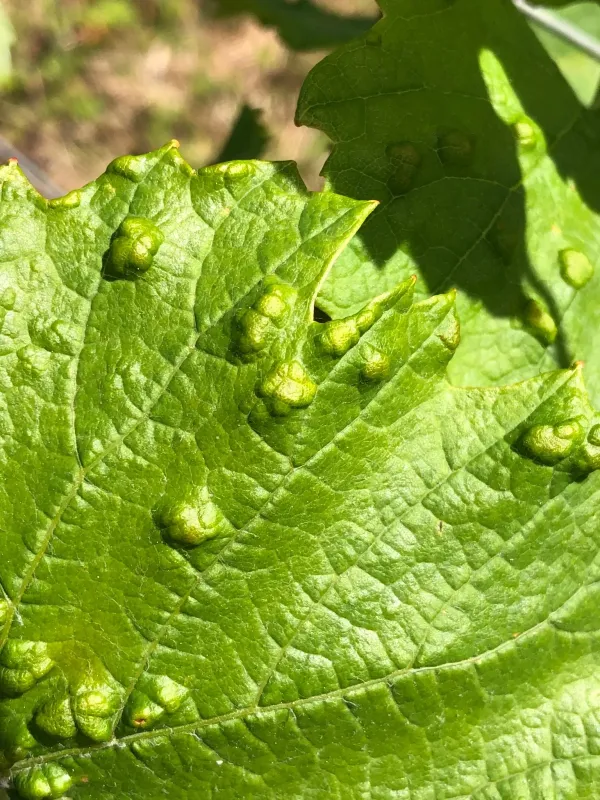
The most diagnostic sign of an erineum mite infestation is the presence of blister-like galls on the upper leaf surface, which correspond to felt-like patches on the underside.
This felt-like growth, known as an erineum, starts as a white, dense mat of leaf hairs but typically turns brown or rust-colored as the season progresses and the leaf ages.
Severe damage often results in leaf curling, yellowing (chlorosis), and premature abscission, which can significantly reduce the vine's canopy density and expose grapes to sunburn.
Deformation of young shoots and clusters is a less common but serious indicator that the infestation has reached a level that threatens the harvest volume and quality.
- Formation of blisters on the top of the leaf surface.
- White to brown felt-like patches on the underside of leaves.
- Distortion and stunting of young shoots and flower clusters.
- Premature yellowing and loss of foliage.
Control measures
Cultural control practices are essential, including the removal and destruction of heavily infested canes during dormant pruning to eliminate primary overwintering sites.
Chemical intervention usually involves the application of acaricides. The most critical timing for treatment is during the early spring bud-burst stage when the mites are active.
It is vital to utilize integrated pest management (IPM) strategies, which prioritize the conservation of natural mite predators, such as phytoseiid mites, to keep the population in check.
Resistance management is crucial; vineyard managers should rotate chemical classes of acaricides to ensure the mites do not develop tolerance to commonly used active ingredients.
Regular field scouting throughout the growing season allows for early detection, enabling spot treatments rather than whole-vineyard spraying, which saves costs and protects beneficial insects.
Content graph
Connections · Grape erineum mite
Most often together:
Marketplace
Products · 8

Community
Discussion
No discussions yet — be the first.