
Speckled mousebird
Colius striatus
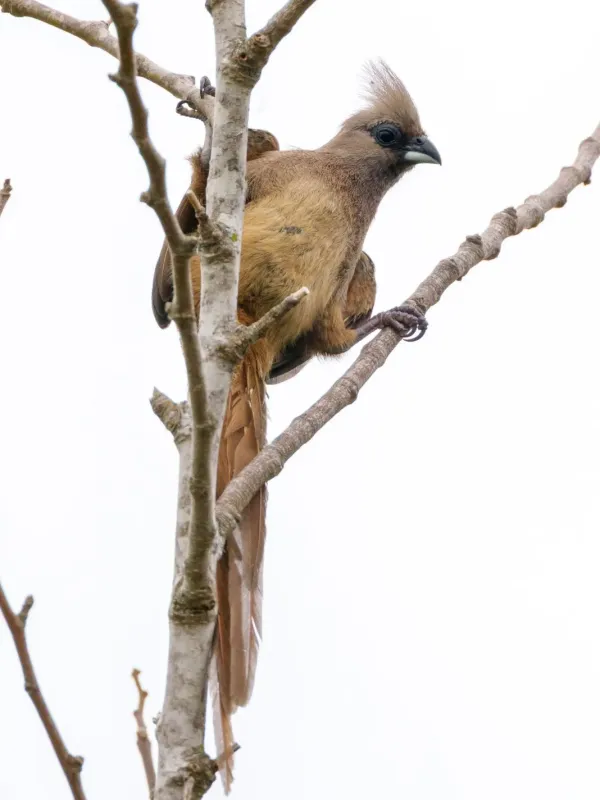
Description
How to identify
The Speckled mousebird (Colius striatus) is a species in the Coliidae family, recognizable by its long tail and grayish-brown plumage with fine barring on the breast.
These birds are known for their social nature, typically moving in small, noisy flocks that can quickly overwhelm a fruit-bearing tree or shrub.
Their name comes from their mouse-like behavior, as they often scurry through foliage rather than flying, using their unique feet to grip branches at odd angles.
They possess a small crest on their heads and a strong, conical beak designed for consuming fruits, berries, and succulent plant materials.
Native to Sub-Saharan Africa, they have adapted well to human-modified landscapes, frequently invading orchards and home gardens to exploit cultivated crops.
What it damages
They are considered significant agricultural pests as they feed on a wide variety of cultivated fruits, including grapes, citrus, papayas, and guavas.
Beyond mature fruit, they frequently consume floral buds and young sprouts, which can severely stunt the growth of trees and reduce total yields.
A flock of these birds can strip a small tree of its entire fruit crop within a very short period, causing substantial economic loss to farmers.
They are particularly destructive because they often attack fruit before it is fully ripe, damaging the crop's marketability and overall quality.
Their feeding habits often involve destroying more tissue than they actually consume, leading to secondary infections in damaged plant parts.
When it appears
Damage intensity peaks during the fruit ripening season when orchards become prime targets for feeding flocks searching for sugar-rich food sources.
During the spring months, their focus shifts to buds and young vegetation, which are crucial for the tree's health and upcoming fruit set.
As they are non-migratory birds, they remain in the agricultural area year-round, posing a constant threat to any available plant food source.
Their feeding activity is most concentrated in the early morning and late afternoon hours, making these times critical for observation and monitoring.
In many regions, they can breed throughout the year, which ensures that their population remains resilient and capable of causing persistent damage.
Signs of infestation
The most obvious sign of an infestation is the presence of partially eaten or pecked fruit hanging on the branches or scattered on the ground.
In the spring, trees may show evidence of missing buds and stripped bark on tender new growth, suggesting recent foraging activity by a flock.
Noisy social interactions among the birds as they move through the canopy are usually the first alert for orchard owners to their presence.
Key symptoms include
- ragged edges on fruits
- loss of blossoms or emerging shoots
- bird droppings around the base of affected trees
Unlike insect pests, mousebirds leave larger, more jagged wounds on plant tissues that are clearly visible during routine field inspections.
Control measures
Exclusion methods, such as installing bird-proof netting over fruit trees and valuable crops, remain the most reliable way to prevent damage.
Visual deterrents like reflective tape or hawk decoys can be used, though their effectiveness often decreases as the birds become accustomed to them.
Acoustic deterrent systems that broadcast alarm calls or predator sounds can disrupt feeding behavior and discourage flocks from remaining in the orchard.
Proper orchard management, including pruning to reduce dense cover, can make the trees less attractive as hiding and nesting sites for these birds.
Farmers can also implement trap crops, planting less valuable fruits at the edges of the property to serve as a distraction for the foraging flocks.
Taxonomy
- Latin name
- Colius striatus
- Family
- Coliidae
- EPPO code
- KOLIST
Discussion
No discussions yet — be the first.