
Mousebirds
Colius
Description
How to identify
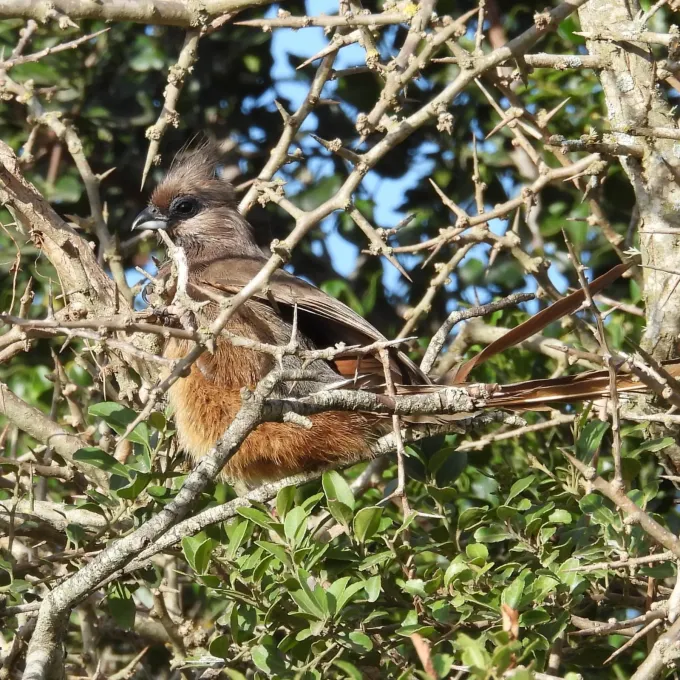
Mousebirds are unique birds belonging to the Coliidae family, characterized by their long tails and soft, mouse-like greyish-brown plumage.
They are highly social creatures, typically moving in small, active flocks and using their sharp claws to clamber through foliage with great agility.
A distinctive feature of these birds is the mobile crest on their heads, which they raise when agitated or during social interaction.
Physically, they are well-adapted for climbing, often seen hanging upside down while foraging for berries or buds on thin branches.
Their flight is generally short and fluttery, characterized by rapid wingbeats followed by gliding, making them easy to observe in open orchards.
What it damages
Mousebirds are considered agricultural pests due to their tendency to feed extensively on fruits, berries, and young plant tissues.
They can cause severe damage to a wide range of crops, including grapes, citrus, figs, papayas, and various stone fruits.
During the spring, they frequently strip fruit trees of their buds, which significantly stunts growth and drastically reduces the potential fruit yield.
The damage is often sudden and destructive, as a feeding flock can quickly overwhelm and ruin a significant portion of a harvest.
By pecking into fruits, they often ruin the marketability of the produce, leading to substantial financial losses for commercial fruit growers.
When it appears
The peak activity of mousebirds coincides with the ripening of fruits, when the availability of sugar-rich food sources attracts them to orchards.
Early spring is another high-risk period, as the birds actively search for fresh growth, including leaves and young succulent buds, to supplement their diet.
They are diurnal animals, most active during the early morning and late afternoon hours when they congregate to feed in groups.
In drier climates, their reliance on cultivated gardens increases, as they seek out irrigation sources and juicy fruit crops for hydration.
Ongoing monitoring is essential throughout the growing season, as these birds can quickly identify and exploit new food sources as they become available.
Signs of infestation
The presence of mousebirds is typically signaled by partially eaten fruits left hanging on branches or strewn across the orchard floor.
One can also observe stripped twigs and bare branches in early spring, indicating where the birds have consumed the developing buds.
The audible chatter and frequent social calls of a flock are common indicators that mousebirds are present and foraging in the canopy.
Visual evidence of bird droppings on leaves and branches confirms frequent visits to specific areas of the garden or orchard.
Rapid disappearance of ripening berries or softening fruit is a clear sign that a flock has targeted the crop for feeding.
Control measures
Installing high-quality bird-exclusion netting is the most effective way to physically protect high-value fruit crops from mousebird damage.
Acoustic deterrents, particularly those that broadcast distress calls of predator birds, can be used to temporarily discourage flocks from settling.
Visual aids such as flash tape, spinning reflectors, and hawk silhouettes can help deter birds if moved frequently to avoid habituation.
Effective orchard management, including the removal of nearby scrub and cover, limits the available perching and resting sites for the flocks.
Timely harvesting of crops as soon as they reach maturity reduces the window of opportunity for mousebirds to inflict damage on the produce.
Taxonomy
- Latin name
- Colius
- Family
- Coliidae
- EPPO code
- KOLISP
Discussion
No discussions yet — be the first.