
Coffee berry borer
Coccotrypes moreirai
Description
How to identify
The coffee berry borer (Coccotrypes moreirai) is a small beetle belonging to the Curculionidae family, specifically within the Scolytinae subfamily. It is a tiny insect, typically measuring about 1.5 to 2 mm in length.
The adults are characterized by their cylindrical body shape and dark brown to black coloration. Their small size allows them to easily navigate through the dense tissues of coffee berries.
Larvae of this species are legless and white, developing exclusively inside the coffee fruit. They remain hidden throughout their growth, making detection challenging during the early stages of infestation.
The life cycle involves all typical stages: egg, larva, pupa, and adult. The entire development process occurs within the host fruit, providing a protected environment from external threats.
The species is highly specialized and thrives in tropical climates. Its mobility, particularly that of the females during flight, allows for rapid colonization of new coffee plots.
What it damages
The coffee berry borer is a severe pest for coffee cultivation. It directly attacks the berries of Coffea arabica and Coffea canephora, causing significant economic damage.
Females bore small holes into the berry to lay eggs. Once the larvae emerge, they consume the bean endosperm, rendering the coffee bean useless for commercial processing.
Beyond physical destruction, the presence of the borer promotes the development of secondary fungal infections, which further degrade the quality of the harvested coffee beans.
Infestation often leads to a drop in the berry quality, reduced weight, and in severe cases, the premature abscission of the fruit from the tree, resulting in total yield loss.
Because the larvae destroy the inner seed, the market value of the crop is severely compromised, causing significant financial hardship for coffee farmers worldwide.
Signs of infestation
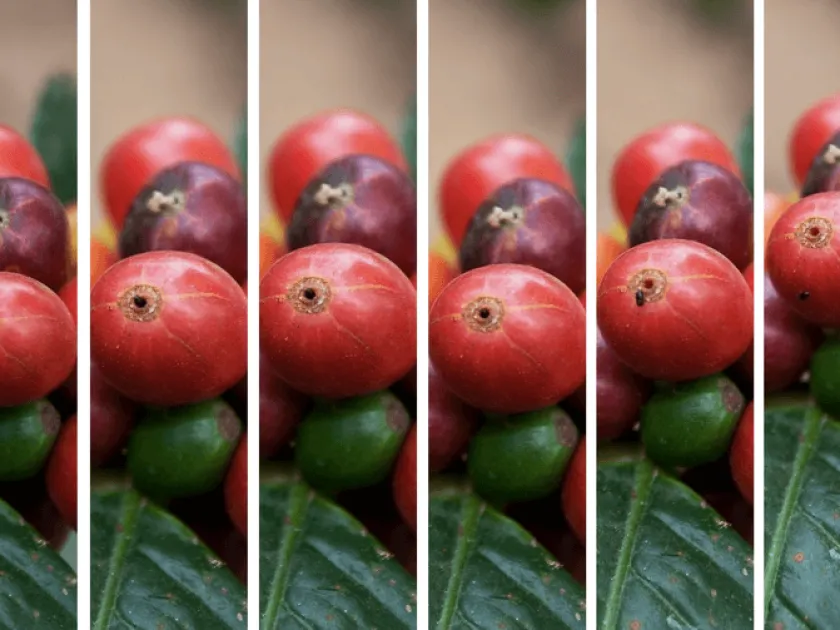
The primary visual sign of an infestation is the presence of tiny, circular entry holes in the coffee berries, usually found near the floral end of the fruit.
Traces of frass, or fine wood-like dust, near the entry hole indicate that the adult beetle or larvae are actively tunneling inside the berry tissues.
Internal examination of suspected berries will reveal intricate galleries created by the larvae, often filled with excrement and fragmented bean tissue.
Fruits that show uneven ripening, yellowing, or early browning while still on the tree are often indicative of an active infestation inside the coffee berry.
Significant numbers of fallen berries on the plantation floor, particularly those showing signs of boring, serve as a strong indicator that the borer population is active.
Control measures
Cultural control is the cornerstone of management. This includes strictly removing all berries from the trees after harvest and clearing the ground of fallen fruits.
Implementing trap cropping or mass trapping using specifically designed attractants can help monitor population levels and reduce the number of active adult beetles.
Timely harvesting practices are essential; picking berries as soon as they reach maturity prevents them from becoming long-term hosts for future generations of the borer.
Chemical control can be employed during periods of high beetle activity. Pesticides should be applied with precision, targeting the adult stage during its migratory phase.
Biological control agents, such as specialized parasitic fungi, are effective tools that contribute to the sustainable management of borer populations in organic coffee farms.
Taxonomy
- Latin name
- Coccotrypes moreirai
- Order
- Coleoptera (beetles)
- Family
- Curculionidae
- EPPO code
- COCOMO
Discussion
No discussions yet — be the first.