
Granary beetle
Coccotrypes graniceps
Description
How to identify
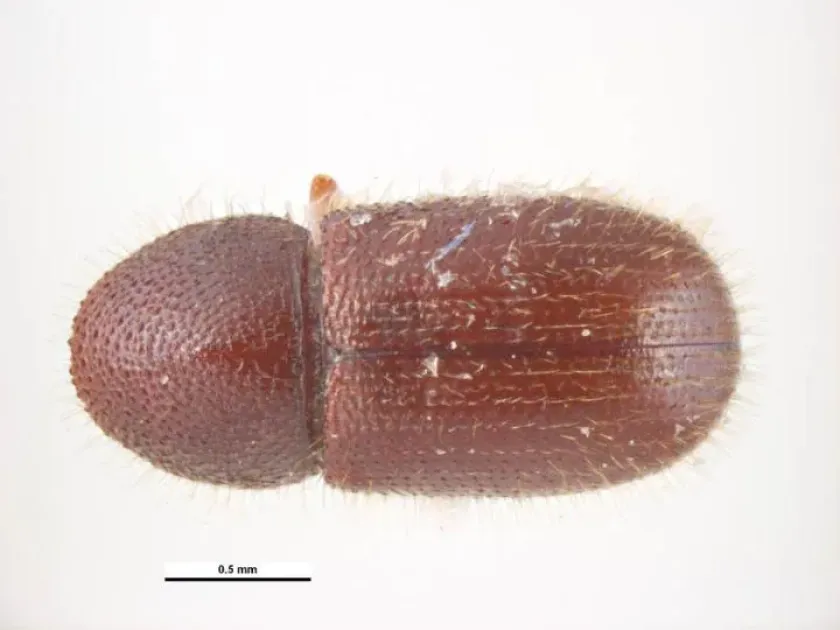
The granary beetle (Coccotrypes graniceps) is a small species of weevil belonging to the Scolytinae subfamily. Adult beetles measure approximately 1.5 to 2.0 mm in length and exhibit a cylindrical body shape that is typical for bark beetles.
Their bodies are usually dark brown or black and covered in fine setae (hairs), giving them a dull appearance. The head is partially retracted under the pronotum, a key anatomical feature used for species identification.
Larvae are legless, white, and possess a well-defined head capsule. They spend their entire developmental period hidden deep within the plant tissues, making them elusive during standard inspections.
As strong fliers, these beetles can easily infest new areas, especially in tropical and subtropical regions where environmental conditions favor their rapid reproduction.
The life cycle is closely associated with seeds and fruits, which serve both as a food source and a protective environment for the beetle's offspring.
What it damages
This beetle is a serious threat to various seeds and fruits, particularly those with hard shells or dense endosperms. It is considered a significant stored-product pest capable of causing substantial economic losses.
Adults bore into seeds, creating intricate tunnels and galleries. This feeding behavior destroys the embryo and endosperm, rendering the seed completely unviable for planting or consumption.
Beyond direct feeding, the beetles facilitate the entry of secondary pathogens, such as molds and bacteria. This deterioration accelerates the rot process, often spoiling the entire batch of product.
International agricultural trade faces major challenges with this species, as it is a target of strict quarantine regulations. Its presence can result in the rejection of entire export shipments.
Seed banks and grain warehouses are particularly vulnerable. A minor initial infestation can quickly escalate into a severe outbreak if the humidity and temperature levels remain unmanaged.
When it appears
In tropical climates, this beetle is active throughout the year, with continuous generations occurring wherever there is a stable food source.
Development is highly dependent on ambient temperature, with 20°C to 30°C being the optimal range for the fastest life cycle completion. In warehouses, where climate control is present, breeding can persist indefinitely.
Migration typically occurs during the maturation phase of the crops in the field, where adults move to new fruits and seeds to establish colonies.
Winter survival is not a concern for this beetle when it is sheltered in heated storage facilities, allowing it to maintain year-round activity and population growth.
Regular monitoring should be performed regardless of the season, as the internal feeding habit makes it difficult to detect an infestation during its early stages.
Signs of infestation
The most common sign of an infestation is the presence of tiny, circular exit or entrance holes on the surface of seeds or fruits. These holes are roughly 1 mm in diameter.
Often, a fine powder known as 'frass' or boring dust accumulates near these holes. This material consists of excreted waste and wood or seed particles pushed out by the beetle.
Infested seeds feel lighter than healthy ones due to the internal tissue being hollowed out. If shaken, infested seeds may produce a faint rattling sound due to the tunnels inside.
A foul, musty odor often develops in storage bins that are heavily infested, signaling the start of mold growth triggered by the beetle's boring activity.
- Visible entry/exit holes on seed coats.
- Accumulation of fine boring dust.
- Noticeable reduction in seed mass.
- Presence of internal tunneling and larvae within split seeds.
Control measures
Rigorous quarantine inspection is the primary defense against the introduction of this beetle. Imports should be thoroughly screened for signs of boring activity.
Warehouse hygiene is critical. Ensuring that storage areas are clean, dry, and cool helps limit the beetle's ability to breed and spread among seed lots.
Fumigation is the standard industry practice for treating infested products. Because the beetles live inside the seeds, gaseous treatments are necessary to reach and eliminate the larvae.
Pheromone traps are highly recommended for early detection within storage facilities, allowing managers to pinpoint the timing of beetle activity and apply localized controls.
If an infestation is discovered, contaminated lots must be isolated immediately. In severe cases, disposal of the batch via incineration is required to prevent wider contamination of healthy inventory.
Taxonomy
- Latin name
- Coccotrypes graniceps
- Order
- Coleoptera (beetles)
- Family
- Curculionidae
- EPPO code
- COCOGR
Discussion
No discussions yet — be the first.