
Coconut fruit borer
Coccotrypes carpophagus
Description
How to identify
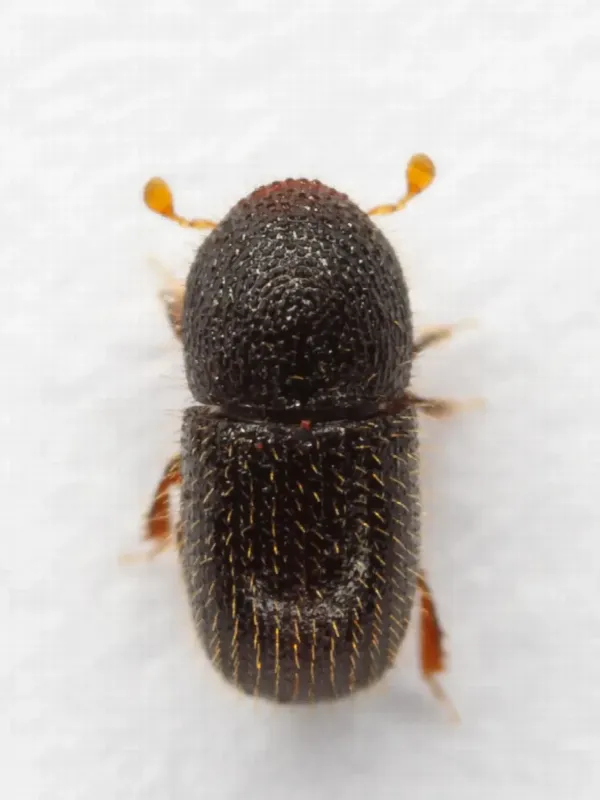
The coconut fruit borer (Coccotrypes carpophagus) is a small bark beetle belonging to the Scolytinae subfamily, known for its significant impact on palm crops.
Adult beetles are typically cylindrical in shape, measuring between 1.5 and 2.5 mm in length, and possess a dark brown to black coloration.
These insects are highly specialized, spending the majority of their lifecycle hidden within the fruits or seeds of host plants, which protects them from predators.
Due to their small size and concealed lifestyle, they are frequently transported across international borders via global trade in nuts and seeds.
The taxonomic classification places them within the Curculionidae family, which includes numerous species of wood-boring and fruit-boring insects of economic importance.
What it damages
The primary hosts of this beetle are various palm species, most notably the coconut palm (Cocos nucifera) and the oil palm (Elaeis guineensis).
Larvae feed internally on the seed and the fleshy parts of the fruit, causing extensive internal tunneling that renders the product commercially worthless.
Beyond palms, the species is known to have a broad host range, occasionally infesting legumes and other botanical seeds, demonstrating a high degree of polyphagy.
Damage to the embryo of the seed prevents germination, causing severe losses for plantations that rely on nursery-grown seedlings for crop renewal.
In addition to direct consumption, the holes created by adults facilitate the entry of pathogens, leading to fruit rot and secondary fungal infections.
Signs of infestation
The most common indicator of an infestation is the presence of minute, circular entrance holes on the surface of the fruit or the shell of the nut.
Fine frass or sawdust-like material often accumulates around these entry points, marking the activity of the larvae burrowing deeper into the fruit tissue.
Premature fruit drop in otherwise seemingly healthy palms is a common field sign that the internal tissues have already been compromised by the borer.
Upon splitting an infested coconut, one can observe complex networks of larval galleries filled with frass, often resulting in the decay of the inner kernel.
Visual surveys supported by the use of specialized traps are necessary to confirm the presence of the beetle before it reaches damaging population levels.
Control measures
Phytosanitary measures, including strict inspection of imported nuts and seeds, serve as the first and most critical line of defense against the borer.
Fumigation is the standard industry practice for treating infested shipments, as it ensures the penetration of gases into the dense structures of the fruit.
Good agricultural practices, such as the routine collection and destruction of fallen fruits, prevent the beetles from completing their life cycle in the field.
Integrated pest management (IPM) strategies incorporating the use of attractant traps help monitor and suppress beetle populations during peak activity periods.
- Strict quarantine and import screening.
- Fumigation of storage facilities.
- Sanitation by collecting fallen fruits.
- Trapping and monitoring programs.
Taxonomy
- Latin name
- Coccotrypes carpophagus
- Order
- Coleoptera (beetles)
- Family
- Curculionidae
- EPPO code
- COCOCA
Discussion
No discussions yet — be the first.