
Palm seed borer
Coccotrypes borasi
Description
How to identify
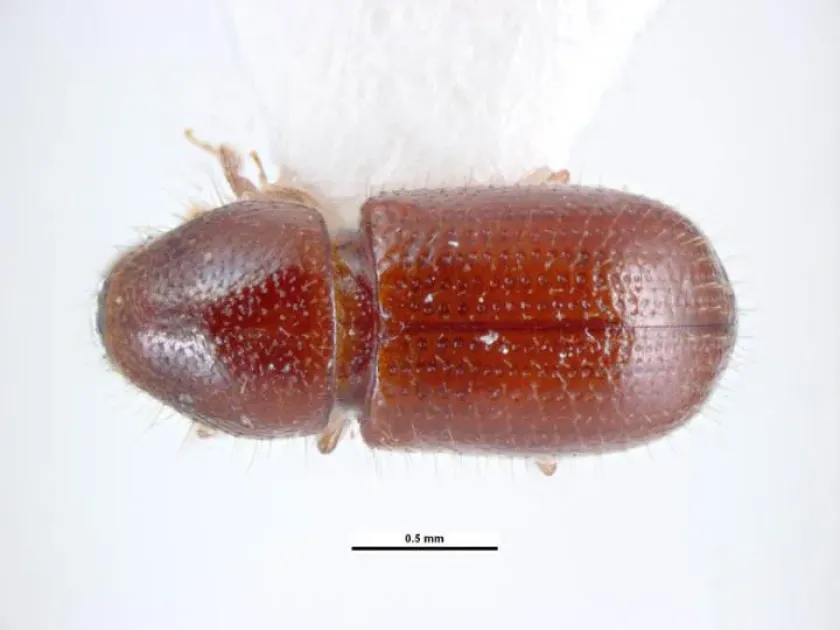
The palm seed borer Coccotrypes borasi belongs to the Curculionidae family, specifically the Scolytinae subfamily. These are tiny beetles, typically measuring between 1.5 and 2 millimeters in length.
The adult beetle has a cylindrical, dark-colored body covered with fine hairs. This morphology is specialized for boring into dense plant tissues like seeds and woody structures.
The larvae are white, legless, and possess a well-developed head capsule, which allows them to efficiently chew through the interior of palm seeds.
Their life cycle consists of four distinct stages: egg, larva, pupa, and adult. The adults are capable of flight, which aids in their dispersal between palm trees and storage facilities.
These insects thrive in warm, humid environments, which are essential for the survival and rapid development of their offspring inside the host seeds.
What it damages
The primary damage is caused to the seeds and fruits of various palm species. The beetles bore into the seed, feeding on the embryo and internal tissues.
This infestation destroys the seed's viability, rendering it useless for propagation and nursery production. It is a major concern for botanical gardens and commercial palm farms.
By tunneling into the seeds, the beetles create entry points for secondary infections such as fungi and bacteria, which lead to rapid decay of the seed material.
Economic losses are significant, as entire batches of imported or stored palm seeds can be ruined if the infestation is not detected early.
While adult beetles can sometimes be found on other plant parts, the damage to the reproductive organs is the most critical factor for palm agriculture.
Signs of infestation
The most reliable sign of an infestation is the presence of tiny, circular exit or entry holes on the surface of the palm seeds or fruits.
Close inspection often reveals fine wood-like dust, or frass, near these entry holes, which is a byproduct of the larvae's feeding activity.
Seeds that appear light or hollow when handled, or those that exhibit signs of decay and mold, are likely infested with these borers.
When an infested seed is cut open, a complex network of tunnels containing larvae, pupae, or adults can usually be observed.
Poor germination rates in a seed batch are often the first indicator that the seeds have been compromised by the palm seed borer.
Control measures
The primary control strategy involves strict phytosanitary measures and inspection of imported seed lots to prevent the introduction of the pest into new areas.
Heat treatment of seeds is an effective way to kill larvae and eggs, provided the temperature is managed carefully to avoid damaging the seed embryo.
Proper storage in sealed, airtight containers is crucial to prevent adult beetles from migrating from infested seeds to healthy ones during storage.
Prompt disposal of infested seeds, preferably by burning or deep burial, is essential to break the life cycle and reduce the local population of the beetle.
- Regular inspection of stored seed batches for entry holes.
- Use of pheromone traps to monitor adult beetle activity.
- Quarantine procedures for any suspicious imported palm seed lots.
Taxonomy
- Latin name
- Coccotrypes borasi
- Order
- Coleoptera (beetles)
- Family
- Curculionidae
- EPPO code
- COCOBO
Discussion
No discussions yet — be the first.