
Coccotrypes advena
Coccotrypes advena
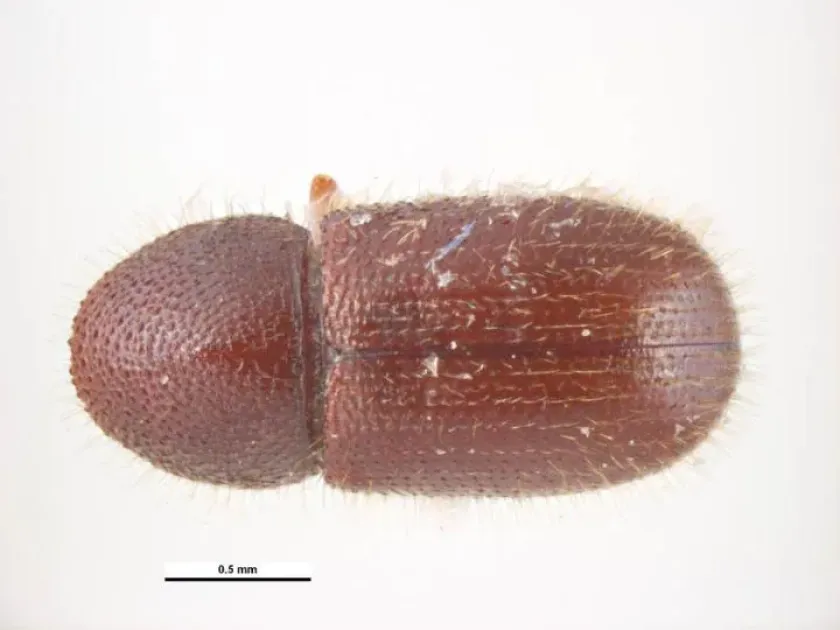
Description
How to identify
Coccotrypes advena belongs to the order Coleoptera and the family Curculionidae, specifically the subfamily Scolytinae. This small beetle is a well-known specialist that targets seeds and fruits of various plant species, particularly palms.
The adult beetle has a cylindrical, robust body measuring approximately 1.5–2 mm in length. Its coloration ranges from dark brown to black, providing excellent camouflage against the dark, fibrous surfaces of palm seeds.
The larvae are white, legless, and have a distinct head capsule. They spend their entire developmental phase feeding inside the endosperm, which keeps them protected from most environmental stressors and external predators.
Sexual dimorphism is characteristic of this species. Females are usually the active dispersers responsible for boring into the fruit, while males often remain within the galleries constructed by the females.
Accurate species identification usually requires expert analysis of the beetle's morphology, specifically the pronotum and elytral structure, as the genus Coccotrypes contains many morphologically similar species.
What it damages
Coccotrypes advena primarily damages palm seeds, leading to a complete loss of viability. The larvae tunnel through the endosperm, consuming the nutrient-rich tissues necessary for embryo development.
The pest poses a significant economic threat to plant nurseries, botanical gardens, and commercial plantations. Infested seeds lose their germinating capacity, rendering them useless for future planting or propagation.
Beyond direct feeding damage, the beetles create entry points that facilitate secondary infections by fungi and bacteria. These pathogens rapidly destroy the internal structure of the seed, causing total decay.
In stored seed collections, an untreated infestation can destroy an entire batch within a few months. Because the damage occurs internally, it is often not detected until the emergence holes become visible on the surface.
Loss of quality makes the seeds unsuitable for any further use. This species is often subject to strict quarantine regulations in many countries to prevent its introduction into new regions.
When it appears
In tropical and subtropical regions, Coccotrypes advena populations can breed continuously throughout the year. The lack of seasonal dormancy makes the pest highly resilient in warm climates.
In controlled greenhouse environments, the life cycle depends entirely on the ambient temperature and humidity. Higher temperatures generally shorten the generation time, leading to rapid population explosions.
The insects can remain active as long as the temperature stays above their developmental threshold. During colder periods, they undergo reduced activity, staying safely inside the host fruit to survive until conditions improve.
The number of generations produced per year is directly correlated with the stability of the environment. In optimal conditions, a generation can be completed within 4 to 8 weeks.
Adult flight for mating and colonization of new fruits often coincides with the ripening of new palm crops. This is the period when crops are most vulnerable and require increased vigilance.
Signs of infestation
The most reliable sign of an infestation is the presence of small, circular exit or entry holes on the seed coat. These holes are often surrounded by fine dust, known as frass, which is pushed out by the beetles.
Internally, the seed contains extensive galleries and tunnels. If cut open, one will observe larvae, pupae, and adults occupying these chambers, along with significant amounts of larval waste.
Premature fruit drop is another common sign. If a fruit or seed feels unusually light or hollow when handled, it is highly likely that it has been colonized by the beetle larvae.
A musty or decaying odor emanating from stored seeds indicates significant internal damage caused by the combined action of the beetles and secondary microbial infections.
Discoloration or softening of the fruit surface can also indicate that the beetle galleries have progressed close to the outer shell, signaling a severe infestation level.
Control measures
Strict phytosanitary inspection and quarantine of imported plant materials are the primary defenses against the spread of Coccotrypes advena. Any suspect shipments should be rejected or treated.
Fumigation of seeds in sealed containers is the most effective way to eliminate larvae and adults inside the seeds. This process must be carried out by professionals to ensure safety and effectiveness.
Monitoring using pheromone traps is essential for early detection in greenhouse environments. These traps help identify the presence of adults before they cause significant damage to the seed stock.
Promptly disposing of and destroying infested materials via incineration is a mandatory practice. Removing discarded fruits from the growing area prevents the pest from completing its life cycle.
Preventive systemic insecticide treatments on mother plants during the fruit formation phase may reduce the risk of infestation, though their use must be balanced against ecological impact and safety guidelines.
Taxonomy
- Latin name
- Coccotrypes advena
- Order
- Coleoptera (beetles)
- Family
- Curculionidae
- EPPO code
- COCOAD
Discussion
No discussions yet — be the first.