
Cliona celata
Cliona celata
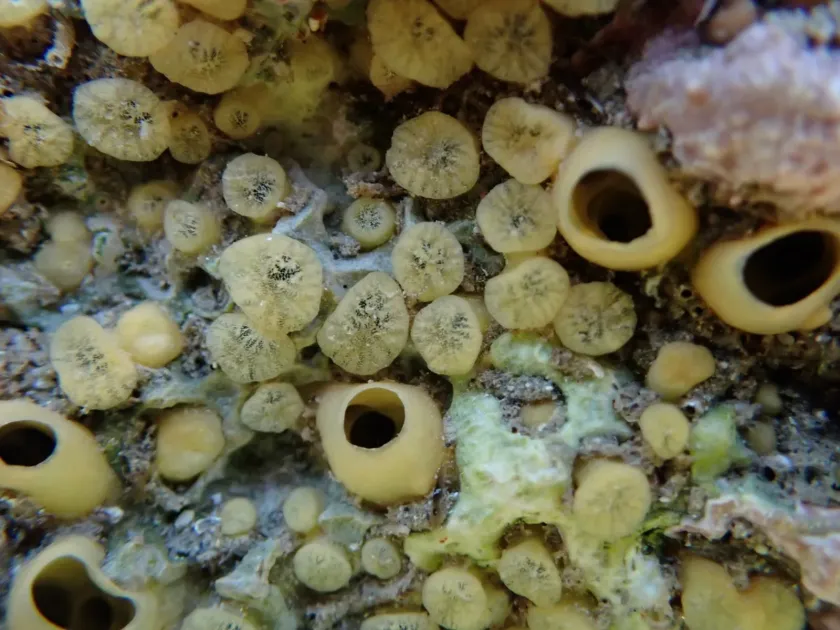
Description
How to identify
Cliona celata is a species of marine sponge belonging to the order Hadromerida and the family Clionaidae. It is widely recognized in marine biology for its ability to bore into calcareous substrates, such as shells and limestone.
The sponge begins its lifecycle as a microscopic larva that settles onto a suitable calcareous surface. Upon attachment, it secretes acidic compounds to dissolve calcium carbonate, gradually creating a complex system of interconnected tunnels and chambers.
As the colony matures, it transitions from an endolithic (internal) existence to an epilithic (external) form, manifesting as bright yellow or orange fleshy growths. These growths are firm and possess a distinct texture due to the presence of silica spicules.
The organism is highly efficient at bioerosion, which is essential for its survival in competitive marine environments. Its ability to thrive in various depths and temperatures makes it a persistent challenge for marine resource management.
Identifying Cliona celata is critical for farm biosecurity. Early detection is often the only way to prevent widespread infestation of bivalve mollusks, which are the primary victims of this sponge's erosive activity.
What it damages
This sponge primarily targets bivalve mollusks, particularly oysters and mussels. By boring into the shells, it compromises the structural integrity of the mollusk's only defense against external predators and environmental stressors.
The damage caused by the sponge leads to significant economic loss in aquaculture. Infected shells become brittle and prone to breakage during harvesting and shipping, rendering the products unsuitable for commercial sale.
Moreover, the energy expenditure required for the mollusk to repair its shell layers diverts resources away from growth and meat production. This results in smaller, lower-quality yields and increased mortality rates among the stock.
Severe infestations can lead to total stock failure. When the sponge reaches the mantle cavity, the mollusk's physiological processes are severely disrupted, often leading to immediate death of the host organism.
Infrastructure damage is also a concern. Cliona celata can bore into limestone structures, pylons, and pier foundations used in aquaculture, necessitating expensive repairs and maintenance to ensure the stability of the farm.
Signs of infestation
The first signs of infestation are small, circular holes on the outer surface of the shell. These pores serve as entry points for the sponge's water-pumping system and become more numerous as the colony expands.
A brittle texture is a hallmark of an advanced infestation. When pressure is applied, the shell surface may crumble, revealing the intricate network of tunnels filled with soft, yellow sponge tissue underneath.
In mature stages, the presence of distinct, thick orange or yellow patches on the shell is undeniable evidence of the sponge. These patches often obscure the original pattern and texture of the healthy shell surface.
The internal side of the shell may show discoloration, with dark or brownish stains appearing in response to the sponge's proximity to the mantle. This indicates that the sponge has eroded the entire thickness of the shell.
Affected shellfish exhibit reduced filtration and feeding rates. The constant stress of living with a burrowing parasite often results in poor physical condition and a failure to thrive compared to healthy, uninfected neighbors.
Control measures
Physical removal is a common practice, though it must be done carefully to avoid causing further damage to the shellfish. Sun-drying the affected batches is a highly effective, low-cost method that utilizes desiccation to kill the sponge.
Freshwater dips are often used in commercial settings. Since Cliona celata is a strictly marine organism, exposure to low-salinity water for a specific duration kills the sponge while leaving the mollusks unharmed.
Farm management strategies should prioritize the isolation of infected stock. Removing and disposing of heavily infested shells prevents the release of sponge larvae, which could otherwise settle on healthy oysters.
- Implement strict biosecurity protocols for equipment sterilization.
- Utilize elevated trays to prevent bottom-dwelling larvae contact.
- Monitor water quality parameters periodically to discourage colonization.
- Practice regular harvesting to keep stock turnover high.
Long-term prevention involves choosing farming sites away from areas with high concentrations of decaying shell debris. Maintaining a clean aquatic environment minimizes the substrate available for new sponge larvae to establish themselves.
Taxonomy
- Latin name
- Cliona celata
- Family
- Clionidae
- EPPO code
- CLIOCE
Discussion
No discussions yet — be the first.