
Thistle weevil
Cleonis piger
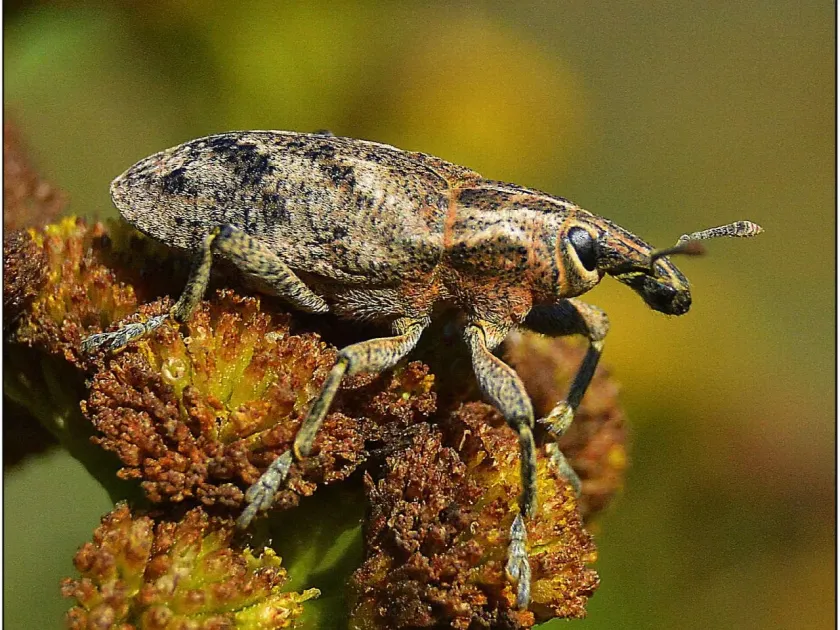
Description
How to identify
The thistle weevil (Cleonis piger) is a beetle species belonging to the Curculionidae family. The adult insect has an elongated body ranging from 12 to 16 mm in length, covered in dense gray or brownish scales.
A key identifying feature is the prominent rostrum (snout) with elbowed antennae. The body is robust, allowing the beetle to blend in with the stems of its host plants.
The larvae are legless with a white, curved body and a distinct brown head. They live and feed internally within the stems or root collars, making them difficult to detect until significant damage has occurred.
The life cycle involves complete metamorphosis. Adults typically overwinter in the soil or under leaf litter, emerging in the spring when temperatures rise to resume their activity.
This pest is commonly associated with fields heavily infested with Asteraceae weeds, which provide the primary breeding ground for the weevil population.
What it damages
The primary hosts of the thistle weevil are plants in the Asteraceae family, such as thistles, burdocks, and knapweeds. In agricultural settings, it poses a direct threat to sunflower crops.
Adults feed on the leaves and stems, creating small, irregular holes that reduce the plant's photosynthetic capacity. However, the larval feeding causes the most severe economic impact.
Larvae bore into the pith of the stem, destroying the internal tissues responsible for water and nutrient transport. This leads to stunted growth, reduced seed set, and deformed flower heads.
Structurally damaged stems are prone to lodging during wind events, leading to significant yield losses. Furthermore, open wounds provide entry points for fungal pathogens and bacterial rots.
High infestation rates can result in the premature death of young sunflower plants, significantly reducing the overall crop density in the field.
When it appears
Overwintered adults emerge from the soil in late spring, usually when air temperatures consistently reach +10°C to +12°C. They begin by feeding on young thistle shoots and other weeds.
The mating and egg-laying period typically occurs throughout June and July. Females create small punctures in the stems and deposit single eggs into the tissues.
The larval stage lasts through the summer months, with the most active feeding period occurring in July and August. During this time, the larvae grow rapidly inside the host stem.
Pupation takes place at the end of the summer inside the stem or in the soil near the roots. New adults emerge in late summer, feed briefly, and then seek overwintering sites.
Field monitoring should be prioritized during the vegetative growth phase, as this is when the crop is most vulnerable to internal stem damage.
Signs of infestation
Adult presence can be detected by examining the leaves for small, notched edges where the beetles have been feeding. These signs are often visible early in the season.
Larval infestation is characterized by the formation of galls, swellings, or thickened areas on the lower part of the sunflower stem.
A significant indicator of established larvae is the wilting of the plant despite sufficient soil moisture, as the internal vascular system has been compromised.
- Presence of circular exit holes in the stems where larvae have emerged.
- Hollowed-out pith detected upon longitudinal stem slicing.
- Discoloration and premature yellowing of lower foliage.
Regular field scouting, particularly around the edges of the field near wasteland or borders, is essential to identify infestations early.
Control measures
The most effective management strategy is the control of host weeds like thistles and burdocks within and around the sunflower fields, which act as primary reservoirs.
Implementation of crop rotation is highly effective, as it disrupts the life cycle of the weevil by removing the host crop from the same field for several consecutive years.
Deep autumn plowing or soil cultivation can help destroy pupae and adults overwintering in the soil, effectively reducing the population for the next growing season.
If thresholds are exceeded, the application of systemic insecticides during the adult emergence phase can mitigate damage before egg-laying begins.
Biological control methods and the use of resistant sunflower hybrids are ongoing areas of research, but cultural practices currently remain the most reliable approach for farmers.
Taxonomy
- Latin name
- Cleonis piger
- Order
- Coleoptera (beetles)
- Family
- Curculionidae
- EPPO code
- CLEOPI
Discussion
No discussions yet — be the first.