
Japanese beet weevil
Cleonis japonicus
Description
How to identify
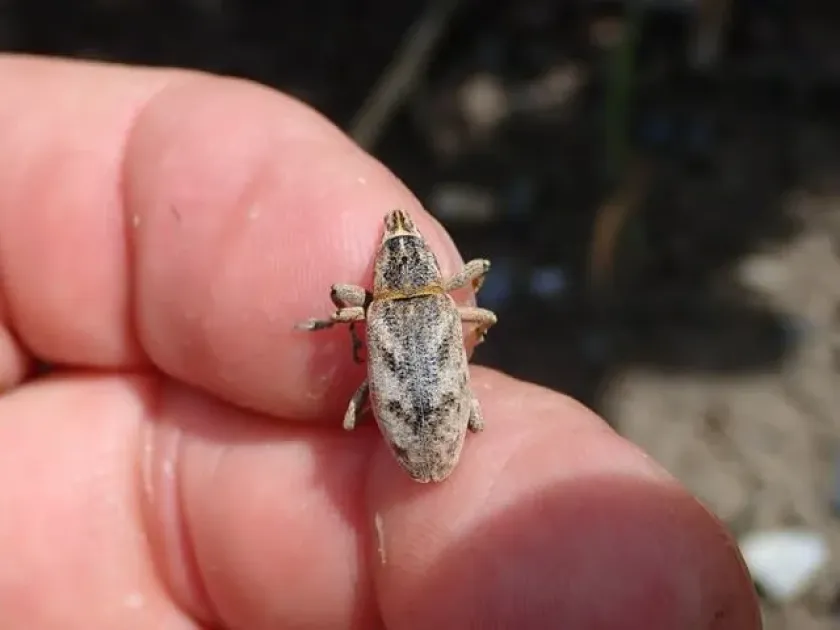
The Japanese beet weevil (Cleonis japonicus) is a member of the Curculionidae family, order Coleoptera. Adult weevils are characterized by a distinct elongated snout and a body covered in mottled brownish-grey scales, providing excellent camouflage against soil.
The larvae of this species are typical for weevils: legless, fleshy, and C-shaped, ranging from cream to white in color with a hardened, brown head capsule. They spend their entire developmental phase within the soil environment.
Adult weevils possess functional wings and are capable of flight, allowing them to migrate between fields and re-colonize suitable host crops throughout the growing season.
The species displays a high level of environmental plasticity, which contributes to its successful survival and proliferation across diverse agricultural landscapes where beets are cultivated.
Proper identification usually involves examining the characteristic snout morphology of the adults and the specific tunnel-like feeding patterns found on the host root systems.
What it damages
The primary hosts for the Japanese beet weevil include sugar beet, fodder beet, and table beet. The pest causes significant economic losses by directly attacking the root systems of the plants.
Adult weevils feed on the foliage during the early stages of plant development, creating characteristic notches or ragged edges on the leaves, which reduces photosynthetic capacity.
The larvae are particularly destructive as they burrow into the taproots of the beets, creating extensive galleries that weaken the plant and severely compromise its structural integrity.
Damaged root crops show a marked decline in sucrose content, making them unacceptable for processing in the sugar industry and reducing the total marketable yield.
Furthermore, the physical damage caused by larvae facilitates the entry of secondary pathogens, leading to an increased incidence of root rots and fungal decay in the field and during storage.
When it appears
Overwintered adults emerge from the soil during the spring, coinciding with the germination phase of the beet crop, when soil temperatures reach favorable levels.
Mating and oviposition occur throughout the late spring and early summer, with females laying eggs in the soil adjacent to the beet roots for easy access by emerging larvae.
Larval development takes place throughout the summer months, with the larvae actively consuming root tissues and reaching maturity by late summer or early autumn.
Pupation occurs within earthen cells in the soil, followed by the emergence of the new generation of adults, which will eventually transition into overwintering sites.
The overwintering stage typically occurs in the adult phase, where the beetles seek shelter deep in the soil profile to withstand winter temperatures.
Signs of infestation
Early-season scouting should focus on the presence of notches on the seedling leaves, which indicates adult weevil feeding activity in the field.
As the season progresses, patches of stunted or wilting plants become visible, often appearing in localized areas where larval populations are concentrated.
Digging around the roots of affected plants typically reveals the presence of larvae or the hollowed-out tunnels they create inside the beets.
Discoloration of the foliage, particularly during the hottest part of the day, is a common indicator of root damage preventing proper water uptake.
- ragged leaf margins on young seedlings
- visible feeding tunnels within harvested roots
- uneven crop emergence and stunted growth
- localized patches of plant decline in the field
Control measures
Crop rotation is the cornerstone of integrated management; avoiding beet cultivation on the same land for several years helps significantly reduce local populations.
Deep autumn plowing is a highly effective cultural control method that disrupts the soil cells where larvae and pupae reside, exposing them to environmental stress and predators.
Seed treatments with systemic insecticides are recommended as a proactive measure to protect young seedlings from early-season adult feeding damage.
In cases of high infestation, targeted foliar applications of insecticides during the peak adult emergence window are necessary to prevent further reproduction.
Sanitation practices, specifically the removal of wild host plants from the Chenopodiaceae family, effectively reduce alternative feeding sites for the weevil.
Taxonomy
- Latin name
- Cleonis japonicus
- Order
- Coleoptera (beetles)
- Family
- Curculionidae
- EPPO code
- CLEOJA
Discussion
No discussions yet — be the first.