
Sea vase
Ciona intestinalis
Description
How to identify
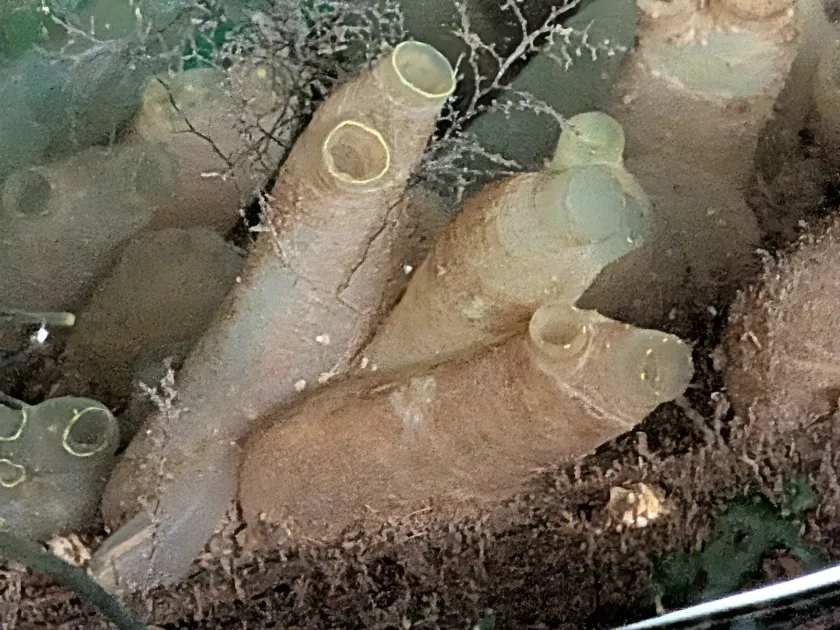
Ciona intestinalis, commonly known as the sea vase, is a solitary tunicate belonging to the subphylum Tunicata. It is recognized by its cylindrical, translucent body attached to a substrate.
The organism features two prominent siphons: an oral siphon for intake and an atrial siphon for water discharge, which are used for filter-feeding on plankton.
The body is encased in a soft, gelatinous tunic that gives it a slippery and semi-transparent appearance, often displaying pale yellow or greenish tints.
These animals are hermaphrodites and reproduce rapidly, which allows them to colonize available surfaces in dense clusters within a very short time frame.
The larval stage is free-swimming and looks like a tadpole, which helps the species disperse across large marine areas before settling on a permanent host surface.
What it damages
The sea vase acts as a major pest in the aquaculture industry, particularly affecting shellfish farms, including oysters, mussels, and scallops.
Its primary damage is caused by heavy biofouling, where dense colonies attach to nets, ropes, and farming cages, significantly increasing the drag and weight of the equipment.
This accumulation can lead to structural failure, causing nets to sag or tear under the excessive weight of the accumulated tunicate biomass.
As efficient filter feeders, they compete directly with farmed mollusks for food resources like phytoplankton, leading to stunted growth and reduced market value of the crop.
Furthermore, the presence of large Ciona populations disrupts local water flow, leading to stagnant conditions and potential accumulation of waste materials near the farming site.
When it appears
The activity and reproduction cycle of Ciona intestinalis are heavily influenced by ambient water temperatures in coastal environments.
In temperate regions, peak colonization occurs during the spring and summer months as rising temperatures trigger mass spawning and settlement of larvae.
In warmer climates, these organisms can remain active throughout the year, causing persistent challenges for aquaculture managers and farmers.
The life cycle from settlement to sexual maturity is remarkably short, allowing several generations to occur in a single growing season.
This rapid succession makes it difficult to maintain clean equipment, necessitating strict seasonal monitoring and timely maintenance interventions.
Signs of infestation
A primary sign of infestation is the appearance of dense, jelly-like clusters on submerged aquaculture structures, which look like clumps of translucent sacs.
Farmers often notice a significant increase in the weight of suspended cages or ropes when retrieving them from the water, indicating high fouling loads.
Decreased water flow through the mesh of aquaculture nets is another key indicator that Ciona colonies have established themselves and are obstructing the cages.
Growth rates of cultivated species might slow down noticeably, indicating that Ciona is successfully competing for essential nutrients in the water column.
Upon inspection, the presence of small, finger-like stalks attached to the gear confirms the start of an infestation before it spreads to fully-grown colonies.
Control measures
Mechanical removal remains the most reliable control method, employing brushes, scrapers, or high-pressure water jets to clear gear of fouling organisms.
The application of non-toxic, eco-friendly anti-fouling coatings on cage structures can help reduce the frequency and intensity of tunicate settlement.
Strategic management of equipment depth can sometimes mitigate the risk of colonization, as settlement patterns often vary within the water column.
Regular monitoring of water conditions and the presence of larvae allows farmers to schedule cleaning operations during critical periods of the reproductive cycle.
Integrated pest management strategies, including the use of local predators that may feed on tunicates, are currently under study for broader biological control.
Taxonomy
- Latin name
- Ciona intestinalis
- Family
- Cionidae
- EPPO code
- CIONIN
Discussion
No discussions yet — be the first.