
White stork
Ciconia ciconia
Description
How to identify
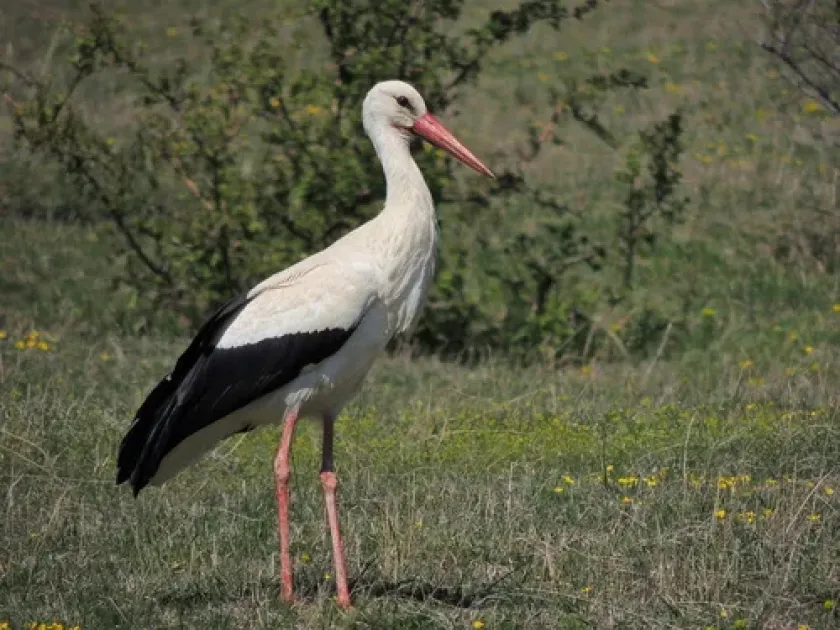
The White stork is a large bird belonging to the Ciconiidae family and Ciconiiformes order. It is characterized by its white plumage, black flight feathers on the wings, and long red bill and legs.
The species is easily recognized by its size, with a wingspan reaching up to 2 meters. During flight, White storks extend their neck and legs, which is a key visual identifier for field observation.
They are typical inhabitants of cultural landscapes and are often found nesting near human settlements. Their nests are highly visible and are typically placed on poles, buildings, or high trees.
Biologically, the species is a predator that relies on high-protein animal food sources. Their presence in the landscape is largely dependent on the availability of wetlands and open fields.
As a prominent member of the ecosystem, the White stork serves as a biological marker for the environmental health of an agricultural region.
What it damages
The White stork is not a plant pest. It is a carnivorous bird that does not consume crops, seeds, fruits, or any other plant tissue as part of its diet.
While storks may traverse cultivated land, they do not cause meaningful damage to agricultural produce. Their mechanical impact on fields is negligible and lacks any economic significance.
Confusion sometimes arises when farmers see storks in fields where crops are already damaged. In these cases, the stork is present to feed on the pests (insects or rodents) that caused the original damage.
Economic damage caused by White storks is non-existent. On the contrary, their role as natural predators helps in the management of grasshoppers, locusts, and small mammals that threaten crop yields.
In agronomy, the White stork is considered a beneficial species. There is no justification for classifying this bird as a threat to agricultural productivity.
When it appears
The White stork is a migratory species that returns to its breeding grounds in the spring, typically between March and April, and departs for migration in late summer or early autumn.
The period of highest activity in fields coincides with the nesting season, when parents must forage extensively to feed their chicks. This period often aligns with the peak development of many crop pests.
Storks are attracted to fields during active agricultural operations, such as plowing or harvesting, which expose soil organisms. They are known for following machinery to capitalize on these feeding opportunities.
Since they are migratory, they are absent from the fields during the winter months, meaning they have no impact on dormant winter crops.
The seasonal presence of the White stork is a natural part of the annual agricultural cycle and requires no specific adjustment in farm management practices.
Signs of infestation
The primary sign of the White stork's presence is visual sightings of the birds in the fields. They prefer open spaces with short vegetation or recently tilled soil where they can easily spot prey.
Physical evidence, such as footprints in soft soil or regurgitated pellets containing insect chitin or small bone fragments, confirms their presence as predators rather than consumers of vegetation.
The absence of bite marks on leaves, stems, or fruits distinguishes the stork from actual crop-destroying pests. If crop damage is observed, it should be attributed to insects or rodents.
Observing storks concentrating in a specific area can act as an early warning system for the agronomist. It indicates a potential outbreak of pests that the birds are actively suppressing.
The White stork leaves no traces of damage, only signs of its activity as an apex predator in the field ecosystem.
Control measures
No control measures or pest management practices are directed toward the White stork. The species is often legally protected, and any harm caused to these birds is strictly prohibited.
Rather than seeking control, farmers are encouraged to promote the presence of storks. They serve as free, efficient biological agents that contribute to pest suppression and ecosystem balance.
Sustainable agricultural practices, such as minimizing the use of broad-spectrum pesticides, help maintain a healthy population of storks, which in turn benefits the farm's productivity.
Management of nesting sites, particularly on utility poles, should be handled in cooperation with local energy authorities to ensure the safety of both the infrastructure and the birds.
- Support nesting site conservation on safe elevated structures.
- Adopt integrated pest management (IPM) to reduce chemical reliance.
- Monitor field pest levels by observing bird foraging behavior.
- Protect patches of natural vegetation to provide a robust prey base for natural predators.
Taxonomy
- Latin name
- Ciconia ciconia
- Family
- Ciconiidae
- EPPO code
- CICOCI
Discussion
No discussions yet — be the first.