
Oblique-banded leafroller
Choristoneura rosaceana
Description
How to identify
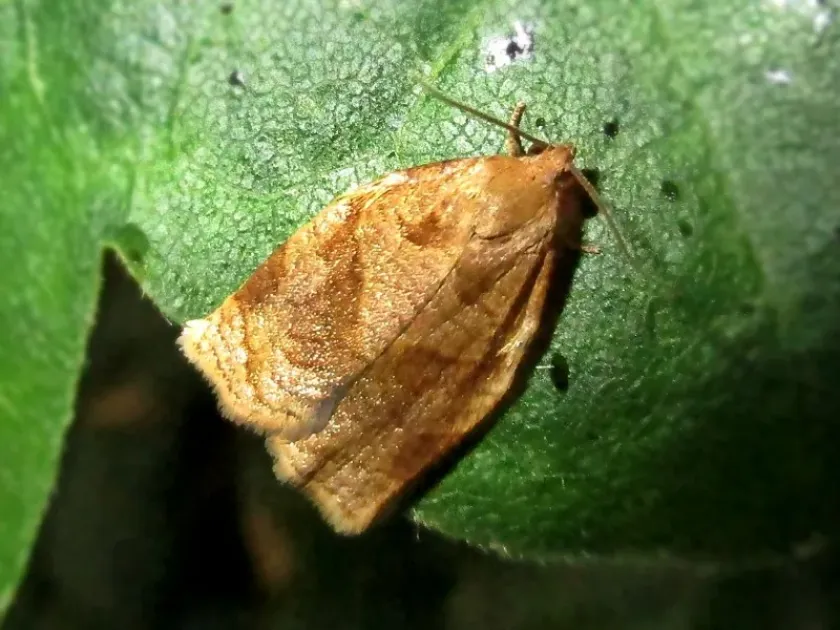
The oblique-banded leafroller (Choristoneura rosaceana) is a moth belonging to the family Tortricidae. The adult moth has a wingspan of approximately 20–25 mm, with a distinctive bell-shaped appearance when at rest, displaying brown to tan forewings with darker oblique bands.
Larvae are the primary damaging stage and pass through several instars. Early instars are typically pale with a black head, while later instars become olive green to brown with a dark head. They are highly active and will wiggle backward or drop on a silken thread when disturbed.
Pupae are found within rolled or tied leaves, serving as a protective shelter during metamorphosis. They are dark brown and usually positioned in the center of the damage site, making them difficult to spot without careful inspection of the foliage.
The eggs are laid in masses on the upper surface of leaves or smooth bark. These egg masses appear as overlapping, scale-like clusters that are greenish-yellow initially and turn darker as the embryos develop inside the eggs before hatching.
Monitoring is effectively conducted using pheromone traps to detect the flight period of adults. This data is critical for growers to time their control efforts precisely, ensuring that applications target the larvae before they create protective leaf shelters.
What it damages
This species is a generalist feeder known to attack a vast range of host plants. Economically significant damage is primarily observed in apple, pear, cherry, and plum orchards, where the larvae feed on both foliage and fruit throughout the growing season.
Beyond tree fruits, the larvae are a major pest for various small fruits such as raspberries, blueberries, and strawberries. Ornamental plants, particularly roses and hawthorns, are also frequently attacked, causing significant aesthetic and structural harm.
In spring, larvae bore into swelling buds and young terminals, causing them to wither and fail to develop. This can severely stunt the growth of young trees in nursery settings, leading to deformed branches and a permanent loss of form.
Fruit damage is a significant concern, as larvae feed on the surface of developing fruit, leaving deep, irregular scars or shallow pits. These injuries not only reduce market grade but also provide entry points for secondary fungal infections like fruit rot.
Heavy infestations can lead to substantial foliage loss, reducing the photosynthetic capacity of the plant. This weakens the tree, making it more susceptible to other stressors, including winter injury and subsequent disease outbreaks in the following year.
When it appears
The species typically overwinters as third-instar larvae tucked into small silk cocoons in bark crevices or other protected sites. As temperatures rise in early spring, they emerge to feed on buds and unfolding leaves, marking the start of the first generation.
Depending on the latitude and climate, the oblique-banded leafroller may complete one, two, or even three generations per year. In regions with long growing seasons, the second and third generations often overlap, complicating pest management decisions.
Adult flight usually occurs in late spring or early summer, depending on the thermal accumulation (degree days). Females lay egg masses shortly after mating, and larvae emerge from these eggs within two weeks to begin the summer feeding cycle.
Summer larvae are responsible for the most severe fruit damage. Because they are often active when fruit is sizing or ripening, late-season control is essential to prevent cosmetic defects that would render the harvest unmarketable.
As day length shortens and temperatures decline in the autumn, larvae of the final generation transition into their overwintering phase. They seek refuge on the woody parts of the host plant to survive the winter months, completing the cycle.
Signs of infestation
The most recognizable sign is the presence of rolled or folded leaves held together with silk strands. These nests act as a refuge for the larvae, and often frass (excrement) can be seen at the edges of these shelters, indicating recent feeding.
Webbed clusters of fruit and foliage are clear indicators of the pest's presence. Larvae frequently tie two leaves together or a leaf to a fruit, protecting themselves from predators while they consume the plant tissue underneath.
Bud damage in spring, manifested as dry, webbed, and stunted buds, is an early sign of infestation. Affected terminals may stop growing or develop in an irregular, curved fashion, which is a classic symptom of leafroller activity.
Shallow, scarred patches on the skin of mature fruit are diagnostic. These wounds often heal into corky, brownish tissue, significantly devaluing the fruit, even if the internal flesh is relatively untouched.
Observing adult moths near pheromone traps or at lights during the night confirms the presence of the population, helping to distinguish it from other tortricid pests that may be present in the same orchard.
Control measures
Integrated Pest Management (IPM) is crucial. Cultural practices such as pruning out infested terminals and removing debris from the orchard floor can reduce overwintering sites, though these are more effective in small-scale plantings.
Biological control involves the use of parasitic wasps and other natural predators. Bacillus thuringiensis (Bt) sprays can be highly effective against early-instar larvae if applied while they are still exposed and before they tie leaves together.
Chemical control must be timed to coincide with the larval hatch. Using selective insecticides that are less harmful to beneficial insects helps preserve the natural balance, preventing outbreaks of secondary pests like spider mites.
Mating disruption using pheromone dispensers is a highly effective, non-toxic strategy for larger commercial orchards. It prevents males from locating females, thereby drastically reducing the total number of larvae in subsequent generations.
- Apply insecticides targeting the first and second larval instars.
- Utilize pheromone traps to monitor adult flight and inform spray timing.
- Encourage natural enemies through habitat management in orchard borders.
- Regularly monitor fruit for early signs of surface feeding damage.
Taxonomy
- Latin name
- Choristoneura rosaceana
- Order
- Lepidoptera (butterflies)
- Family
- Tortricidae
- EPPO code
- CHONRO
Discussion
No discussions yet — be the first.