
Jack pine budworm
Choristoneura pinus
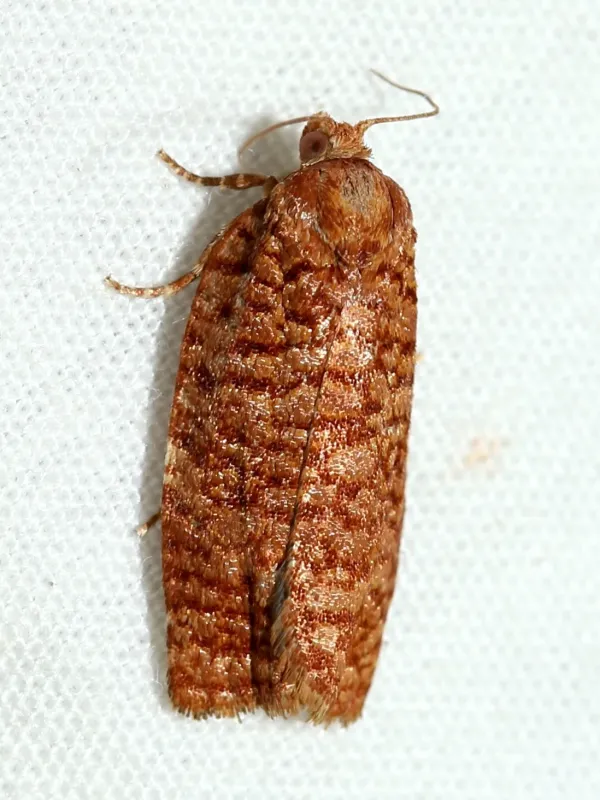
Description
How to identify
The Jack pine budworm (Choristoneura pinus) is a moth belonging to the family Tortricidae, known for its significant impact on pine forests.
Adult moths have a wingspan of approximately 20–25 mm, with forewings that display a mottled pattern of grey, brown, and rust, providing excellent camouflage.
Larvae (caterpillars) progress through several instars; early stages are light green, gradually darkening to a tan or olive-brown as they approach maturity.
Eggs are typically laid in masses on the upper surface of needles, appearing as overlapping, shingle-like clusters protected by a sticky secretion.
Pupation occurs within the protective webbing made of needles and silk, usually situated at the feeding site on the tree branches.
What it damages
The primary host for this species is the Jack pine (Pinus banksiana), though it can also infest other pine varieties within its range.
Feeding larvae consume needles, starting with the new growth, which severely reduces the tree's photosynthetic capacity.
Extensive defoliation throughout the growing season weakens the host trees, making them highly susceptible to secondary attacks by wood-boring beetles.
Repeated outbreaks over multiple years can result in top-kill, tree mortality, and significant loss of timber volume in affected stands.
In ornamental and nursery settings, this pest causes aesthetic damage by deforming growth and causing premature needle browning.
When it appears
The adult moth flight season generally occurs in mid-summer, typically peaking in July when mating and oviposition take place.
The species overwinters as second-instar larvae that enter diapause in small, silken shelters hidden in bark crevices or under cone scales.
In the spring, larvae emerge to mine old needles before migrating to newly expanding buds, which are their preferred food source.
The peak feeding period occurs during late spring and early summer, correlating with the phenology of the host tree's bud burst.
The development cycle is tightly synchronized with host tree development, ensuring food availability for the larvae as they grow.
Signs of infestation
The most visible indication of an infestation is the presence of silk webbing, which binds the needles and buds together into small clumps.
Damage symptoms include browned, clipped needles that remain attached to the webbed clusters, giving the tree a scorched appearance.
Heavy frass (larval waste) accumulation on branches and the forest floor is a strong indicator of an active and heavy infestation.
New shoots often appear stunted, malformed, or entirely consumed, reflecting the larvae's preference for fresh growth.
- Webbed needle clusters on branch tips.
- Reddish-brown discoloration of the canopy.
- Increased bird activity in the stand searching for larvae.
Control measures
Monitoring programs often utilize pheromone-baited traps to track moth populations and predict potential outbreak severity.
Chemical control involving systemic insecticides is sometimes utilized in high-value timber or urban areas during the early larval stage.
Biological pesticides, such as those derived from Bacillus thuringiensis, provide an effective alternative for environmentally sensitive areas.
Promoting diverse forest structures and maintaining tree vigor are long-term strategies to mitigate the risk of severe budworm damage.
Encouraging natural predators, including parasitic wasps and insectivorous birds, is a vital component of integrated pest management in forests.
Taxonomy
- Latin name
- Choristoneura pinus
- Order
- Lepidoptera (butterflies)
- Family
- Tortricidae
- EPPO code
- CHONPI
Discussion
No discussions yet — be the first.