
Spruce budworm
Choristoneura orae
Description
How to identify
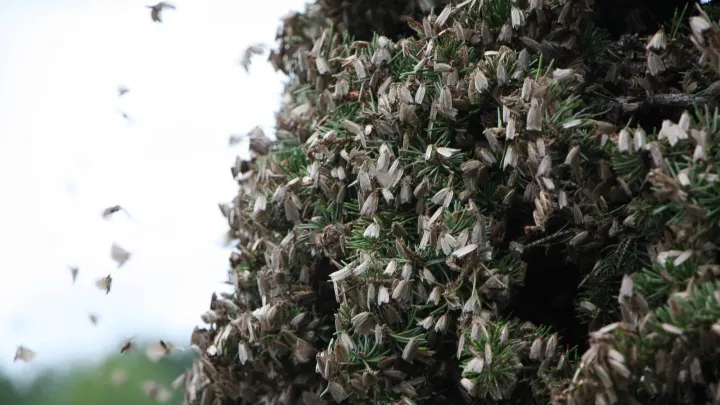
The spruce budworm (Choristoneura orae) is a member of the Tortricidae family, an order of Lepidoptera. The adult moth typically has a wingspan of 20–25 mm, displaying mottled brownish patterns that provide excellent camouflage against tree bark.
The larvae, or caterpillars, undergo several instars. They are typically dark-colored with visible light spots at the base of their setae, which distinguishes them from other conifer-feeding larvae.
The life cycle consists of four distinct stages: egg, larva, pupa, and adult. This species typically completes one generation per year, with environmental temperature being the primary driver of development rates.
Female moths lay eggs in clusters on the needles or twigs of the host tree. These egg masses are covered with a protective fluid that hardens, shielding the eggs throughout the winter until spring hatching.
Larvae are highly gregarious during the early stages of development, often working together to web needles and terminal shoots into protective shelters where they feed and grow.
What it damages
This pest primarily attacks members of the Picea (spruce) genus. In some forest environments, they can also infest fir trees, causing significant needle loss and shoot damage across large areas.
The larvae feed specifically on the new needles of the current year's growth. By severing the needles at the base, they cause them to wither and fall, resulting in the characteristic brown appearance of damaged branch tips.
Severe infestations can lead to the total destruction of the new annual growth. Persistent attacks over several years can weaken trees, reduce diameter growth, and eventually lead to tree mortality.
In ornamental landscapes, the aesthetic damage is significant, as the crown becomes ragged and deformed. Weakened trees are significantly more susceptible to secondary infestations by bark beetles.
In silvicultural settings, spruce budworm outbreaks represent a serious economic threat, as they directly reduce timber yield and health in coniferous stands.
When it appears
Larval emergence occurs in early spring, synchronized with the bud burst of spruce trees. This timing ensures that the caterpillars have access to the most nutritious, succulent foliage immediately upon hatching.
The active feeding phase peaks in late spring and early summer. During this time, larvae consume needle tissues rapidly, causing the most visible damage to the tree's health.
Pupation typically occurs in mid-summer. Pupae are protected within the foliage webbing or in crevices of the bark, which provides a degree of security from avian predators.
Adult moths emerge in mid-to-late summer. They are nocturnally active and are the stage responsible for mating and dispersing to new host trees to lay their eggs for the following year.
Monitoring for adult flight activity using pheromone traps is standard practice for forest managers, allowing for population density assessments before the next growing season begins.
Signs of infestation
Initial signs of an infestation include fine silk webbing around the buds and needles. This is the first indicator that larval activity has begun on the host plant.
As the infestation progresses, the needles within the webbing turn yellowish-brown. Severely infested shoots eventually become brittle and fall off, giving the tree a scorched appearance.
- Webbed needle clusters on the tips of branches.
- Needle discoloration (yellowing and browning).
- Accumulation of frass (larval excrement) trapped in the webbing.
- Distorted, curled, or stunted terminal shoots.
- Presence of larvae that drop on silk threads when disturbed.
Close inspection of the branch tips during the spring is the most reliable way to spot the caterpillars before they cause extensive damage to the tree crown.
The loss of new growth makes it easy to detect affected trees from a distance, as the bright green tips are replaced by brown, dying tissue.
Control measures
Biological control methods include the application of Bacillus thuringiensis (Bt), which targets the larval stage while remaining harmless to beneficial insects and birds.
Mechanical control is effective in small gardens: pruning and destroying infested twigs and webbed clusters can significantly reduce the local population of the pest.
Chemical control using systemic insecticides is generally reserved for severe outbreaks and must be applied at the correct timing—shortly after larval emergence and before they protect themselves with thick webbing.
Fostering a healthy environment for natural predators, such as parasitic wasps and predatory beetles, is a sustainable way to keep population numbers below economic damage thresholds.
Maintaining tree health through proper irrigation and balanced fertilization increases the tree's vigor and its ability to withstand or recover from budworm feeding.
Taxonomy
- Latin name
- Choristoneura orae
- Order
- Lepidoptera (butterflies)
- Family
- Tortricidae
- EPPO code
- CHONOR
Discussion
No discussions yet — be the first.