
Western spruce budworm
Choristoneura occidentalis
Description
How to identify
The Western spruce budworm (Choristoneura occidentalis) is a moth belonging to the order Lepidoptera and the family Tortricidae. It is considered one of the most destructive forest defoliators in North America.
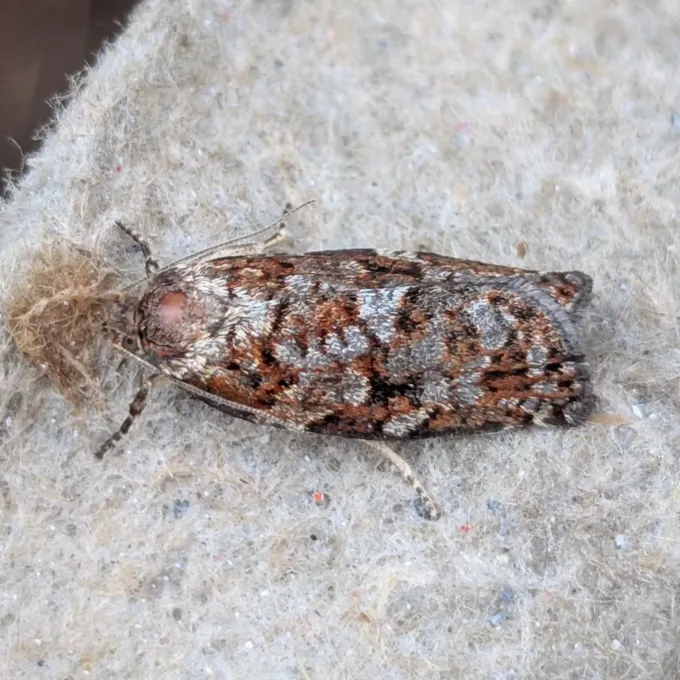
Adult moths have a wingspan ranging from 20 to 25 mm. Their forewings typically exhibit a mottled pattern of grey, brown, and reddish-orange, providing excellent camouflage against tree bark.
Larvae, commonly known as budworms, undergo several instars. They start as pale-colored larvae and develop darker brown bodies with prominent light-colored spots as they mature.
The pupal stage occurs within the foliage where the larvae have been feeding. Pupae are dark brown and usually attached to silk webbing spun between needles.
This species is highly adapted to temperate coniferous forests, and its life cycle is synchronized with the bud burst of its host tree species.
What it damages
The primary hosts of the Western spruce budworm are various species of fir (particularly Douglas-fir, grand fir, and subalpine fir) and spruce.
Larvae cause damage by feeding on current-year foliage and buds. This intensive feeding behavior causes the needles to wither and drop prematurely.
Repeated annual defoliation can lead to stunted tree growth, branch dieback, and eventually the mortality of the entire tree, especially in younger or stressed stands.
Large-scale outbreaks can cause significant economic losses in timber production by reducing wood quality and volume increment over many years.
Secondary damage often occurs when trees, weakened by budworm feeding, become susceptible to infestation by bark beetles and wood-boring insects.
When it appears
The Western spruce budworm follows a univoltine life cycle, meaning it produces one generation per year. Adult moths emerge and fly during the mid-to-late summer months.
Following mating, females lay eggs in clusters on the needles of host trees. These egg masses are often difficult to spot due to their green color.
Upon hatching, first-instar larvae do not feed immediately. Instead, they seek out sheltered locations under bark flakes to spin a hibernaculum for overwintering.
In spring, larvae emerge from their winter shelters precisely when the host tree buds begin to swell. They then bore into the buds to begin their feeding cycle.
The larval stage lasts for several weeks until pupation begins in early summer, effectively completing the development cycle before the next generation of adults appears.
Signs of infestation
The most visible sign of infestation is the presence of silk webbing among the needles, which the larvae use to tie needles together into protective nests.
Affected trees often show "browning" of the canopy, as the damaged needles turn reddish-brown and remain attached to the twigs for a time due to the silk webbing.
The accumulation of larval frass (excrement) within the webbed needles is a clear indicator of active feeding by the larvae during the spring growth period.
Terminal shoots may become deformed or stunted if the larvae focus their feeding activity on the leading bud of the tree branches.
Observation of high moth activity in the forest during the summer is a reliable indicator of a potential outbreak and significant defoliation in the following spring.
Control measures
Biological control is the preferred management strategy, particularly the application of Bacillus thuringiensis (Bt) to foliage to specifically target the larvae.
Integrated Pest Management (IPM) programs rely heavily on pheromone monitoring to track population density and determine the necessity of intervention.
Silvicultural treatments, such as thinning overstocked stands or increasing tree species diversity, can make forests less favorable for budworm outbreaks.
Conservation of natural predators, including parasitic wasps and various bird species, helps to maintain larval populations below an economic threshold in healthy forests.
In high-value forest areas or during severe outbreaks, chemical insecticides may be used as a last resort to protect critical timber stands or sensitive ecological habitats.
Taxonomy
- Latin name
- Choristoneura occidentalis
- Order
- Lepidoptera (butterflies)
- Family
- Tortricidae
- EPPO code
- ARCHOC
Discussion
No discussions yet — be the first.