
Lafaury's Tortrix
Choristoneura lafauryana
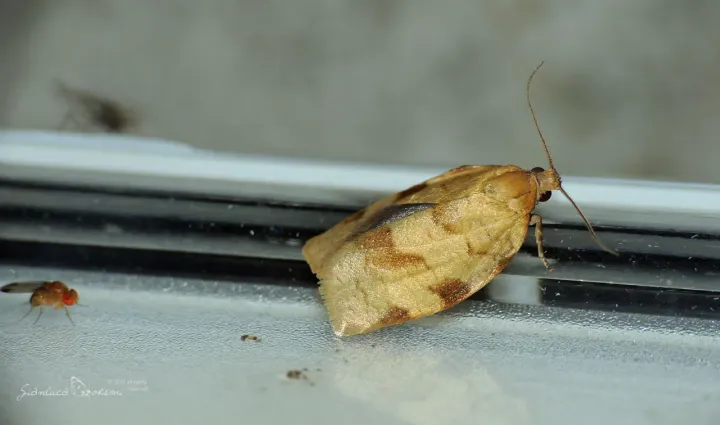
Description
How to identify
Lafaury's Tortrix (scientific name: Choristoneura lafauryana) belongs to the order Lepidoptera and the family Tortricidae, commonly known as leafrollers.
The adult moth is relatively small with a wingspan ranging from 18 to 22 mm, featuring a brownish-yellow pattern on the forewings that provides excellent camouflage.
The larvae are typically olive-green to yellowish with a dark head capsule, showing significant agility and the ability to drop on silk threads when disturbed.
Pupation occurs within the folded leaves or hidden within the crevices of the bark, providing shelter for the insect during its metamorphosis stage.
As a polyphagous species, it exhibits strong environmental adaptability, allowing it to thrive in diverse climatic zones and successfully colonize various orchard environments.
What it damages
The species primarily attacks fruit-bearing trees such as apples, pears, peaches, and various decorative shrubs, causing significant economic losses.
Larvae are the main destructive stage, feeding on foliage, buds, and young fruit, which compromises the overall health and vigor of the host plant.
By webbing leaves together, the larvae create protected feeding chambers, which also act as a shield against predators and contact-based pesticide applications.
The fruit damage involves superficial feeding scars, which not only reduce the market value of the crop but also create entry points for pathogens and fungal rot.
Extensive defoliation caused by high pest populations leads to reduced photosynthetic capacity, weakening the tree and making it susceptible to winter injury.
When it appears
The life cycle begins in early spring as temperatures rise, typically coinciding with the bud-burst stage of the host trees.
There are usually multiple generations per season, with adult flights occurring predominantly in early summer and again in mid-to-late August.
Larval activity is most intense during periods of rapid vegetative growth when the foliage is softest and highly suitable for larval nutrition.
The development time for each stage is highly dependent on the cumulative heat units, meaning warmer seasons often accelerate the population turnover.
Overwintering occurs primarily at the larval stage within dense, silk-lined hibernacula tucked away in the bark or near dormant buds.
Signs of infestation
The most visible sign of infestation is the presence of leaves tightly rolled or tied together with silk, forming noticeable clusters or nests.
- Accumulation of frass (larval excrement) near the damaged leaves.
- Wilting of flower clusters caused by larvae feeding on the pedicels and buds.
- Skeletonization of leaves, where only the veins remain after the tissue has been consumed.
- Visible scarring on the fruit surface, often resulting in misshapen development.
- The presence of larvae inside the rolled leaf nests when inspected during the growing season.
Severe infestations often show yellowing and premature leaf drop in the affected canopy areas, indicating high feeding pressure.
During the dusk hours, the presence of moths flying around the tree crowns serves as a precursor to the next generation of larvae.
Control measures
Integrated pest management (IPM) should start with the use of pheromone traps to monitor adult flight periods and determine the timing of interventions.
Cultural control practices, including orchard sanitation and pruning to remove infested branches, are effective in reducing the overwintering population.
Biological control using Bacillus thuringiensis or parasitic wasps like Trichogramma can be highly effective against the larval stage.
Chemical control should be applied strategically, targeting the younger larval stages to prevent significant fruit damage and minimize environmental impact.
Rotating insecticide modes of action is critical to prevent the development of resistance in the pest population, ensuring long-term control effectiveness.
Taxonomy
- Latin name
- Choristoneura lafauryana
- Order
- Lepidoptera (butterflies)
- Family
- Tortricidae
- EPPO code
- CHONLA
Discussion
No discussions yet — be the first.