
Variegated golden tortrix
Choristoneura hebenstreitella
Description
How to identify
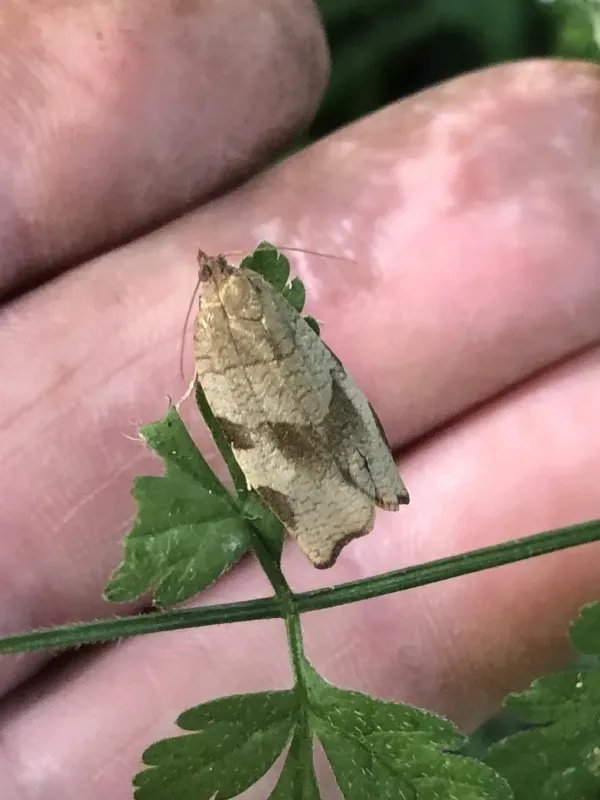
The Variegated golden tortrix belongs to the Tortricidae family within the order Lepidoptera. The adult moth has a wingspan ranging from 18 to 26 mm, displaying a complex, mottled pattern of brown and ochre scales on its forewings, which mimics tree bark.
Larvae, or caterpillars, reach lengths of 20–25 mm. They typically exhibit an olive-green to grayish body color with a dark, often black, head capsule. Their bodies are sparsely covered with fine, pale setae, which aid in stability within their shelters.
Eggs are deposited by females in flat, overlapping masses known as egg shields. These structures are remarkably cryptic, camouflaged to match the texture and color of the host tree bark, making them extremely difficult to locate.
Pupation occurs within the safety of leaf rolls or silken webs constructed by the caterpillars. The pupae are brown and remain relatively stationary until the adult moth emerges to continue the reproductive cycle.
This species is a generalist polyphage, meaning it can infest a wide variety of deciduous trees and shrubs, showing significant adaptability to different environmental conditions and host plant species.
What it damages
Primary host plants include various members of the Rosaceae family, such as apple, pear, plum, cherry, and hawthorn. The pest is particularly harmful because it consumes both foliage and developing reproductive structures.
Caterpillars emerge in early spring, targeting opening buds. By feeding on the buds, they effectively destroy the potential growth and fruit-bearing capacity of the shoots, leading to significant yield reduction.
As the season progresses, the larvae move to the leaves, rolling them into characteristic tubes or dense clumps secured by silk webbing. This behavior shields the pest from predators and many pesticide applications.
Severe infestations can lead to complete skeletonization of the leaves, which hinders photosynthesis and weakens the tree's overall vigor. In many cases, this physiological stress negatively affects future bud differentiation.
Damage to the fruit itself is another critical issue. The larvae bore into the developing fruit, creating cavities that often serve as entry points for rot-causing fungi, ultimately ruining the harvest quality.
When it appears
The adult moth flight period typically peaks in June. Depending on the geographical region and climate, the insect can complete one or two generations per year, significantly influencing the population density within an orchard.
Larval emergence in the spring is highly synchronized with the fruit tree phenology, specifically the green-tip or bud-burst stage. This timing is essential for monitoring as it marks the most vulnerable period for the larvae.
Following the feeding period, the larvae undergo pupation within their leaf shelters. This stage lasts approximately two weeks, after which the new generation of adults emerges to mate and lay eggs for the next cycle.
Environmental factors like mild, humid springs favor rapid development and higher survival rates for young larvae. Conversely, extreme heat or heavy rainfall may limit population surges but rarely eliminate the pest entirely.
By autumn, the young larvae enter a state of diapause. They seek out protected crevices in tree bark or among woody debris to overwinter successfully until the temperatures rise the following spring.
Signs of infestation
- Evidence of damaged buds that appear withered or partially consumed during early spring observations.
- Presence of rolled or folded leaves bound together by visible silken webbing on shoots.
- Accumulation of larval frass (waste) trapped within the silken nests near the feeding sites.
- Small, deep holes in young fruit, often accompanied by sap or gum exudation at the entry point.
- Skeletonized leaf remnants, where only the primary veins remain intact due to heavy feeding.
Observing egg shields on tree trunks during the off-season is a key sign of a resident population, although their perfect mimicry requires a trained eye to spot successfully.
Increased moth activity at dusk, particularly near light sources or within the tree canopy, indicates the onset of the reproductive phase and the need for immediate orchard inspection.
During the growing season, a high frequency of folded leaf clusters is a reliable indicator that the population has reached an actionable threshold requiring pest control measures.
Control measures
Cultural control involves the removal and destruction of infested leaf clusters and the periodic cleaning of loose tree bark, which removes overwintering sites for the larvae.
Chemical intervention is most effective when applied early in the season, targeting young larvae before they have secured themselves within leaf shelters. Systemic insecticides are often preferred for better coverage.
Pheromone traps serve a dual purpose: they are essential for population monitoring and can also be used for mating disruption, effectively reducing the number of fertile egg-laying females.
Biological control strategies include the release of beneficial insects, such as Trichogramma wasps, which parasitize the pest's eggs and help maintain the population below the economic damage threshold.
Maintaining vigorous tree health through balanced fertilization and appropriate irrigation helps trees recover more quickly from larval feeding, reducing the long-term impact on the orchard’s productivity.
Taxonomy
- Latin name
- Choristoneura hebenstreitella
- Order
- Lepidoptera (butterflies)
- Family
- Tortricidae
- EPPO code
- CHONSO
Discussion
No discussions yet — be the first.