
Spruce budworm
Choristoneura fumiferana
Description
How to identify
The spruce budworm (Choristoneura fumiferana) is a moth belonging to the family Tortricidae. Adult moths have a wingspan of approximately 20–25 mm.
Their forewings feature a distinctive mottled pattern of brown, gray, and white, providing excellent camouflage against tree bark. Hindwings are generally a uniform gray-brown color.
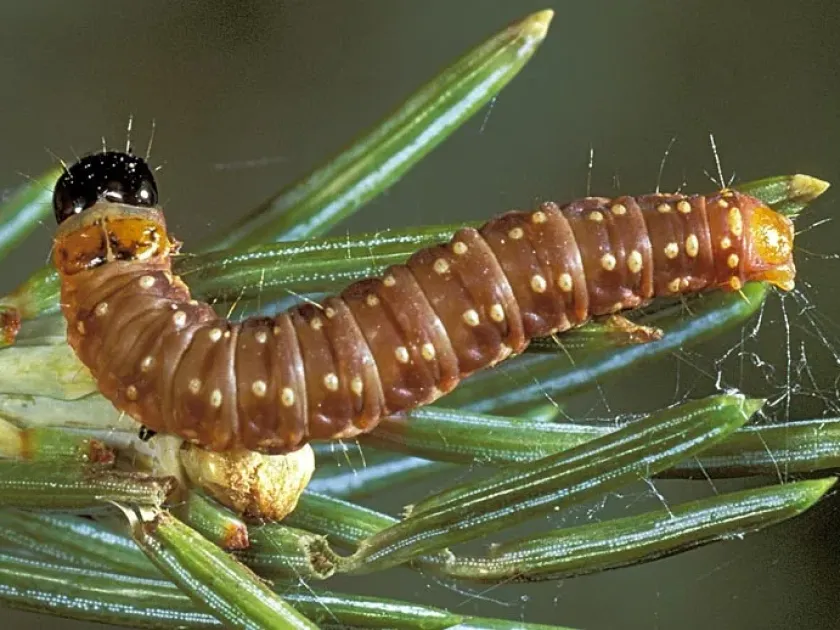
Larvae pass through several growth stages, changing color from light yellow to a dark brown with noticeable light spots. Mature larvae reach up to 30 mm in length.
Females lay eggs in clusters on the underside of needles. These eggs are flat and laid in an overlapping, scale-like pattern, making them difficult to detect.
The pupae are dark brown and develop within silken webs created between needles, which provides them with protection during their transformation into adults.
What it damages
The spruce budworm primarily targets coniferous trees, with a strong preference for balsam fir and white spruce species.
Larvae focus their feeding on new needles and buds during the spring, which halts the tree's growth for the current season and causes significant stress.
During outbreaks, these pests can strip a tree of its needles entirely within a few weeks, severely weakening the plant and making it susceptible to secondary pests.
Persistent attacks over several years lead to chronic crown defoliation, reduced wood growth, and eventually the death of entire forest stands.
Damage to the leading shoots causes stunted development and structural deformities in both forest trees and ornamental conifers.
When it appears
This species completes one generation per year. Adult moths emerge in mid-summer, typically July, to mate and lay eggs.
After hatching, the first-instar larvae do not feed immediately. Instead, they seek out shelter under bark scales to overwinter.
In the spring, as temperatures rise and sap begins to flow, larvae emerge from their overwintering sites to begin feeding on the fresh foliage.
The larval feeding stage lasts for about 4–6 weeks, followed by a pupation period that occurs directly within the crown of the host tree.
The damage is most severe during the spring and early summer months when the larvae are actively consuming the current year's needles.
Signs of infestation
The first sign of infestation is the appearance of silk webbing on branch tips, where larvae bind needles together to construct protective nests.
Frass (larval waste) accumulates within these silken webs and on the branches below, serving as a clear indicator of active feeding.
Damaged needles quickly turn yellow, then reddish-brown, and eventually drop, leaving the tree crown looking scorched or bare, especially at the top.
High moth activity observed in late summer can be an early warning sign of a potentially heavy larval infestation the following spring.
- Defoliation of new shoots.
- Needles bound together by silk.
- Premature yellowing and needle drop.
- Dark larvae present within webs.
Control measures
Management strategies often rely on promoting forest diversity to encourage natural predators, such as insectivorous birds and parasitic wasps.
In nurseries and parklands, biological insecticides containing Bacillus thuringiensis are highly effective and environmentally friendly solutions.
For large forest outbreaks, aerial or ground-based application of chemical insecticides may be necessary during the critical larval emergence window.
Sanitation practices, such as removing heavily infested or weakened trees, help to reduce local population density and slow the spread of the outbreak.
Pheromone traps are essential tools for monitoring population fluctuations and timing control interventions for maximum impact.
Taxonomy
- Latin name
- Choristoneura fumiferana
- Order
- Lepidoptera (butterflies)
- Family
- Tortricidae
- EPPO code
- CHONFU
Discussion
No discussions yet — be the first.