
Fruit tree leafroller (Choristoneura fractivittana)
Choristoneura fractivittana
Description
How to identify
The fruit tree leafroller (Choristoneura fractivittana) is a member of the Tortricidae family within the Lepidoptera order, commonly found in various orchards.
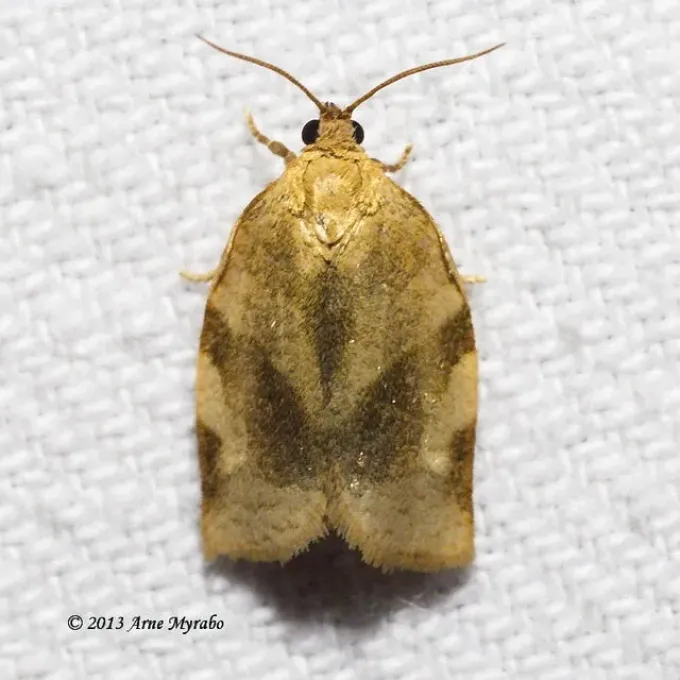
Adult moths have a wingspan of approximately 20–25 mm, featuring distinct ochre-brown forewings adorned with darker transverse bands and irregular patterns.
The larvae, or caterpillars, exhibit a color range from light green to brownish-green, typically distinguished by a dark, hardened head capsule.
Larval stages are characterized by their ability to produce silk, which they use to spin protective shelters by folding or rolling the leaves of host plants.
Pupation occurs within these folded leaves or in crevices on the tree bark, providing the insect with a degree of protection against predators.
What it damages
This pest primarily attacks a wide range of fruit trees, with a strong preference for apple, pear, cherry, and plum trees in commercial and home orchards.
The caterpillars feed on new foliage, often skeletonizing leaves and consuming the tissue between the leaf veins, which severely impacts photosynthesis.
Beyond foliage, the larvae cause direct damage to developing fruits by eating holes in the surface, leading to scarring, fruit drop, and susceptibility to rot.
Heavy infestations can significantly weaken the trees, reducing their vigor and overall yield potential for the current and subsequent growing seasons.
Young nursery stock is particularly vulnerable, as the leafroller can damage terminal buds, disrupting the apical growth and overall structure of the young tree.
When it appears
The species typically overwinters as late-instar larvae, hiding in silk-lined cocoons located in deep bark crevices or protected spots on the tree trunk.
In spring, as temperatures rise and buds begin to swell, larvae emerge from their overwintering sites to begin feeding on young buds and emerging leaves.
The first generation of moths typically emerges in late spring, around May or June, followed by a second generation later in the summer season.
Activity levels are highly dependent on local climate conditions, with warmer springs leading to earlier emergence and more rapid larval development.
As the season progresses toward autumn, the larvae of the final generation prepare for diapause, seeking out safe overwintering locations before winter sets in.
Signs of infestation
A primary indication of a leafroller infestation is the presence of tightly curled or rolled leaves, often secured with fine, white silk webbing.
Larval frass (excrement) is frequently visible inside these silk-bound leaf clusters, appearing as small, dark, granular deposits left by the feeding caterpillars.
Fruit damage manifests as shallow pits or deep, irregular cavities on the skin of developing fruits, which often fail to heal properly over time.
Sparse or ragged foliage is another indicator, resulting from extensive leaf feeding that causes the canopy to appear thin or "shredded" from a distance.
If you observe webbing connecting leaves to young fruit, it is a strong sign that leafroller larvae are present and actively feeding in the vicinity.
Control measures
Orchard sanitation is a critical first step, involving the removal and destruction of fallen leaves and pruning of infested twigs to reduce overwintering sites.
Encouraging natural enemies, such as parasitic wasps and predatory birds, can help manage low-level infestations without the need for synthetic chemicals.
Monitoring using pheromone-baited traps allows growers to detect moth flight patterns accurately, ensuring that insecticide applications are timed for maximum effect.
Biological insecticides, such as products containing Bacillus thuringiensis, are effective against young larvae and are considered environmentally friendly.
For severe outbreaks, targeted applications of registered contact or systemic insecticides should be applied during the window when larvae are most active.
Taxonomy
- Latin name
- Choristoneura fractivittana
- Order
- Lepidoptera (butterflies)
- Family
- Tortricidae
- EPPO code
- ARCHFR
Discussion
No discussions yet — be the first.