
Choristoneura dinota
Choristoneura dinota
Description
How to identify
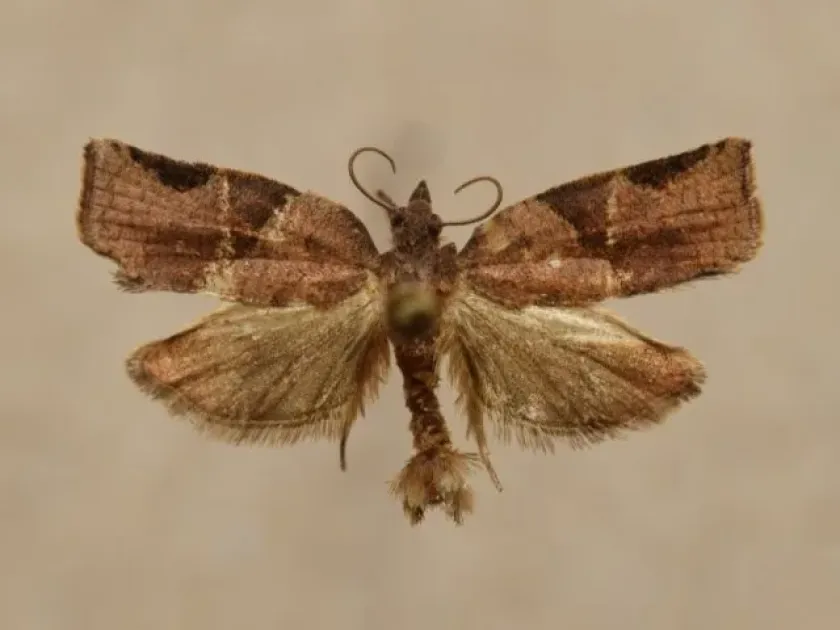
Choristoneura dinota is a species of moth belonging to the family Tortricidae. Adult moths are characterized by a specific wing pattern that serves as camouflage, blending in with the bark and needle foliage of their host trees during the daytime.
The larvae of this species undergo several developmental stages, exhibiting variations in body color and size. Identification at the larval stage relies on observing specific markings and their habit of living within silk-spun nests among the needles.
Systematically, this insect is classified under the order Lepidoptera. Due to the high similarity between species within the Choristoneura genus, microscopic examination of the male genitalia is often required for accurate taxonomic identification in field studies.
Female moths lay eggs in clusters, which they cover with a protective secretion. This "egg mass" serves as a robust defense mechanism against harsh environmental conditions and various natural predators throughout the wintering or pre-hatching period.
Larvae demonstrate distinct defensive behaviors, including dropping from the branches on silken threads when disturbed. This survival strategy makes manual inspection and mechanical removal a challenging task for foresters and nursery managers.
What it damages
The primary hosts for Choristoneura dinota are various species of conifers. The pest prefers young, succulent growth, making nurseries and sapling plantations particularly susceptible to significant defoliation and growth loss.
Larvae feed initially by mining the buds and needles, eventually consuming the entire foliage of the current year's growth. This leads to needle drop, which significantly weakens the tree's overall photosynthetic capacity and vigor.
Severe infestations over consecutive years can result in substantial timber volume loss and may trigger tree mortality. Weakened trees often become targets for secondary pests, such as bark beetles, which can permanently damage the plantation.
The aesthetic value of coniferous trees in urban settings is also severely compromised by the presence of webbed, partially consumed needles. This makes the species a concern not only for industrial forestry but also for ornamental landscaping.
In cases of extreme population outbreaks, the forest canopy may appear thin or brown, signaling a critical stage that requires immediate intervention to prevent the permanent degradation of the stand.
When it appears
The lifecycle of Choristoneura dinota is strictly synchronized with the phenology of its host plants. Larval emergence usually coincides with bud break, ensuring that the offspring have immediate access to the most nutritious food source available.
The pupal stage occurs within the canopy inside silk-spun retreats. This stage is relatively brief and highly temperature-dependent, usually occurring in late spring or early summer as the insect prepares for the reproductive phase.
The adult flight period takes place in mid-to-late summer, when mating and egg-laying occur. The population typically overwinters in the egg or early larval stage, tucked away in bark crevices for protection against winter temperatures.
Climate factors play a major role in population dynamics. Unseasonably cold weather during early spring can significantly reduce the number of surviving larvae, acting as a natural regulator of the pest population size.
Understanding these developmental milestones is essential for scheduling monitoring and control efforts, as the window of vulnerability to insecticides or biological controls is often quite narrow and linked to specific larval stages.
Signs of infestation
The most prominent sign of infestation is the presence of webbed nests at the tips of shoots. Within these nests, one can often find frass (larval excrement) and damaged needles held together by silk strands.
Yellowing or reddish-brown discoloration of the new growth during the spring is a key indicator of feeding activity. As the larvae grow larger, the damage becomes more visible, leading to a ragged appearance of the canopy.
Holes in the buds and partially eaten needles are signs of early larval feeding. As the infestation progresses, entire shoots may be stripped of needles, leaving behind skeletal branches that eventually die back.
Monitoring the flight of adult moths using light traps or pheromone lures provides an early warning system. Large numbers of captured moths indicate a likely outbreak in the upcoming season, necessitating preventive management.
- Webbed needle clusters at shoot tips.
- Discoloration and thinning of new growth.
- Presence of larval frass within silk retreats.
- Holes in buds and partially consumed foliage.
- Increased adult moth activity during mid-summer.
Control measures
Integrated Pest Management (IPM) strategies for Choristoneura dinota rely heavily on accurate population monitoring. Pheromone traps are the gold standard for detecting threshold levels and timing the application of control agents.
Biological control methods, particularly the use of Bacillus thuringiensis (Bt), are highly effective when applied during the early larval stages. These treatments are preferred as they minimize the impact on beneficial predators and parasitoids.
Chemical insecticides are used as a last resort in cases where significant economic damage is expected. Applications must be carefully timed to target the larvae before they are protected within their silk-spun nests or before they mature into late instars.
Promoting forest diversity helps maintain healthy populations of natural enemies, such as insectivorous birds and parasitic wasps, which play a vital role in keeping pest populations at non-damaging levels.
Regular forest pathology surveys are critical for identifying early-stage infestations. By managing small, isolated outbreaks, foresters can effectively prevent the need for large-scale interventions across the entire plantation.
Taxonomy
- Latin name
- Choristoneura dinota
- Order
- Lepidoptera (butterflies)
- Family
- Tortricidae
- EPPO code
- TORTDI
Discussion
No discussions yet — be the first.