
Green leaf weevil
Chlorophanus viridis
Description
How to identify
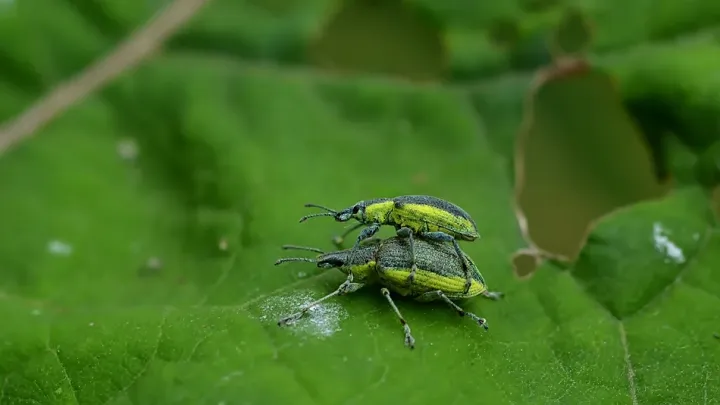
The green leaf weevil (Chlorophanus viridis) is a beetle species belonging to the Curculionidae family. Adults typically measure between 7 and 11 mm in length and are characterized by their brilliant green or yellowish-green color, which provides excellent camouflage among foliage.
The insect's body is covered in dense, flattened scales that give it a unique sheen. Unlike many other weevils that specialize in fruit or wood, this species features a relatively short and broad snout, which is a key diagnostic feature for identification in the field.
Larvae are typically white or cream-colored, legless, and exhibit a C-shaped posture. They possess a dark, hardened head capsule and are primarily found inhabiting the soil or the rhizosphere, where they feed on plant roots.
The life cycle involves complete metamorphosis, including egg, larva, pupa, and adult stages. Adults hibernate in the soil or beneath dense vegetation during the winter, emerging in the spring when soil temperatures reach favorable levels for their activity.
Reproduction occurs during the spring and early summer. Females lay eggs in small clusters on the undersides of leaves or directly into the soil near the host plant's base, ensuring that newly hatched larvae have immediate access to food sources.
What it damages
This weevil is a polyphagous pest, meaning it attacks a wide range of host plants. Major agricultural crops affected include sugar beets, cabbage, carrots, lettuce, and various other garden vegetables that are essential for successful harvesting.
The green leaf weevil is particularly destructive to young seedlings. In sugar beet fields, mass infestations can cause significant loss of density, severely impacting crop yields and necessitating replanting if the pressure is high enough early in the season.
Beyond vegetable crops, the weevil often colonizes various berries, including raspberries, currants, and gooseberries. It also thrives on common weeds like thistle and pigweed, which allows the population to persist even in the absence of cultivated crops.
Adults cause damage by feeding on the edges of leaves, leaving behind jagged, irregular patterns. In extreme cases, they can defoliate entire leaves, leaving only the midribs, which drastically impairs the plant's ability to photosynthesize and grow.
Larval feeding on the root system is equally dangerous. By consuming fine root hairs, the larvae weaken the plant's ability to absorb water and nutrients, leading to yellowing, stunted growth, and in severe cases, the complete collapse of the plant.
When it appears
Adult weevils typically emerge from hibernation in April and May, coinciding with the crucial early development stages of vegetable crops. This period is when the plants are most vulnerable to defoliation and root damage.
The peak of adult activity occurs in late spring and early summer. During these warmer months, the weevils are most visible and mobile, making this the best time to perform field scouting and implement monitoring measures to assess the infestation level.
Larval development continues in the soil throughout the summer months. Their presence often goes unnoticed until the plants begin to show visible signs of stress, such as sudden wilting, despite adequate watering and soil conditions.
By late summer and early autumn, the new generation of adults reaches maturity. They begin to seek out overwintering sites, often moving into the top layer of the soil or under debris, where they will remain dormant until the following spring.
Climatic factors, such as a mild winter followed by a moist spring, can significantly influence the population density of the green leaf weevil. These conditions often lead to earlier emergence and a faster rate of reproduction for the species.
Signs of infestation
The most recognizable sign of infestation is the characteristic scalloped or irregular feeding damage along the edges of leaves. This pattern distinguishes the green leaf weevil from many other insects that create holes within the leaf surface.
Adult weevils are masters of evasion; when approached, they frequently drop from the plant to the ground and remain motionless, making them difficult to spot. Searching for them is best done during the cool morning hours when they are less mobile.
Scouting should focus on both the foliage and the surrounding weed patches. If weeds show similar damage patterns, it is a strong indicator that the weevil population is present and may soon move onto your valuable vegetable crops.
Signs of root damage include plants that appear yellow or stunted for no obvious reason. If a plant can be pulled from the soil with very little resistance, the root system has likely been decimated by larvae feeding in the soil.
While spotting the insects themselves is the most reliable sign, one may also observe small droppings on the leaf surfaces. However, because these can be confused with other insect waste, they should be treated only as a secondary confirmation factor.
Control measures
Cultural control is essential: maintaining clean fields by removing weeds eliminates primary food sources and egg-laying sites. Deep tillage or plowing in the autumn is highly effective, as it exposes the overwintering adults and larvae to adverse conditions.
Proper crop rotation is a fundamental practice to disrupt the weevil's life cycle. Avoiding the planting of susceptible crops in the same area for several consecutive years helps to starve out the population and prevents build-up in the soil.
In small garden settings, manual collection of beetles in the early morning is practical and safe. Placing protective fabric or sticky barriers can also help prevent the weevils from reaching sensitive, newly planted seedlings.
Biological controls, such as the use of entomopathogenic nematodes or specific fungi, are excellent tools for targeting larvae within the soil. These methods are environmentally friendly and target the pest without disturbing the local ecosystem.
If chemical intervention becomes necessary due to high population pressure, choose registered insecticides compatible with your specific crops. Always adhere strictly to the recommended dosages and harvest intervals to ensure food safety and minimize environmental impact.
Taxonomy
- Latin name
- Chlorophanus viridis
- Order
- Coleoptera (beetles)
- Family
- Curculionidae
- EPPO code
- CHLSVI
Discussion
No discussions yet — be the first.