
Cereal thrips
Chirothrips
Description
How to identify
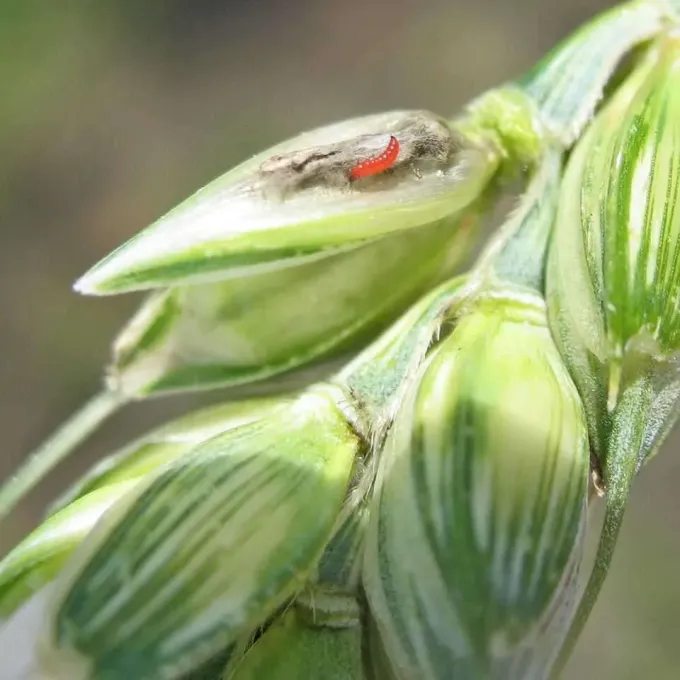
The cereal thrips (Chirothrips) belongs to the order Thysanoptera and family Thripidae. These are tiny insects, measuring between 1 and 2 mm in length, with a narrow body and fringed wings.
Adults are typically dark brown or black, allowing them to blend into the spikelets of cereals. Larvae are wingless, yellowish or orange, and display high mobility during early development stages.
The genus Chirothrips is highly specialized, having evolved to exploit grasses and cereal crops. They exhibit cryptic behavior, often hiding deep within leaf sheaths or inside the glumes of spikes.
The life cycle involves egg, two larval instars, prepupa, and pupa stages. They typically overwinter in the soil or within crop residues as adults or larvae.
Proper identification usually requires the use of a magnifying glass or a hand lens, as the pests are small and often congregate in hard-to-reach areas of the cereal spike.
What it damages
Wheat, barley, rye, and oats are the primary host crops for the cereal thrips. They also thrive on various wild grasses that serve as an alternative food source.
Feeding occurs by piercing plant tissues and sucking cell sap. This disrupts the plant's metabolic processes and reduces the efficiency of photosynthesis in the damaged leaves and stems.
The most significant impact happens during the heading and flowering stages, where thrips attack the ovaries, leading to sterile florets and poorly developed grain.
Heavy infestation leads to "white ear" symptoms, deformation of the spike, and a substantial decrease in the thousand-kernel weight, which directly impacts total yield.
Furthermore, cereal thrips can act as vectors for various plant viruses, adding a layer of phytosanitary risk that can further reduce crop vigor and quality.
When it appears
The emergence of cereal thrips from wintering sites is synchronized with the booting phase of cereal crops, triggered by rising temperatures in the spring.
Peak population activity occurs during heading and flowering, when the insects migrate into the developing spikes to feed and lay eggs within the soft tissues.
Warm and dry weather conditions act as catalysts, significantly speeding up the developmental stages and allowing for multiple generations within a single season.
Activity gradually decreases as the grain matures and the plants lose their nutritional appeal. By late summer, the population moves to enter diapause.
Effective scouting is essential from the booting stage through the milk development stage, as this is when the crop is most vulnerable to economic damage.
Signs of infestation
A classic sign of cereal thrips infestation is the appearance of bleached or white spikes, commonly referred to as "white heads," which stand out in a green field.
- Distorted, stunted, or bent spikes showing clear signs of developmental failure.
- Small, dark fecal spots visible on the glumes and floral parts.
- Yellowing or premature senescence of leaf tissues due to extensive sap removal.
- Reduced grain filling, resulting in thin or shriveled kernels at harvest.
Field scouting is best conducted by shaking spikes over a white sheet or tray, which allows for the rapid detection and counting of the insects.
In addition to direct visual signs, decreased yield performance in specific field patches may indicate the presence of high pest pressure throughout the growing season.
Control measures
Cultural control practices, such as deep plowing after harvest, are highly effective in burying crop residues and reducing the overwintering population.
Crop rotation and the removal of volunteer grasses around the field edges help limit the spread and buildup of thrips populations between seasons.
Early maturing crop varieties can often escape the peak of the thrips migration, providing a natural way to minimize yield losses without chemical intervention.
Chemical control should be employed only when the economic threshold is surpassed, utilizing systemic insecticides during the critical heading window.
It is important to ensure proper application coverage to reach the hidden insects within the spikes while strictly adhering to safety intervals and environmental regulations.
Taxonomy
- Latin name
- Chirothrips
- Order
- Thrips
- Family
- Thripidae
- EPPO code
- CHITSP
Discussion
No discussions yet — be the first.