
Fairy shrimp
Chirocephalus
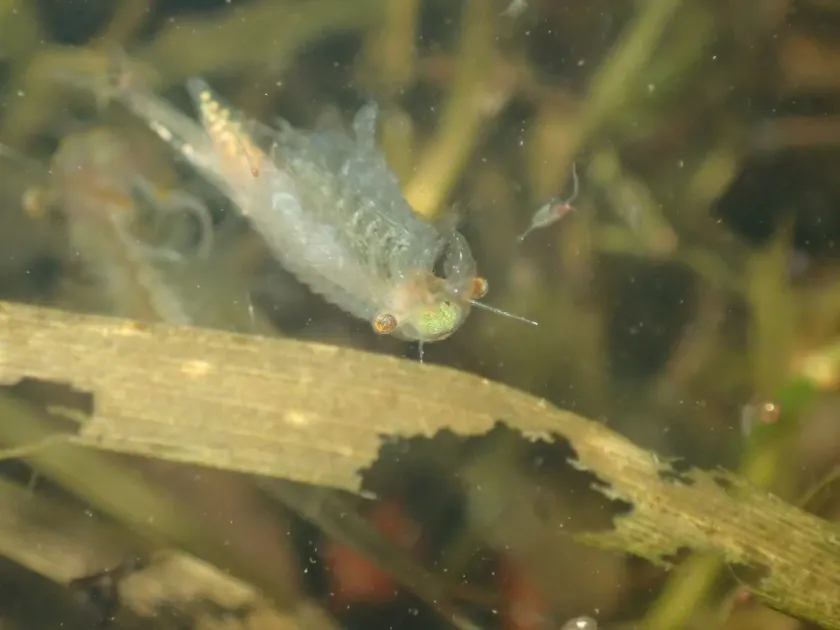
Description
How to identify
Fairy shrimp (order Anostraca, family Chirocephalidae) are small freshwater crustaceans that often appear in temporary pools or flooded agricultural fields.
They possess elongated, segmented bodies ranging from 1 to 3 centimeters in length, with distinctive stalked eyes and numerous pairs of feathery swimming legs.
These organisms are generally translucent or slightly colored and are known for their habit of swimming on their backs while using their appendages for both movement and filter feeding.
Their life cycle involves the production of highly resistant cysts that can remain dormant in the soil for years, waiting for the return of favorable flooding conditions.
Because they lack a hard shell, they are often found in environments where high fish predation is absent, which explains their presence in newly flooded rice fields.
What it damages
In the context of rice cultivation, fairy shrimp act as pests primarily by damaging young seedlings shortly after the fields are flooded for crop establishment.
The crustaceans can graze on the fragile root systems and tender stems of germinating rice, leading to mechanical injury that weakens or kills the young plants.
High densities of fairy shrimp can cause significant thinning of rice stands, forcing farmers to incur additional costs for reseeding the affected areas.
Besides direct physical damage, their continuous filter-feeding and movement disturb the substrate and increase water turbidity, hindering plant development.
The cumulative damage often results in uneven crop stands, delayed vegetative growth, and a measurable reduction in final grain yields across infested sectors.
When it appears
Fairy shrimp activity begins immediately after the rice paddies are flooded in the spring, as the water triggers the hatching of dormant cysts stored in the soil.
The optimal temperature range for their rapid development is between 15 and 25 degrees Celsius, allowing the population to explode within a couple of weeks.
A single generation can reach maturity in as little as two weeks, meaning that under continuous flooding, multiple generations can emerge during a single season.
They are most destructive during the early vegetative stage of the rice crop, which coincides with the period when young plants are least capable of recovering from root damage.
Once the water is drained from the field for mid-season maintenance, the adult population dies off, leaving behind a new generation of cysts for the future.
Signs of infestation
Field observation is the primary method of detection; on sunny days, clusters of small, swimming crustaceans can be seen clearly in the water columns of the paddies.
Plants affected by fairy shrimp often appear yellowed or may be found floating on the water surface if their root systems have been completely severed by the pests.
Increased water turbidity that is not associated with wind or heavy machinery operation is a strong indicator of a high crustacean population in the field.
Close inspection of the base of the rice plants may reveal frayed edges or shallow lesions on the root tissue, which are typical symptoms of crustacean feeding.
The presence of white, transparent molted exoskeletons floating on the water surface is another clear sign of active growth and development of the fairy shrimp colony.
Control measures
Effective management begins with proper land preparation to ensure uniform leveling of the fields, which prevents the formation of deep, stagnant puddles that favor pests.
The use of crop rotation and strategic drying intervals is critical to break the life cycle by inducing the mortality of cysts through environmental exposure.
If population levels exceed economic thresholds, specific chemical control agents registered for use in aquatic environments must be applied carefully.
- Application of selective insecticides safe for aquatic ecosystems.
- Integration of biological controls by introducing crustacean-eating fish.
- Maintaining optimal water circulation across all sections of the field.
Frequent monitoring during the first 14 days post-flooding is essential to identify early outbreaks and implement localized control measures before damage becomes widespread.
Taxonomy
- Latin name
- Chirocephalus
- Family
- Chirocephalidae
- EPPO code
- CHRKSP
Discussion
No discussions yet — be the first.