
Book scorpion
Chernes cimicoides
Description
How to identify
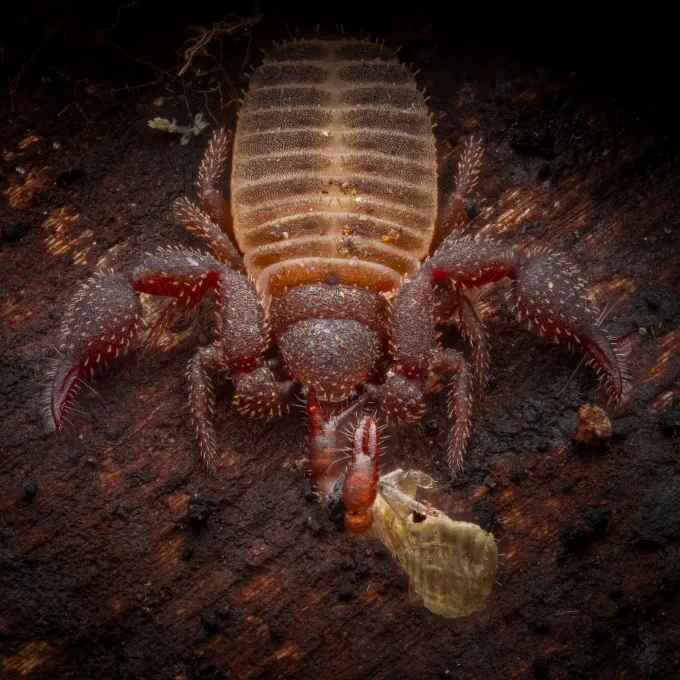
The book scorpion (Chernes cimicoides) belongs to the order Pseudoscorpionida. Despite their name, they are not true scorpions and lack the venomous tail stinger.
Adult individuals typically measure between 3 to 4 mm in length. Their bodies are flattened, featuring a reddish-brown or dark brown coloration that allows them to blend into bark or leaf litter.
The most distinctive features are their oversized pedipalps (claws), which contain venom glands used to subdue tiny prey. These claws are equipped with sensitive sensory hairs.
They are cryptic animals, preferring dark and humid environments where they can hide in narrow crevices of tree bark or under organic debris.
While their appearance can be intimidating, they are harmless to humans and plants, as their venom is effective only against microscopic invertebrates.
What it damages
It is important to clarify that Chernes cimicoides is not a plant pest. It is a predatory organism (zoophagous) that consumes small insects, mites, and their larvae.
These organisms do not feed on plant tissues, sap, or fruits. Consequently, they cause absolutely no damage to crops or trees in agricultural settings.
They are often mistakenly identified as pests because they are frequently observed near bark beetle tunnels, where they hunt the larvae of the actual pests.
The ecological significance of the book scorpion is positive, as they contribute to the natural biological control of garden pest populations.
Because they are beneficial, no protection or control measures are required. They should be encouraged as part of an integrated pest management strategy.
When it appears
Book scorpions are active throughout the growing season, starting from early spring when temperatures remain consistently above freezing.
They are most mobile during the warm summer months, hunting for food across trees and on the forest floor where moisture levels are high.
With the approach of winter, they enter a state of dormancy, seeking shelter in deep bark fissures, hollows, or leaf litter to survive the cold period.
Their life cycle consists of egg, nymph, and adult stages, with breeding cycles often synchronizing with periods of high environmental humidity.
Adults are rarely seen during the day as they prefer to remain hidden, emerging to hunt primarily in dim light or nocturnal conditions.
Signs of infestation
There are no signs of damage associated with the presence of book scorpions, as they do not attack living plant tissues.
Their presence is typically noted only during specific garden inspections or when clearing old, exfoliating bark from trees.
Unlike common garden pests, they do not create exit holes, leaf mines, or necrotic spots, meaning the foliage remains healthy and vibrant.
Finding a book scorpion indicates a healthy, balanced garden ecosystem where natural predators help manage pest populations.
No agricultural intervention is necessary; therefore, growers should avoid using broad-spectrum insecticides that would harm these beneficial predatory arachnids.
Taxonomy
- Latin name
- Chernes cimicoides
- Family
- Chernetidae
- EPPO code
- CHERCI
Discussion
No discussions yet — be the first.