
Book scorpion
Chelifer cancroides
Description
How to identify
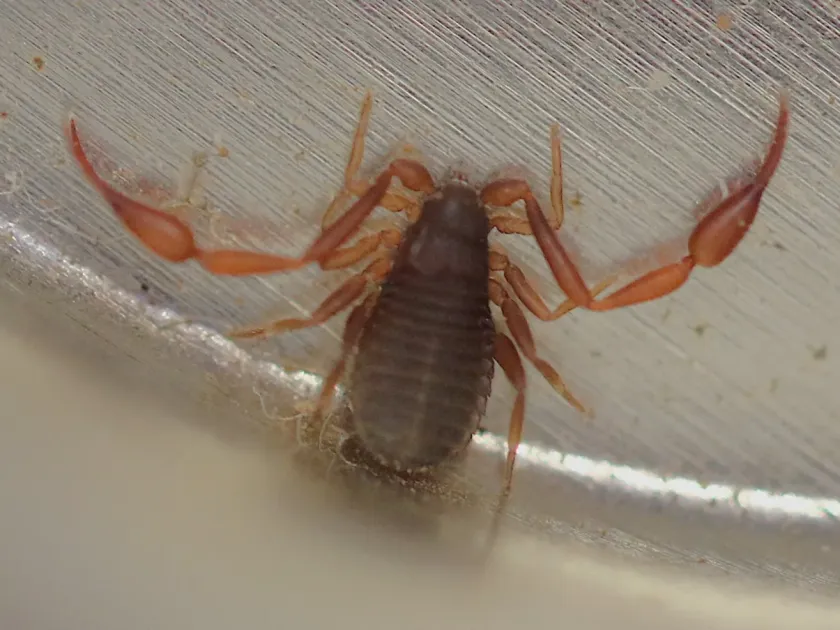
The book scorpion (Chelifer cancroides) is a small arachnid belonging to the order Pseudoscorpiones and the family Cheliferidae. Despite its name and scorpion-like appearance, it lacks the iconic tail and sting.
Adult individuals typically measure between 3 to 4 millimeters in length. Their bodies are dorsoventrally flattened and protected by a hard, dark-brown chitinous exoskeleton which helps them navigate tight crevices.
The most striking feature is their large pair of pedipalps equipped with pincers. These appendages are highly sensitive and are used to capture small prey such as mites, small insects, and larvae.
They are primarily nocturnal and shy away from light. Their preferred habitats include dark, humid environments such as crevices, under bark, in stored grain, or inside old book bindings where they can find prey.
As members of the pseudoscorpion order, they are remarkable for their phoretic behavior, often hitching rides on larger insects to relocate to new areas with abundant food supplies.
What it damages
It is important to clarify that the book scorpion is not a plant pest. It is an insectivorous predator that feeds exclusively on small arthropods and does not consume any plant tissues.
In agricultural settings, they are often considered beneficial because they hunt common storage pests like booklice, mites, and various fly larvae. They act as natural biological regulators of indoor pests.
Direct damage to agricultural crops is non-existent. However, their presence can be perceived as an annoyance or a sign that storage conditions are not optimal for long-term grain preservation.
The secondary issue is that they thrive in environments with high humidity and organic debris. If these conditions exist, the crops themselves may be at risk of fungal growth or other pest infestations.
Therefore, while the book scorpion itself causes no damage, it serves as a valuable biological indicator that the storage environment requires better management to prevent rot and grain pests.
Control measures
Since the book scorpion is not a crop pest and may even be beneficial by consuming harmful pests, aggressive eradication is usually unnecessary in professional storage facilities.
To reduce their population, focus on lowering ambient humidity levels. Keeping storage areas dry is the most effective way to eliminate the moist conditions that the book scorpion requires to survive.
Maintain strict sanitation by removing dust, old organic residue, and damaged grain. A clean environment removes the prey base that attracts these arachnids, forcing them to disperse.
Ensure proper ventilation in all warehouses. Good airflow prevents the formation of damp spots, which are the primary breeding grounds for both the book scorpion and its small prey.
If population control is required for aesthetic or sanitary reasons, use general integrated pest management techniques aimed at controlling broader populations of storage-dwelling insects.
Taxonomy
- Latin name
- Chelifer cancroides
- Family
- Cheliferidae
- EPPO code
- CHEFCA
Discussion
No discussions yet — be the first.