
Chaoborus crystallinus
Chaoborus crystallinus
Description
How to identify
Chaoborus crystallinus is a small fly belonging to the Chaoboridae family. Adults resemble non-biting midges but can be distinguished by specific wing venation patterns.
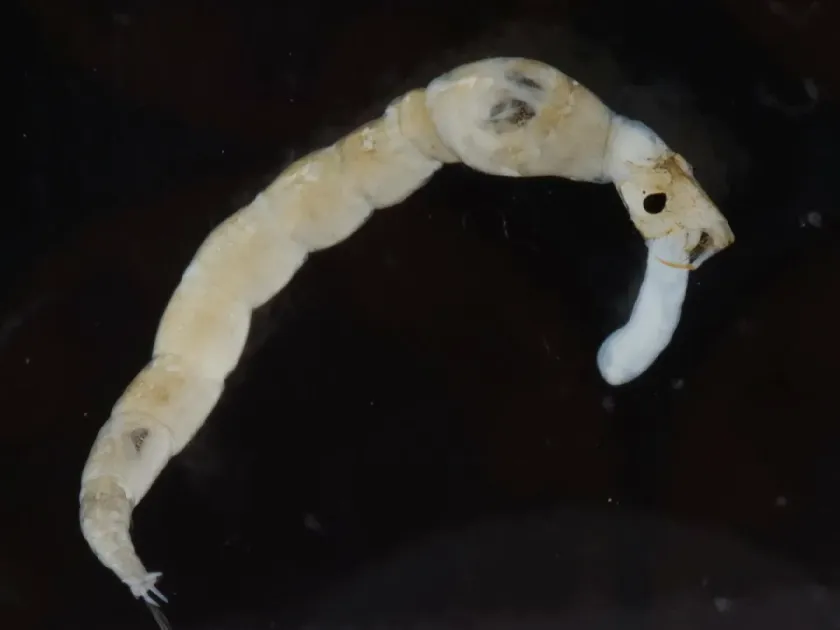
The larval stage is known as the phantom midge larva. It is characterized by its almost complete transparency, making it nearly invisible in the water column.
Larvae possess specialized hydrostatic organs known as air sacs located in the thoracic and abdominal regions, which assist in maintaining buoyancy.
The body length of the larva typically ranges between 10 and 15 mm. The head features strong, prehensile appendages used for capturing prey.
The pupal stage is also active and mobile, utilizing specialized paddles to move through the water before the adult emerges to complete the life cycle.
What it damages
The larvae are significant pests in aquaculture ponds and hatcheries. As predators, they feed on fish larvae, causing substantial economic losses in fish seed production.
Damage is primarily caused by direct predation on fish fry, which can decimate fish populations during their most vulnerable early developmental stages.
These larvae compete directly with fish fry for natural zooplankton food sources, limiting the nutritional availability for growing fish.
High densities of Chaoborus larvae in nursery ponds can lead to the near-total loss of stocked fish larvae if not managed effectively.
Furthermore, their predatory behavior induces stress in fish populations, which negatively affects the overall growth rates and health of the fish stock.
When it appears
The life cycle of C. crystallinus is highly temperature-dependent, with adult emergence typically occurring during the warmer months of spring.
During the summer, the population peaks as warmer water temperatures accelerate the development rate, allowing for multiple generations per year.
In the autumn, larvae migrate to the benthos, where they enter a state of diapause and reside in the sediment to survive the winter conditions.
Spring emergence often correlates with the timing of pond stocking, posing a high risk to the newly introduced fish population.
The rate of reproduction is influenced by the trophic state of the pond, as higher levels of organic matter favor the development of their prey base.
Signs of infestation
Detecting C. crystallinus is challenging due to the transparency of the larvae. A primary sign is an unexplained decline in fish fry survival rates.
Monitoring using plankton nets can reveal the presence of phantom midge larvae in water samples, which appear as thin, ghost-like organisms.
Mass emergence of adult midges around the pond perimeter during dusk is a strong indicator of high larval density within the pond water.
Analysis of sediment samples taken from the pond bottom can determine the abundance of larvae overwintering or emerging from dormancy.
Checking the stomach contents of small fish during sampling can provide confirmation if fragments of the larvae are present, indicating active predation.
Control measures
The most effective management strategy is to drain and completely dry out pond beds during the winter to destroy the overwintering larval population.
Liming the pond bottom prior to filling is a standard practice that helps reduce the acidity and lethally impacts the larval population in the silt.
Utilizing fine-mesh screening around the pond can prevent adult females from accessing the water to lay eggs, thereby reducing the infestation risk.
Adopting fish stocking strategies that involve larger-sized fingerlings that are no longer susceptible to larval predation is a key preventive measure.
Continuous monitoring of the water quality and larval density before and during the stocking season is essential for timely intervention and protection.
Taxonomy
- Latin name
- Chaoborus crystallinus
- Order
- Diptera (flies)
- Family
- Chaoboridae
- EPPO code
- CHABCR
Discussion
No discussions yet — be the first.