
Chalcodermus collaris
Chalcodermus collaris
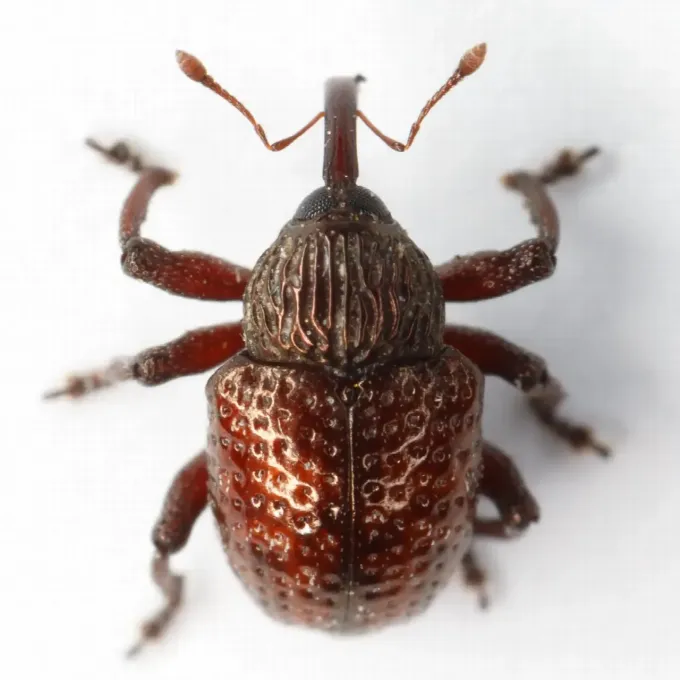
Description
How to identify
Chalcodermus collaris belongs to the Curculionidae family, commonly known as true weevils, within the order Coleoptera. This species is recognized by its distinct snout and robust body structure.
The adult beetle is typically dark brown or black, with a texture on the elytra that helps it blend into soil and debris environments. Its appearance is characteristic of snout beetles, with a compact body shape.
Larvae are legless, C-shaped grubs with a creamy-white appearance, which is standard for the development stages of many curculionids. They are primarily specialized to feed within the reproductive parts of host plants.
The life cycle encompasses complete metamorphosis: egg, larva, pupa, and adult. The adults are highly mobile, allowing them to migrate between fields or search for suitable host legume plants.
As an agricultural pest, this species thrives in climates where legume cultivation is intensive, making it a recurring challenge for farmers in tropical and subtropical regions.
What it damages
The primary hosts for Chalcodermus collaris are legumes, with common bean (Phaseolus) and cowpea (Vigna) being the most frequently reported targets for infestation.
Adult beetles damage the plant by feeding on foliage, stems, and buds. While this causes physical stress, the most severe damage occurs at the reproductive stage of the plant.
Females oviposit into developing pods. The hatching larvae then feed on the developing seeds, creating tunnels and often consuming a significant portion of the seed interior.
Seed damage reduces yield volume and quality, rendering the produce unsuitable for human consumption or future sowing, which causes significant economic loss.
Heavy infestations can devastate crop stands, especially when combined with adverse environmental conditions that weaken the plants' natural defense mechanisms.
When it appears
The activity of Chalcodermus collaris is largely dictated by temperature and humidity cycles. Adults emerge from overwintering sites as temperatures rise in the spring.
Peak activity generally coincides with the flowering and pod-filling stages of the legume crop. During this time, the beetles actively congregate on the host plants.
Depending on regional conditions, multiple generations can occur within a single growing season, necessitating constant monitoring throughout the plant's development.
As the growing season draws to a close, the adults move to seek shelter in the soil or beneath plant litter to survive the cooler months in a state of diapause.
Environmental fluctuations, particularly rainfall patterns, can influence the timing of emergence and the overall success of the pest's reproductive cycle.
Signs of infestation
Small, circular perforations on leaves are among the primary indicators of adult beetle feeding activity within the field.
Evidence of egg-laying manifests as tiny, dark spots or punctures on the surface of young pods, which may darken as the plant tissues react to the damage.
Infestation is often confirmed during harvest, where seeds may be found with internal cavities, exit holes, or frass left by the developing larvae.
Stunted growth, wilting, or yellowing of the plants at the seedling or early vegetative stages can indicate feeding damage on the stems or root crowns.
Visual inspection of the field, especially during the early morning hours, often reveals the presence of adult beetles on the lower leaves or soil surface near the plants.
Control measures
Cultural practices, such as crop rotation, are essential. Avoiding the continuous planting of legumes on the same field disrupts the beetle's life cycle and food source.
Sanitation is critical; removing and destroying crop residues after harvest eliminates overwintering habitats for the pests.
Selecting resistant legume varieties can provide a level of protection, reducing the attractiveness of the crop to ovipositing females and limiting larval development.
Chemical control involving selective insecticides can be employed during periods of peak adult activity to prevent significant damage to the pods.
Integrated Pest Management (IPM) strategies, which combine biological controls and careful monitoring, are the most sustainable approach for long-term reduction of Chalcodermus collaris populations.
Taxonomy
- Latin name
- Chalcodermus collaris
- Order
- Coleoptera (beetles)
- Family
- Curculionidae
- EPPO code
- CHLDCO
Discussion
No discussions yet — be the first.