
Cowpea curculio
Chalcodermus aeneus
Description
How to identify
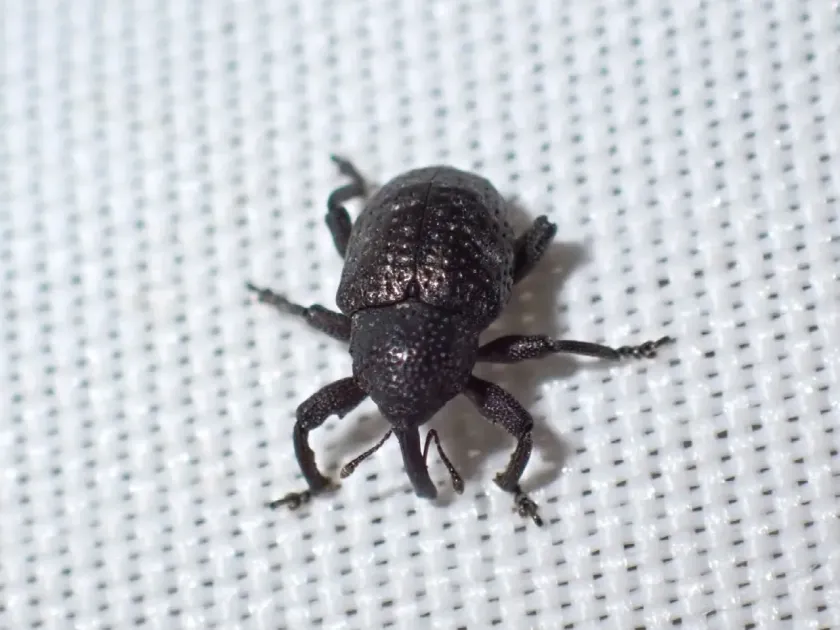
The Cowpea curculio is a beetle belonging to the Curculionidae family, easily recognizable by its snout-like rostrum. The adult insect has a stout, oval-shaped body, colored dark brown or black with a slight metallic sheen.
The elytra, or wing covers, are deeply pitted with longitudinal rows of punctures, giving the insect a rough, textured appearance. This morphology helps it blend into the soil and debris of its environment.
Larvae are legless, C-shaped grubs with creamy-white bodies and brown heads. They spend their entire developmental phase feeding inside the pods, making them inaccessible to many contact insecticides.
Pupation takes place in the soil. After feeding, the larva drops from the pod, burrows into the earth, and constructs an earthen cell where it transforms into a pupa and later an adult beetle.
When disturbed, these beetles exhibit thanatosis, a behavior where they retract their legs and feign death, falling off the plant to the ground to evade potential threats.
What it damages
The primary hosts for this pest include cowpeas, beans, and occasionally other leguminous crops. They also thrive on wild legume species, which serve as alternative food sources throughout the season.
Adult beetles cause damage to seedlings by feeding on the leaves and stems, creating small, circular punctures. This can stunt plant growth or cause plant loss in early developmental stages.
The most severe damage occurs when beetles feed on the developing pods. They pierce the pod wall to feed on the seeds inside, which often facilitates the entry of pathogens and secondary infections.
Once inside the pod, larvae feed directly on the developing seeds. This feeding destroys the endosperm and embryo, rendering the seeds unmarketable and preventing them from germinating.
Infestation levels can be extreme in favorable conditions, sometimes resulting in total crop failure if management measures are not implemented during the pod-filling stages.
When it appears
Adult Cowpea curculios emerge from overwintering sites in the soil when spring temperatures rise. They typically migrate to fields as soon as host plants start germinating.
The first active period occurs during the seedling stage. Adults feed on foliage to gain energy for reproduction, coinciding with the early growth phase of the crop.
A second, more critical peak occurs during the flowering and pod-setting stage. This is when females begin laying eggs in the developing pods, ensuring that larvae have an immediate food source.
Developmental cycles are temperature-dependent, with multiple generations possible in warmer climates. The beetle remains active until the end of the harvest season.
As the weather cools in autumn, the adult beetles seek shelter for diapause. They dig into the topsoil or hide beneath dense vegetation and crop residues to survive the winter months.
Signs of infestation
The initial signs of infestation are small, needle-like punctures on the leaves of young plants, indicating the presence of feeding adults.
Visible spots or scars on the pods are clear indicators of egg-laying activity. These spots are often dark and indicate that a female has pierced the pod wall to deposit an egg.
When infested pods are opened, one can find the white larvae and their dark frass (excrement) deposited within the pod cavity, which compromises the quality of the harvest.
Field-level indicators include uneven growth and stunted patches, which are often the result of heavy adult feeding pressure on younger, more vulnerable plants.
At harvest, seeds from damaged pods show distinct round holes where adult beetles have emerged, or they may be shriveled and hollowed out due to internal larval feeding.
Control measures
Cultural control is essential, including crop rotation and the destruction of crop residues immediately after harvest to disrupt the beetle's life cycle.
Deep plowing during the off-season helps expose overwintering adults and pupae to predators and adverse weather conditions, significantly reducing the population density.
Chemical control involves the application of registered insecticides during the peak of adult activity, particularly just before or during the pod-setting phase.
Biological management can be enhanced by encouraging natural enemies, such as parasitic wasps and predatory insects, which help keep pest populations in check.
Monitoring using yellow sticky traps or sweep nets allows farmers to track the movement of beetles and apply interventions only when economic thresholds are met.
Taxonomy
- Latin name
- Chalcodermus aeneus
- Order
- Coleoptera (beetles)
- Family
- Curculionidae
- EPPO code
- CHLDAE
Discussion
No discussions yet — be the first.