
Pistachio bark beetle
Chaetoptelius vestitus
Description
How to identify
The pistachio bark beetle (Chaetoptelius vestitus) is a small wood-boring insect belonging to the Curculionidae family. Adult beetles typically measure between 2 and 3 mm in length.
The beetle’s body is cylindrical and densely covered with fine hairs, which gives it a distinct appearance. The coloration is dark brown to black, helping it blend with the bark of its host plant.
Larvae are legless, white, and possess a chitinized head capsule. They reside exclusively beneath the bark of pistachio trees, where they feed on the cambium layer.
Being a specialized pest of the Pistacia genus, this insect has evolved to perfectly synchronize its development with the physiological cycles of pistachio trees.
Proper identification is crucial for orchard managers, as these beetles often go unnoticed until significant damage to the host trees has already occurred.
What it damages
The primary host for this beetle is the common pistachio (Pistacia vera). It attacks both young saplings and mature, productive trees in orchards.
Damage is twofold: adults feed on developing buds in the spring, leading to bud loss and reduced yield, while larvae create galleries under the bark, damaging the conductive tissues.
Severe infestations can lead to the wilting and death of entire branches or the whole tree. This disruption of nutrient transport is a critical threat to tree vigor.
The feeding sites created by the beetle serve as entry points for various pathogenic fungi, which can exacerbate tree decay and lead to secondary wood diseases.
Economically, the pistachio bark beetle is considered a major pest because it directly reduces nut production and increases the cost of orchard maintenance and tree replacement.
When it appears
Adult beetles typically emerge from overwintering sites in early spring, usually when temperatures rise in March or April, coinciding with bud burst.
After a period of maturation feeding on buds, the beetles mate and bore into the bark to lay eggs, initiating the first generation of the season.
The lifecycle can be multivoltine depending on the climate, with larvae developing under the bark throughout the summer and a new generation appearing by late summer or autumn.
Overwintering occurs in the adult stage under the bark of previously infested trees, allowing the beetle to survive cold periods and re-emerge the following spring.
Tracking the emergence window is essential for timing insecticide applications effectively, as targeting the adults before they establish galleries is most critical.
Signs of infestation
The earliest sign of infestation is the presence of dried, blackened buds in early spring, which have been hollowed out by the feeding beetles.
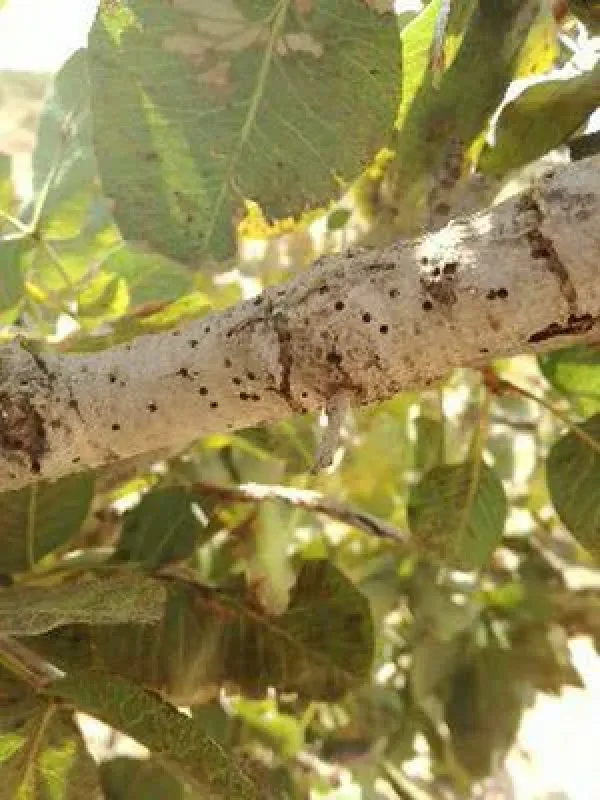
Visible boreholes on the bark, sometimes surrounded by small piles of frass (fine wood dust), indicate that the beetles have successfully entered the host tissue.
In mid-summer, wilting leaves and drying branches are typical symptoms of internal larval activity, which interrupts the flow of water and nutrients within the plant.
Removing a small section of bark often reveals a complex network of tunnels or galleries carved by the larvae in the cambium and sapwood.
Resin exudation, or gummosis, is a common defensive response by the pistachio tree, often seen as streaks or drops on the bark surface near entry holes.
Control measures
Sanitation is the most effective management tool: regularly prune and burn infested wood to destroy overwintering beetle populations and prevent the spread.
Cultural practices, including balanced irrigation and proper fertilization, help keep trees robust and less susceptible to bark beetle colonization.
Chemical control involving contact insecticides is most effective when applied during the spring emergence phase to reduce the adult population before egg-laying occurs.
Encouraging the presence of natural enemies, such as parasitic wasps, can help suppress beetle populations within an integrated pest management framework.
- Monitor orchards frequently during the spring growth phase.
- Remove and incinerate infested tree material immediately.
- Use pheromone traps for early detection of beetle activity.
- Apply recommended insecticides during the bud burst period.
Taxonomy
- Latin name
- Chaetoptelius vestitus
- Order
- Coleoptera (beetles)
- Family
- Curculionidae
- EPPO code
- CHTTVE
Discussion
No discussions yet — be the first.